🌺 Orchid Watering Calculator
Find out exactly how much water your orchids need based on type, pot, medium, and growing conditions
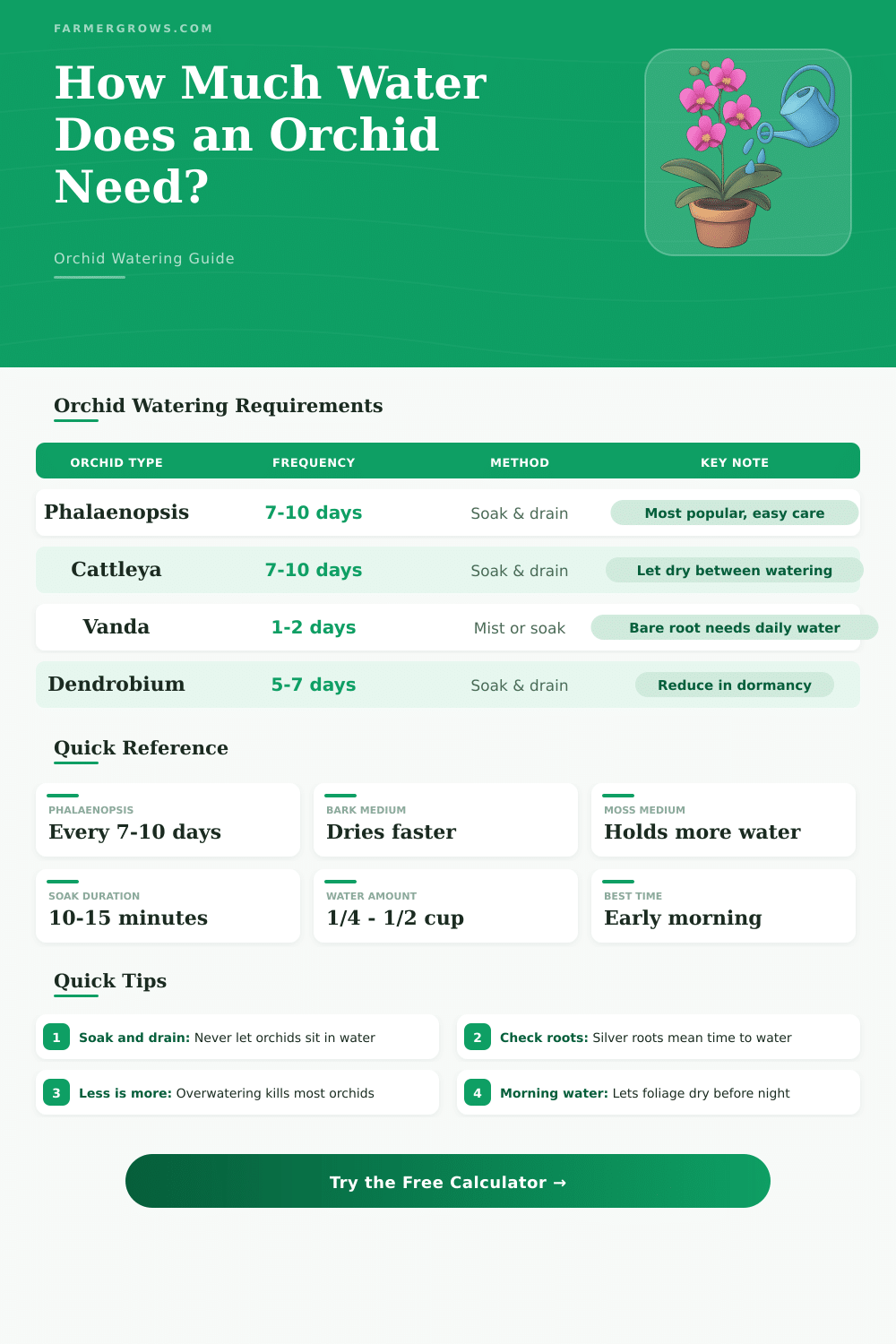
| Orchid Type | Bark Mix | Sphagnum Moss | Mounted / Bare Root |
|---|---|---|---|
| Phalaenopsis | Every 7–10 days | Every 10–14 days | Daily misting |
| Cattleya | Every 7–10 days | Every 10–12 days | Every 1–2 days |
| Dendrobium | Every 5–7 days | Every 7–10 days | Daily misting |
| Oncidium | Every 5–7 days | Every 7–10 days | Every 1–2 days |
| Vanda | Every 3–5 days | Every 5–7 days | Daily soak or mist |
| Paphiopedilum | Every 5–7 days | Every 7–10 days | Every 2–3 days |
| Cymbidium | Every 5–7 days | Every 7–10 days | Every 1–2 days |
| Medium | Drying Speed | Water Retention | Watering Adjustment |
|---|---|---|---|
| Bark Mix | Fast | Low | Baseline – standard frequency |
| Sphagnum Moss | Slow | High | Water 30–40% less often |
| LECA / Semi-Hydro | Moderate | Consistent | Top up reservoir as needed |
| Mounted / Bare Root | Very Fast | None | Water 2–3x more often |
| Season | Frequency Adjust | Soak Duration | Key Notes |
|---|---|---|---|
| Spring | Standard frequency | 10–15 min | Active growth begins, increase gradually |
| Summer | More frequent (+25%) | 10–15 min | Higher evaporation, watch for drying |
| Fall | Slightly less (–10%) | 10–12 min | Growth slows, reduce gradually |
| Winter | Less frequent (–25%) | 8–10 min | Dormancy for many types, avoid overwatering |
| Symptom | Overwatering | Underwatering | Action |
|---|---|---|---|
| Roots | Brown, mushy, rotting | Gray, shriveled, papery | Check roots every watering |
| Leaves | Yellow, limp, soft | Wrinkled, leathery, floppy | Adjust frequency immediately |
| Crown | Crown rot (black center) | No new growth | Never var water pool in crown |
| Pseudobulbs | Soft, mushy base | Shriveled, wrinkled | Pseudobulbs store water reserves |
| Pot Size | Water Amount | Soak Duration | Drying Time |
|---|---|---|---|
| 3 inch | ¼–⅓ cup (60–80 ml) | 8–10 min | Fastest – check often |
| 4 inch | ⅓–½ cup (80–120 ml) | 10–12 min | Moderate drying |
| 5 inch | ½ cup (120–150 ml) | 12–15 min | Standard timing |
| 6 inch | ½–¾ cup (150–180 ml) | 15–18 min | Slowest – risk of overwatering |
When you receive a new Orchid the Water around it must balance it well. They require Water, but clearly do not want to sit in it. The main idea is to Water them when they already almost dry out.
Most Orchids would like to stay on the dry side rather than too wet… Constant moisture simply kills the roots. Those roots have a special layer called velamen, a thin layer that absorbs Water and minerals from the air.
How to Water Your Orchid
Here is the useful part: you can read the thirst of your Orchid simply by watching the roots. Bright green roots? They still hold a bit of moisture.
When they turn to silver-gray color, that shows that you must Water.
A fixed Water rhythm usually happens around once each seven to ten days, although it does depned on how quickly your soil dries. Before you Water, stick your finger in the moss or bark… Push it to the first knot and check whether it fully dries.
A simple check is simply lifting the jar. If the jar is light, it thirsts. While you Water, soak the whole soil, then leave it to dry down before the next time.
The simplest method? Place the jar above your sink and pour gentle Water through it, between room-temperature and body heat works well. Pour slowly and allow it too flow for some minutes, then leave everything to drain.
Even do that twice to ensure full soaking. The drainage is key, in my view. If you do not want to deal with Water, try the opposite: fill the sink to under the edge of the jar, lay the Orchid here for around fifteen minutes, then empty the sink and leave it to sit for another ten minutes before you replace it.
Ice cubes form another option that surprisingly works. The Water melts slowly, giving your Orchid a slow and steady drink with almost no work.
Your soil mix plays a role here. Sphagnum moss keeps Water like a sponge, so if you use that, let some warm Water flow through it until it spills from the bottom. If your jar dries too quickly, mix a bit of moss with the bark to slow things down.
Terra cotta dries quickly also, which some folks like and others find annoying.
Summer arriving, Orchids commonly require Water twice weekly because they grow actively and use more Water and nutrients. Winter fully reverses that, less light, colder temperature and rest period all mean Water simply sits there. You would want to watch that for Wateringthen.
Flowering Orchids thirst also because flowers lose Water and the plant energy goes to new blooms, but the same rule counts: wait for drying outside and silver root color before you Water again.
Do not forget the humidity. Keep it between forty and sixty percent is perfect. A shallow plate with pebbles and Water under your Orchid creates steam.
Use clean Water. Salt buildup will destroy your plant partly over time. Water culture deserves to be looked into, actually.
It skips bark or moss entirely, which reduces root rot and keeps everything healthier. Phalaenopsis, Vandas and Antelope-type Dendrobiums adapt to it best.