🥕 Carrot Sunlight Calculator
Calculate ideal daily sun hours for your carrot garden based on location, season & garden type
| Daily Sun Hours | Classification | Expected Yield | Root Quality |
|---|---|---|---|
| Under 3 hrs | Deep Shade | Very Poor / Fail | Stunted, pale |
| 3–4 hrs | Heavy Shade | Poor | Thin, weak |
| 4–6 hrs | Partial Shade | Moderate | Acceptable, small |
| 6–8 hrs | Partial–Full Sun | Good | Normal, sweet |
| 8–10 hrs | Full Sun | Excellent | Large, sweet, vibrant |
| 10+ hrs (hot) | Intense Sun | Good (with water) | May bolt in heat |
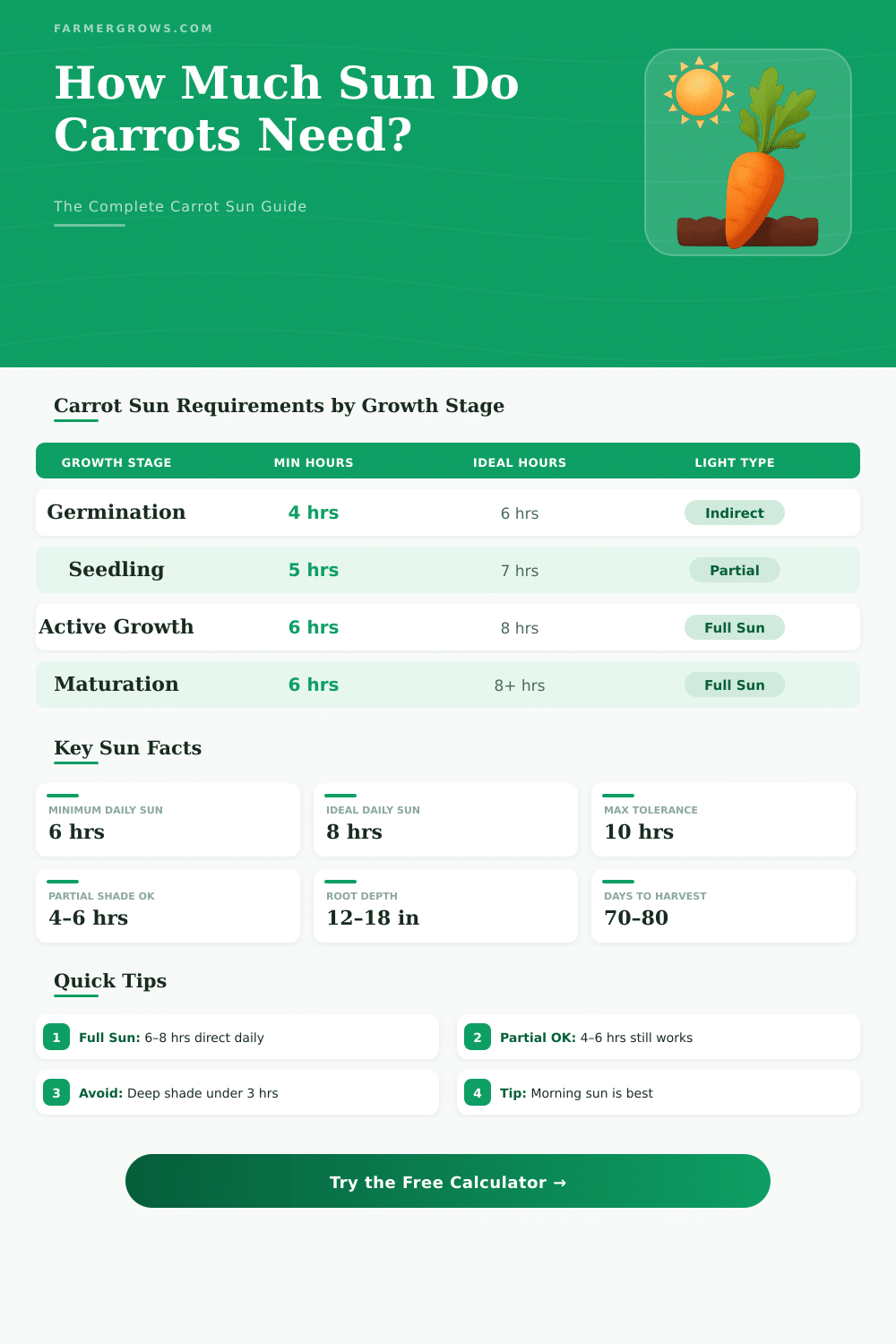
| Growth Stage | Min Sun Hours | Ideal Sun Hours | Light Type | Duration |
|---|---|---|---|---|
| Germination | 4 hrs | 6 hrs | Indirect OK | 10–21 days |
| Seedling | 5 hrs | 7 hrs | Partial | Wks 1–3 |
| Active Growth | 6 hrs | 8 hrs | Full Sun | Wks 4–10 |
| Maturation | 6 hrs | 8 hrs | Full Sun | Final 2–3 wks |
| Season / Zone | Avg Daily Sun | Adjustment | Note |
|---|---|---|---|
| Spring – Temperate | 6–8 hrs | None needed | Ideal growing season |
| Summer – Temperate | 8–10 hrs | Shade cloth if >10 hrs | Watch soil moisture |
| Fall – Temperate | 5–7 hrs | Maximize exposure | Good flavor season |
| Winter – Temperate | 3–5 hrs | Add grow lights | Use greenhouse |
| Hot / Arid Zone | 9–12 hrs | Afternoon shade cloth | Prevent bolting |
| Cool / Northern | 5–7 hrs | Maximize all sun | Use reflectors |
| Tropical / Humid | 8–10 hrs | Filtered midday sun | High humidity offset |
| Spacing | Plants per Sq Ft | Sun Competition | Recommended Sun |
|---|---|---|---|
| 2 in apart | ~36 | High | 8+ hrs |
| 3 in apart | ~16 | Moderate | 7–8 hrs |
| 4 in apart | ~9 | Low | 6–8 hrs |
| 6 in apart | ~4 | Very Low | 6+ hrs |
Carrots require full Sun for best growth. For good growth, they require at least six to eight hours of direct sunshine each day. That direct sunshine has clear character because it means no shades, rather than the spread and less strong light of hazy sky or reflecting surfaces.
When lacking that mainstream light, the roots of carrots can stay little, weak grown and colourless.
Carrots Need 6 to 8 Hours of Direct Sunlight
The sunshine delivers the energy for making food. In that process the plants combine carbon dioxide with water, to create glucose and oxygen. When carrots do not receive enough Sun, they hardly generate the food necessary for healthy growth.
Full sunshine also helps the development of strong roots, which is the mainstream target of their farming.
Carrots depend on sunshine to form beta-carotene. It later turns into vitamin A inside our body. That vitamin matters for good sight, healthy skin and strong immune system.
Lack of enough Sun, carrots simply can not generate this food in the needed amount.
Although carrots manage to handle a bit of shade, in such situations they grow more slowly. With three to four hours of direct sunshine they already do quite a lot good, even so they reach their maximum sweetness and crispness only under full Sun. Plant them under afternoon shade or with protective cover to let them receive the light, that they want, while the ground stays cool during the midday heat.
A practical method is use reflective surfaces to increase the Sun exposure in dark places. If your garden lacks direct light, that truly can alter the results.
The root of Carrot, the edible part, usually stays underground and does not touch the Sun. Hence the change of green color does not happen. Even so, with home grown carrots sometimes the root pushes above the surface.
When that happens, the sunshine reaches the top and causes green color, which gives green shade. One can safely eat partly green carrots. The green simply results from color that formed wear the root was exposed to light during growth, storage or after harvest.
Growing carrots inside in a jar is possible, but it is not very good. Because they require much sunshine, one should add extra lighting. Carrots best grow during spring and autumn, and they do not benefit in summer heat.
Raised garden beds work well for them. For autumn sowing, one plants ten to twelve weeks before the first cold.
The oil from Carrot seeds offers only tiny protection against sunshine, compared to average sunscreens. Actually it is almost the opposite of such protection. It stores chemicals that interact with the skin and light, whichcan cause painful and lasting scars.