🧱 Garden Wall Block Calculator
Calculate exactly how many blocks you need for any garden wall — retaining, raised bed, or decorative
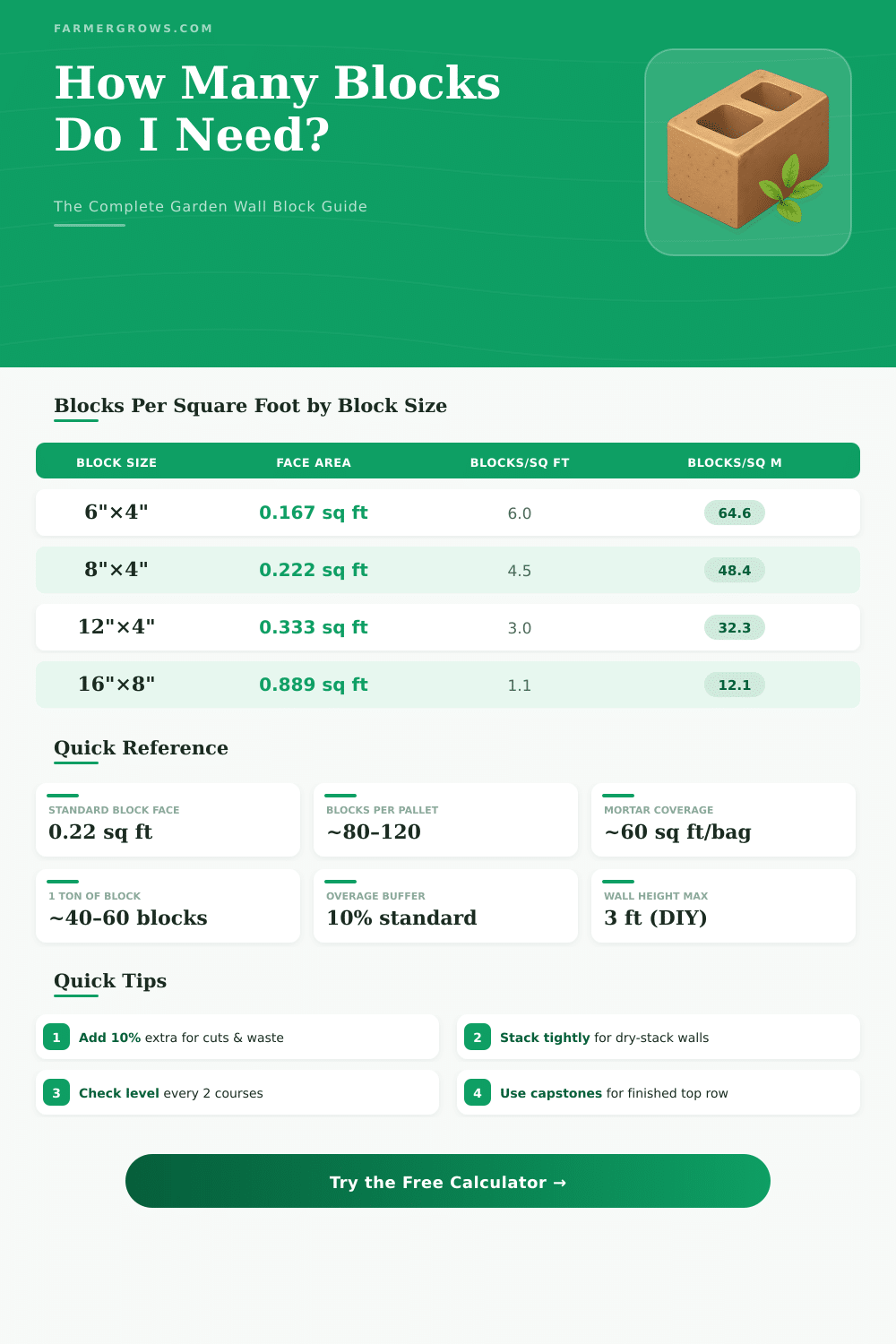
blocks/sq ft (8"×4")
blocks/sq ft (16"×8")
blocks/sq ft (8"×2.67")
blocks/sq ft (6"×4")
blocks/sq ft (12"×4")
blocks/sq ft (6"×3")
blocks/sq ft (12"×3")
blocks/sq ft (12"×6")
| Block Size (W×H) | No Joint | 3/8" Joint | 1/2" Joint | Weight Each (lbs) |
|---|---|---|---|---|
| 6" × 3" (Landscape) | 8.00 | 7.20 | 6.96 | 6–9 |
| 6" × 4" (Natural Stone avg) | 6.00 | 5.45 | 5.27 | 8–15 |
| 8" × 2.67" (Brick) | 6.75 | 5.98 | 5.76 | 4–5 |
| 8" × 4" (Retaining) | 4.50 | 4.07 | 3.93 | 18–24 |
| 12" × 3" (Cap Block) | 4.00 | 3.68 | 3.56 | 15–20 |
| 12" × 4" (Patio) | 3.00 | 2.75 | 2.66 | 20–30 |
| 12" × 6" (Allan Block) | 2.00 | 1.86 | 1.80 | 28–35 |
| 16" × 8" (Cinder Block) | 1.13 | 1.04 | 1.01 | 26–35 |
| Project | Length | Height | Wall Area | Blocks (8"×4") |
|---|---|---|---|---|
| Small Flower Bed | 10 ft | 1 ft | 10 sq ft | ~45 |
| Garden Edging | 20 ft | 1 ft | 20 sq ft | ~90 |
| Raised Bed Border | 20 ft | 2 ft | 40 sq ft | ~180 |
| Low Retaining Wall | 30 ft | 3 ft | 90 sq ft | ~405 |
| Medium Retaining | 40 ft | 4 ft | 160 sq ft | ~720 |
| Large Property Wall | 50 ft | 4 ft | 200 sq ft | ~900 |
| Block Type | Weight / Block | Blocks / Pallet | Pallet Weight | Sq Ft / Pallet |
|---|---|---|---|---|
| Concrete Retaining (8"×4") | 20 lbs | 72 | ~1,440 lbs | ~18 sq ft |
| Cinder Block (16"×8") | 30 lbs | 36 | ~1,080 lbs | ~32 sq ft |
| Standard Brick (8"×2.67") | 4.5 lbs | 500 | ~2,250 lbs | ~74 sq ft |
| Landscape Block (6"×3") | 7 lbs | 120 | ~840 lbs | ~15 sq ft |
| Allan Block (12"×6") | 32 lbs | 48 | ~1,536 lbs | ~24 sq ft |
| Patio Block (12"×4") | 25 lbs | 60 | ~1,500 lbs | ~20 sq ft |
garden wall block form a good choice for building low walls and give shape to open areas. Usually they are made up of small wall pieces that work for fancy uses or for improving landscape. Like this they differ from retaining walls, that does from empty stone bags designed to receive grit and require cover or support.
Those bits well answer for forming flower beds, banks of gardens and various little landscape pieces. Also one uses them for pavements in gardens, winding walls and almost round places for fires. Some garden wall block have a lip left, what ensures stability and ease of line during setup.
How to Build and Use Garden Wall Blocks
One can simply lay them on a thickened crushed stone base, without use of concrete, what simplifies the whole thing.
While stacking of garden wall block, one fills them by means of ground and carefully thickens, what helps to set them flatly. Add stones between the wall bits strengthen the stability. New rows one must lay with joints offset regarding teh bottom row.
Clean the blocks and control level form a key stage in the construction.
Installation of garden wall block is meant for walls under three feet high. For more complete landscape work, one finds big sets of retaining wall blocks, that are designed for full construction. Concrete precast retaining wall blocks one stacks until three rows before geo-net must strengthen the ground left.
For bigger retaining walls, ten feet and more, one can effect that in the work.
Some blocks interlock, so one stacks them together without mortar. That allows much more fast setup. Some simply stand alone, while others require glue by means of a gun for silicone.
Wedge-shaped blocks it is possible too use for round walls around main garden parts, and rectangular form lines for straight walls.
Walls from blocks offer different textures and natural color mixes. Some copy the look of natural stones different: as if falling, stacked, tiled or from carving. Except garden walls, those bits answer for open spots for fires, kitchens under the sky, fires, built-in plantations, columns and benches.
One series of products have an extra strong mix, what does it much more lasting than natural stone and good in cycles of freeze-thaw.
Good base is truly important. The base or first row should have four until six inches of depth and twelve inches of width, or about twice the width of used block. The blocks should sit half in the ground.
Ignore that stage can create serious troubles. Without a good base, thewall can lean down in the soil over time.