🪨 Decomposed Granite Calculator
Calculate cubic yards, bags, and weight for any DG project
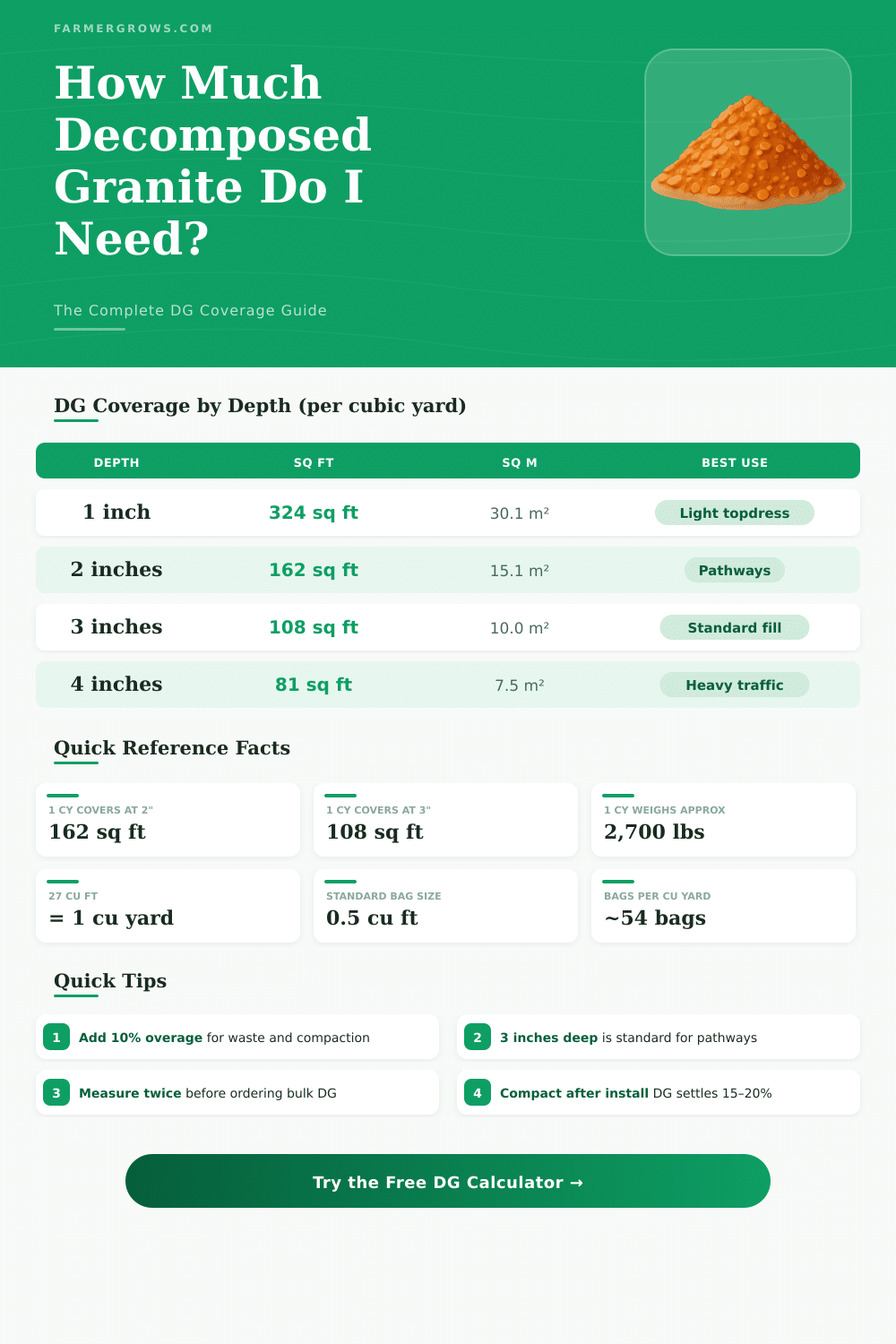
| Depth | Coverage (sq ft) | Coverage (m²) | Best Application |
|---|---|---|---|
| 1 inch (2.5 cm) | 324 sq ft | 30.1 m² | Light topdressing |
| 2 inches (5 cm) | 162 sq ft | 15.1 m² | Pathways, light use |
| 3 inches (7.6 cm) | 108 sq ft | 10.0 m² | Standard paths & beds |
| 4 inches (10 cm) | 81 sq ft | 7.5 m² | Driveways, patios |
| 6 inches (15 cm) | 54 sq ft | 5.0 m² | Heavy traffic areas |
| Bag Size | Volume per Bag | Bags per Cu Yd | Coverage at 3" |
|---|---|---|---|
| 0.5 cu ft bag | 0.5 cu ft | 54 bags | 2 sq ft |
| 1 cu ft bag | 1 cu ft | 27 bags | 4 sq ft |
| 1.5 cu ft bag | 1.5 cu ft | 18 bags | 6 sq ft |
| 2 cu ft bag | 2 cu ft | 13.5 bags | 8 sq ft |
| 3 cu ft bag | 3 cu ft | 9 bags | 12 sq ft |
| Bulk (1 ton) | ~0.74 cu yd | — | ~80 sq ft at 3" |
| Project | Area (sq ft) | Cu Yards Needed | Bags (0.5 cu ft) |
|---|---|---|---|
| Small path 4x20 | 80 sq ft | 0.74 cu yd | ~40 bags |
| Garden bed 10x20 | 200 sq ft | 1.85 cu yd | ~100 bags |
| Patio 15x20 | 300 sq ft | 2.78 cu yd | ~150 bags |
| Side yard 10x30 | 300 sq ft | 2.78 cu yd | ~150 bags |
| Driveway 12x40 | 480 sq ft | 4.44 cu yd | ~240 bags |
| Full yard 50x50 | 2,500 sq ft | 23.1 cu yd | ~1,250 bags |
decomposed granite is a type of stone from granite rock, that breaks because of time weather and wearing activity. This process spans thousands of years and converts the hard, strong material into little pieces. Those bits look like gravel, even so they own softer and wet structure.
One sometimes calls it “decomposed granite” because of the high amount of fine granite sand in it. While it keeps breaking, it can split into bits of size of gravel, that one knows as “grus“, and ultimately create mix with clay.
Decomposed Granite: What It Is and How to Use It
In the landscaping sector, one describes decomposed granite as grainy stone above the basic material. It not always comes from granite. The size of particles ranges from maximum of 3/8-inch until very final rocky dust.
That mix of various sizes means good packing. The crushed stones have odd forms with jagged edges, what helps them sit flatly.
decomposed granite appears in several colours. There are variants in tan-colour and gold with varied shades of brown, gray types and almost pink tonal types. It sells with either without stabilizer.
Stabilised decomposed granite ranks between the most commonly used natural replacements for paved and concrete ways. Some stabilising links are made up of 100 percent organic stuff, what does the material less harmful for the surroundings compared to asphalt or cement. Because it forms natural from granite, one considers it sustainable and environmental choice for landscaping.
It works well for ways, terraces, driveways, garden beds, slopes and pavements. Also it works as ground covering, base for areas or installation of pavers and filler for gaps between pavers. Gray decomposed granite gives more stable surface then the most many gravels, but always allow water pass through itself.
One from the typical advantages are that it keeps humidity in the ground and stops erosion.
The natural form of decomposed granite commonly used as bed. It stays lasting after installation and even can give nutrients to nearby plants and trees. It drains well and fits with succulents, that likes more mineral ground mix.
Plant directly in decomposed granite is possible and can work with the right method.
For installation, good mode is use basic weed-free soil. The advised layers include pure ground, later herbicide, then fence against grasses, then two until three inches of gravel and ultimately two until three inches of stabilised decomposed granite. Placing bigger rocks first helps to set the decomposed granite in place and reduce future rut forming.
The little dusty particles have big surface area, what can hold water around and stop its draining through landscape fabric. It is cheap choice forlandscaping and sold in amounts of cubic yard with delivery available.