🍅 Bone Meal Per Tomato Plant Calculator
Calculate exactly how much bone meal you need for your tomato garden — by plant count, bed size, or custom area
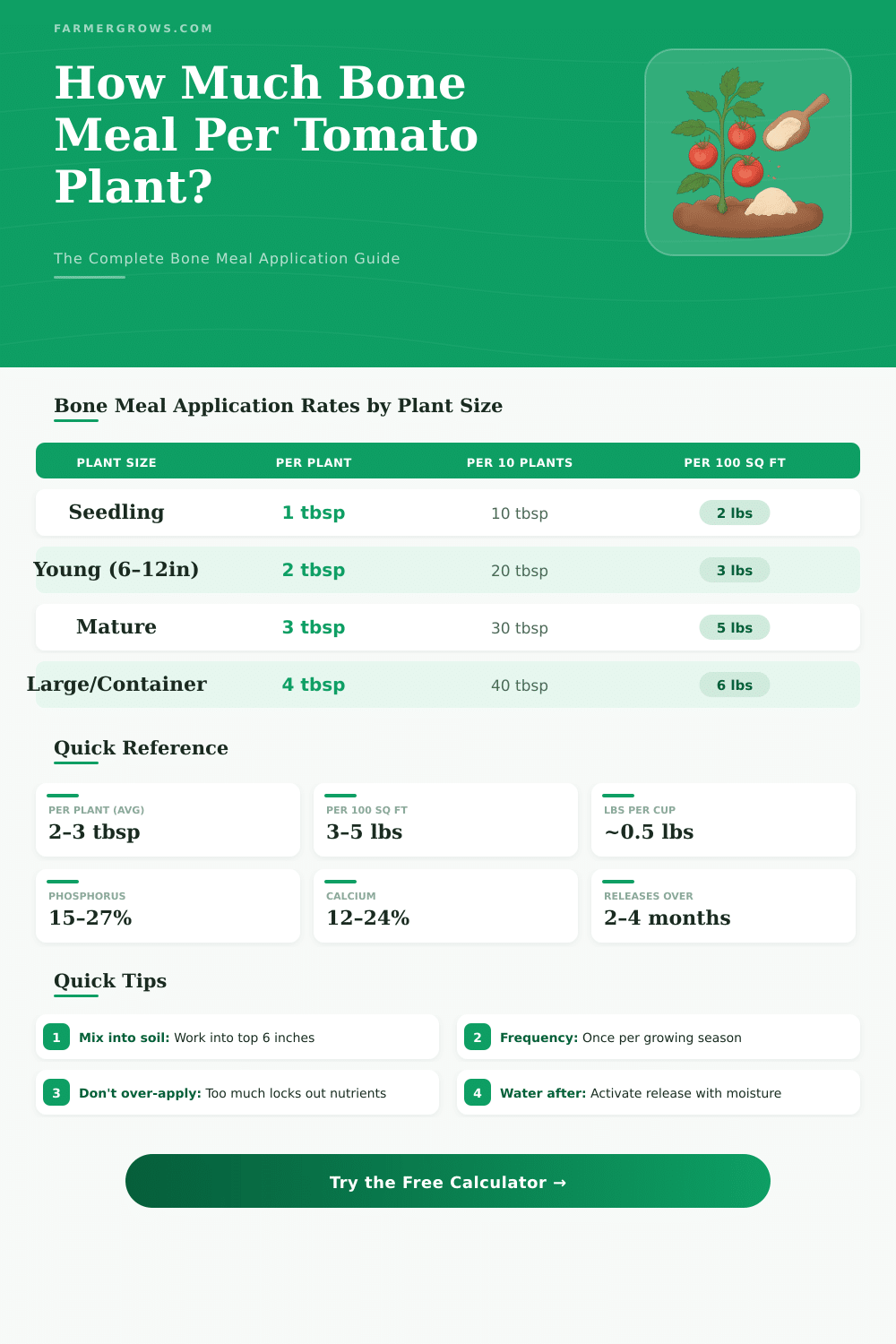
| Plant Stage | Per Plant (tbsp) | Per Plant (lbs) | Per 10 Plants (lbs) | Per 100 sq ft (lbs) |
|---|---|---|---|---|
| Seedling / Transplant | 1 tbsp | 0.04 lbs | 0.4 lbs | 2 lbs |
| Young (6–12 in) | 2 tbsp | 0.08 lbs | 0.8 lbs | 3 lbs |
| Mature Plant | 3 tbsp | 0.12 lbs | 1.2 lbs | 4 lbs |
| Large / Container | 4 tbsp | 0.16 lbs | 1.6 lbs | 5 lbs |
| Bag Size | Weight | Plants Covered (Mature) | Area Covered (100 sq ft @ 3.5 lbs) | Metric Equiv. |
|---|---|---|---|---|
| Small Bag | 2 lbs (0.9 kg) | ~16 plants | ~57 sq ft (5.3 m²) | 0.9 kg |
| Standard Bag | 4 lbs (1.8 kg) | ~33 plants | ~114 sq ft (10.6 m²) | 1.8 kg |
| Medium Bag | 8 lbs (3.6 kg) | ~67 plants | ~229 sq ft (21.3 m²) | 3.6 kg |
| Large Bag | 20 lbs (9.1 kg) | ~167 plants | ~571 sq ft (53 m²) | 9.1 kg |
| Bulk Bag | 50 lbs (22.7 kg) | ~417 plants | ~1,428 sq ft (133 m²) | 22.7 kg |
| Project | Area | Plants (est.) | Bone Meal Needed | Bag Size Rec. |
|---|---|---|---|---|
| Patio Container (4 plants) | — | 4 | 0.5 lbs (0.23 kg) | 2 lb bag |
| Small Raised Bed 4x8 | 32 sq ft (3 m²) | 6–8 | 1.1 lbs (0.5 kg) | 2 lb bag |
| Standard Raised Bed 4x12 | 48 sq ft (4.5 m²) | 8–12 | 1.7 lbs (0.77 kg) | 2 lb bag |
| Large Raised Bed 4x16 | 64 sq ft (5.9 m²) | 12–16 | 2.2 lbs (1 kg) | 4 lb bag |
| Garden Row 10x10 | 100 sq ft (9.3 m²) | 16–20 | 3.5 lbs (1.6 kg) | 4 lb bag |
| Large Garden 10x20 | 200 sq ft (18.6 m²) | 30–40 | 7 lbs (3.2 kg) | 8 lb bag |
| Commercial Row 20x50 | 1,000 sq ft (93 m²) | 150+ | 35 lbs (15.9 kg) | 50 lb bag |
Bone Meal is made from stone, that prepares from ground bones of farm animals. One cooks them, sterilises and later grinds in dust or granules. Ultimately ground Bone Meal has makeup virtually like baking powder.
It stores around 24 percent of calcium and 20 percent of phosphorus. Main nutrients in it are nitrogen phosphorus and potassium.
Using Bone Meal to Grow Tomatoes
Tomatoes are heavy feeders. They pull many elements from the ground, hence one commonly must add dressings so that they grow well. Bone Meal answers well as ground fix at the beginning of the season.
It involves time to divide, because the germs in the soil require time to prepare it before the plants can use it. Hence one adds it before the crop. It delivers phosphorus more late in the year, when the Tomato Plant frutis.
The more phosphorus tomatoes receive, the bigger and fuller their fruits will become. Feeding tomatoes with Bone Meal helps to create truly big, red and juice full tomatoes. Use one or two spoons of Bone Meal in the planting hole while you transplant children of tomatoes.
Like this one gives enough phosphorus for early root growth, without overloading the young plants. Extra method is add one spoon of Bone Meal for every two square feet of soil, mixing or covering it in the garden.
Most many vegetable plants benefit from Bone Meal, but it best helps root crops as carrots and onions. Flowering crops, for instance tomatoes, peppers and eggplants, also grow surprisingly with it. Zucchinis, sweet potatoes, potatoes and chives all benefit thanks too the extra phosphorus from Bone Meal.
Bone Meal divides slowly and releases nitrogen during the whole season. It does not burn the plants, what is big advantage. Suffice to add it only at the beginning of the flowering.
If the growth surroundings already are rich in organic material, as compost, the plants rarely require anything additional.
Mix Bone Meal in the soil and water the hole are entirely usual. A bit of white mold can appear after some days. It is fully normal and goes when the Bone Meal breaks down.
Bone Meal can combine with other fixes. Mix it with worm castings, aged cow manure and granular dressings in jars well works for tomatoes and peppers. Some soil mixes carry Bone Meal together with rice bark, crushed crab bark and other organic stuff weeks before the crop.
Add compost as well, but complete with phosphorus through Bone Meal or rock phosphate helps Tomato Plant grow even more. Bloody meal serves for nitrogen, Bone Meal for phosphorus andgreensand for potassium.
The tomato itself does not store blood, raw meat or bones from the Bone Meal, that one uses in the soil.