🏗️ Concrete Weight Calculator
Calculate concrete weight by volume, mix type, and project dimensions — imperial & metric
| Depth (in) | Depth (cm) | Sq Ft per Cu Yd | Sq M per Cu M | Cu Ft per Yd³ |
|---|---|---|---|---|
| 2 in | 5.1 cm | 162 sq ft | 15.1 m² | 27 |
| 3 in | 7.6 cm | 108 sq ft | 10.0 m² | 27 |
| 3.5 in | 8.9 cm | 92.6 sq ft | 8.6 m² | 27 |
| 4 in | 10.2 cm | 81 sq ft | 7.5 m² | 27 |
| 6 in | 15.2 cm | 54 sq ft | 5.0 m² | 27 |
| 8 in | 20.3 cm | 40.5 sq ft | 3.8 m² | 27 |
| 10 in | 25.4 cm | 32.4 sq ft | 3.0 m² | 27 |
| 12 in | 30.5 cm | 27 sq ft | 2.5 m² | 27 |
| Bag Size | Cu Ft per Bag | Cu M per Bag | Bags per Cu Yd | Bags per Cu M |
|---|---|---|---|---|
| 40 lb bag | 0.30 cu ft | 0.0085 m³ | 90 bags | 118 bags |
| 50 lb bag | 0.375 cu ft | 0.0106 m³ | 72 bags | 94 bags |
| 60 lb bag | 0.45 cu ft | 0.0127 m³ | 60 bags | 79 bags |
| 80 lb bag | 0.60 cu ft | 0.0170 m³ | 45 bags | 59 bags |
| 90 lb bag | 0.675 cu ft | 0.0191 m³ | 40 bags | 52 bags |
| Project | Dimensions | Cu Yards (4 in) | Est. Weight (lbs) | 80-lb Bags |
|---|---|---|---|---|
| Small Patio | 10 x 10 ft | 1.23 | ~4,800 | 56 |
| Standard Driveway | 20 x 20 ft | 4.94 | ~19,270 | 222 |
| Sidewalk Section | 30 x 4 ft | 1.48 | ~5,780 | 67 |
| Garage Floor | 20 x 22 ft | 5.43 | ~21,180 | 244 |
| Parking Slab | 20 x 30 ft | 7.41 | ~28,900 | 333 |
| Shed Foundation | 12 x 16 ft | 2.37 | ~9,240 | 107 |
| Round Footing 12ft | 12 ft dia | 1.40 | ~5,460 | 63 |
| Basement Floor | 30 x 40 ft | 14.81 | ~57,760 | 667 |
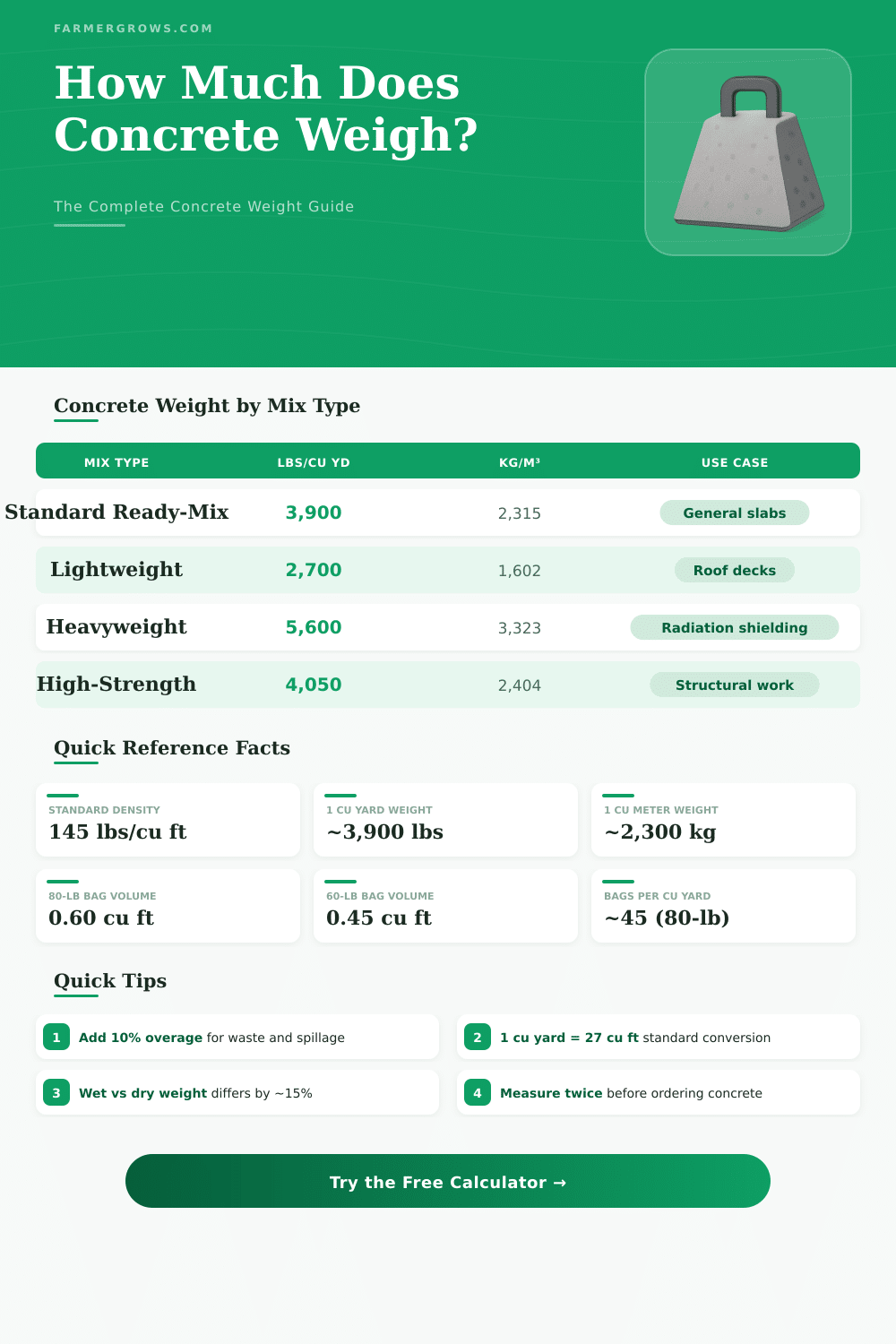
The concrete weight is not the same for everything, it depends on many factors. Typical mix of concrete reaches around 150 pounds per cubic foot, which matches to around 4 050 pounds per cubic yard or 2 400 kilos per cubic metre. The real density changes according to the type of aggregates that one uses, the kind of concrete, the amount of water in the mix and whether air content appears during preparation.
Talking about a cubic yard of concrete one considers around 4 100 pounds; so a bit more than two tons. Here the spot: those figures change according to the density of your particular mix and the addition of extra soil or sand. Concrete from pre-mix from truck usually weighs between 3 690 and 4 010 pounds per yard.
How Much Does Concrete Weigh?
The differences come from the local aggregates that one mines and uses in the area. Some mixes get closer to 144 or 145 pounds per cubic foot than to the precise 150.
According to the metric system, average concrete falls between 2,3 and 2,4 tons per cubic metre. Concrete from Portland-cement has density around 2 300 kilos per cubic metre, so 15 cubic metres of it would reach a wait of around 34 500 kilos or so. The calculation is easy: one multiplies the density by the volume to get the weight.
If one knows the wanted weight and the density stays same, sharing the weight by density one finds the volume.
For slabs of concrete, the concrete weight one estimates according to surface in square feet. One takes the density in pounds per cubic foot and multiplies it by the thickness in feet. A slab of four inches weighs then around 48 pounds per square foot.
For a driveway, one multiplies length by width to have the surface, then multiplies by depth for the whole amount. A calculator for concrete helps to estimate the concrete weight from that.
Lightweight concretes follow other rules. They enter the “lightweight” category when the density falls under 2 200 kilos per cubic metre. Normal concrete weighs more, between 2 300 and 2 400.
The lightweight aggregates themselves have density under 1 200 kilos per cubic metre and come in natural and fake forms, for instance pumice, expanded perlite and foamed slag. That kind of concrete weighs from 110 to 125 pounds per cubic foot.
More finely crushed bits of concrete pack themselves denser, which can raise the whole concrete weight per yard even though each bit itself is more lightweight. When weighing concrete, the best idea is to measure it before the blending. The finished product matters more than the ingredients, because the relation between volume and weight stays pretty stable.
For fast guesses during transportation, two tons per cubic yard serves as good guess, andten cubic yards of pre-concrete fit in a typical truck.
Concrete only from cement and water weighs around 1 900 kilos per cubic metre. When one adds fillers, the weight can drop between 20 and 30 percent or even more. Bags of ready mix lose a bit of weight when water dries during the run, although the difference stays small.