🧱 Concrete Calculator
Calculate cubic yards, bags, and weight for any concrete project — slabs, footings, walls & more
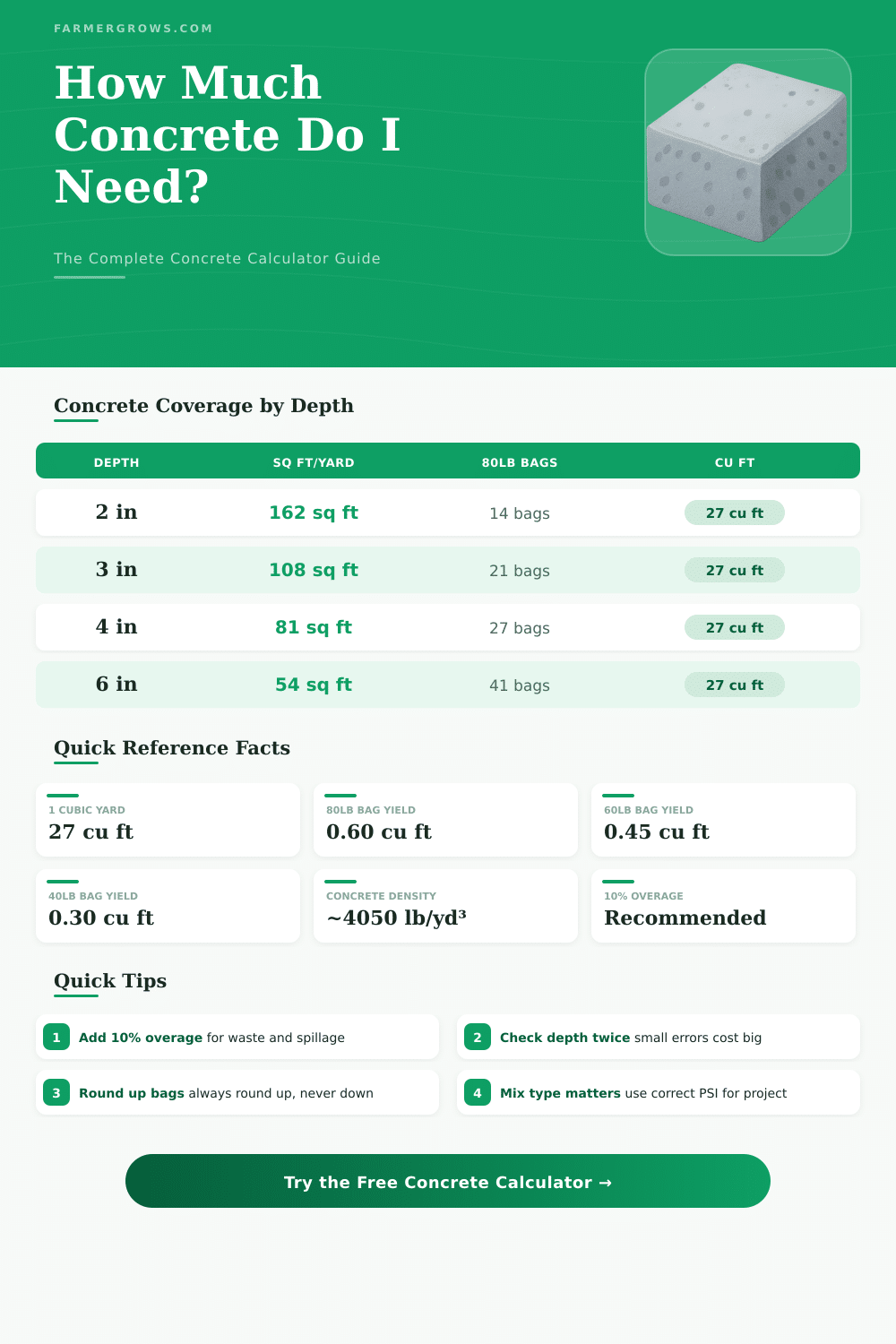
| Depth | Coverage (sq ft) | Coverage (m²) | 80 lb Bags Needed |
|---|---|---|---|
| 2 inches (5 cm) | 162 sq ft | 15.1 m² | 45 bags |
| 3 inches (7.6 cm) | 108 sq ft | 10.0 m² | 45 bags |
| 4 inches (10 cm) | 81 sq ft | 7.5 m² | 45 bags |
| 6 inches (15 cm) | 54 sq ft | 5.0 m² | 45 bags |
| 8 inches (20 cm) | 40.5 sq ft | 3.8 m² | 45 bags |
| 12 inches (30 cm) | 27 sq ft | 2.5 m² | 45 bags |
| Bag Size | Volume per Bag | Bags per Cu Yd | Coverage at 4 in |
|---|---|---|---|
| 40 lb bag | 0.30 cu ft | 90 bags | ~0.9 sq ft |
| 60 lb bag | 0.45 cu ft | 60 bags | ~1.35 sq ft |
| 80 lb bag | 0.60 cu ft | 45 bags | ~1.8 sq ft |
| Bulk (ready-mix) | 27 cu ft | 1 yd³ | 81 sq ft at 4 in |
| Project | Dimensions | Area (sq ft) | Cu Yds at 4 in |
|---|---|---|---|
| Small Patio | 10 x 10 ft | 100 sq ft | 1.24 yd³ |
| Standard Driveway | 20 x 20 ft | 400 sq ft | 4.94 yd³ |
| Single Car Garage | 12 x 20 ft | 240 sq ft | 2.96 yd³ |
| Double Car Garage | 24 x 24 ft | 576 sq ft | 7.11 yd³ |
| Sidewalk (50 ft) | 50 x 4 ft | 200 sq ft | 2.47 yd³ |
| Workshop Pad | 20 x 30 ft | 600 sq ft | 7.41 yd³ |
concrete ranks among the most commonly used building materials globally. It is also the most produced on Earth. Only after water it holds the second place among used materials.
Here we show how big a role it plays.
What Concrete Is and How We Use It
What exactly makes up concrete? That mixed mass is made up of fillers and binder. The binder forms paste, that works like glue to hold the fillers.
One calls the fillers aggregates, that can be fine or coarse. Usually the fine type is sand. The coarse type carries elements like gravel, crushed rock or slag.
If one mixes them with cement and water, the cement reacts and hardens over time, what results in tough mass.
Cement forms the main part of the mix. It ties the other elements and ensures the durability of concrete. One commonly chooses Portland cement for the mix.
Some concretes add chemicals, that alter the time of hardening or othor attributes. Various recipes for concrete exist, and each gives different results.
concrete receives its durability by means of chemical reaction, during which the binder hardens. One can pour it in molds on the place to form almost anything. Forms from concrete extend during thousands of feet and have thickness of some inches too feet.
It serves also as structure, so it backs buildings and big builds. Because of its weight, concrete requires more complex base compared to other materials.
concrete has big benefits, because it does not burn, does not break down or get eaten by termites. That makes it very useful for building. It shows in almost every project, small to big.
Roads, walkways, load-bearing walls, bases, streets and terraces all depend on concrete.
concrete fits well in the design. It creates nice contrast with refined materials like metal and glass. It blends with rustic features, for instance wood or brick.
It also stresses the homely warmth of soft furniture, what makesthe room more nice for the sight and the touch.
Production of concrete causes pollution. But one can recover the material just as easily for base or fillers. Recycle, fix and reuse existing concretes give better lasting results than always building fresh.
The earliest usage of concrete shows up in ancient Egypt, where one applied it as filling for the pyramids.