🌳 Bark Mulch Calculator
Calculate cubic yards, bags, and weight for any mulching project — rectangle, circle, or triangle beds
lbs / cu yd
lbs / cu yd
lbs / cu yd
lbs / cu yd
lbs / cu yd
lbs / cu yd
lbs / cu yd
lbs / cu yd
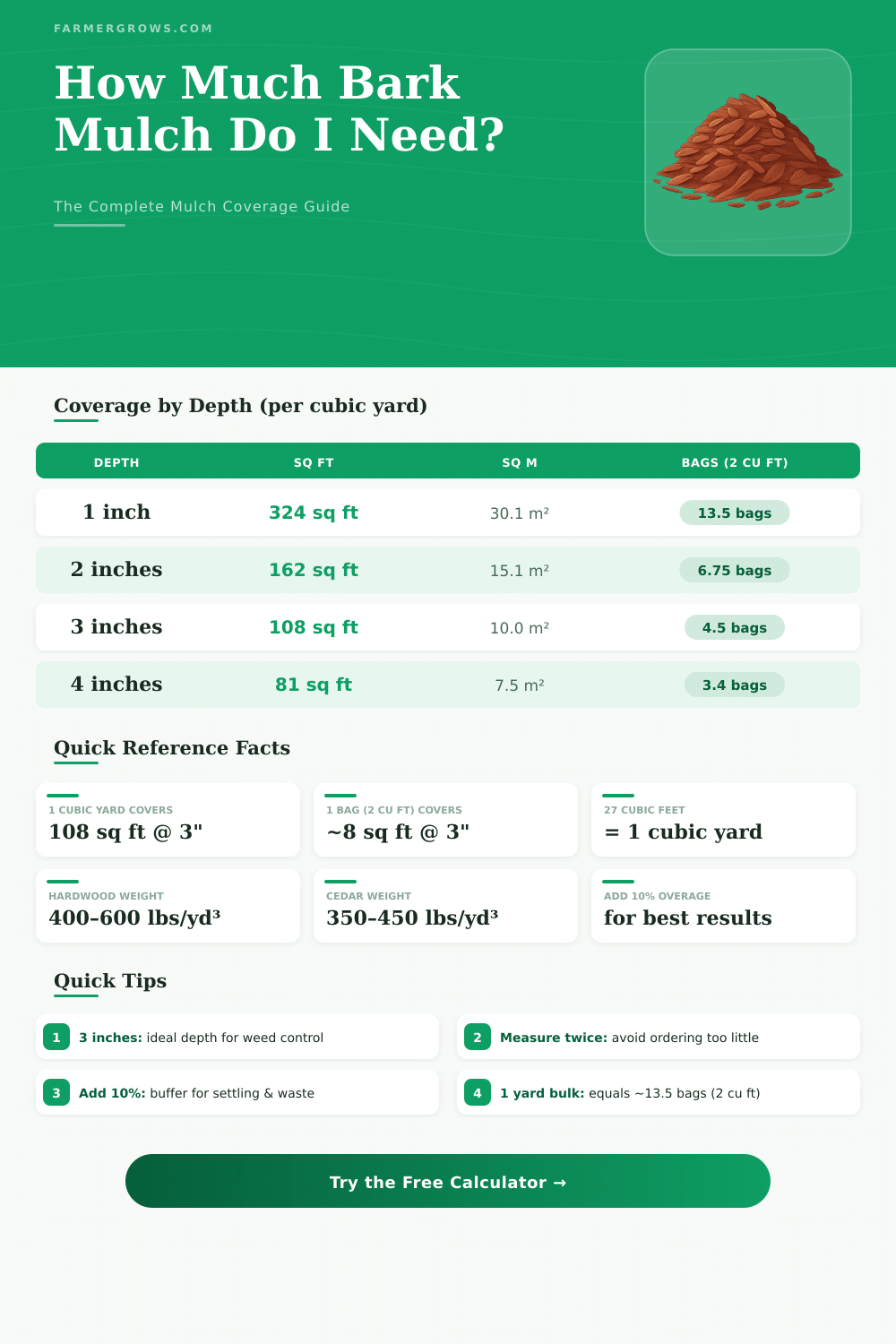
| Depth | Coverage (sq ft) | Coverage (m²) | 2 cu ft Bags | 3 cu ft Bags |
|---|---|---|---|---|
| 1 inch (2.5 cm) | 324 sq ft | 30.1 m² | 13.5 bags | 9 bags |
| 2 inches (5 cm) | 162 sq ft | 15.1 m² | 6.75 bags | 4.5 bags |
| 3 inches (7.5 cm) | 108 sq ft | 10.0 m² | 4.5 bags | 3 bags |
| 4 inches (10 cm) | 81 sq ft | 7.5 m² | 3.4 bags | 2.25 bags |
| 6 inches (15 cm) | 54 sq ft | 5.0 m² | 2.25 bags | 1.5 bags |
| Bag Size | Volume | Bags per Cu Yd | Coverage @ 3" | Coverage @ 2" |
|---|---|---|---|---|
| 1 cu ft bag | 1 cu ft / 28.3 L | 27 bags | 4 sq ft | 6 sq ft |
| 2 cu ft bag | 2 cu ft / 56.6 L | 13.5 bags | 8 sq ft | 12 sq ft |
| 3 cu ft bag | 3 cu ft / 84.9 L | 9 bags | 12 sq ft | 18 sq ft |
| Bulk 1/2 cu yd | 13.5 cu ft | — | 54 sq ft | 81 sq ft |
| Bulk 1 cu yd | 27 cu ft / 0.76 m³ | — | 108 sq ft | 162 sq ft |
| Project | Area (sq ft) | Cu Yds @ 3" | Bags (2 cu ft) @ 3" |
|---|---|---|---|
| Small flower bed (8x10) | 80 sq ft | 0.74 cu yd | ~10 bags |
| Medium garden bed (10x20) | 200 sq ft | 1.85 cu yd | ~25 bags |
| Large bed (25x40) | 1,000 sq ft | 9.26 cu yd | ~125 bags |
| Tree ring (6 ft dia) | 28.3 sq ft | 0.26 cu yd | ~4 bags |
| Tree ring (12 ft dia) | 113.1 sq ft | 1.05 cu yd | ~14 bags |
| Playground (15x15) | 225 sq ft | 2.08 cu yd | ~28 bags |
| Full yard (50x50) | 2,500 sq ft | 23.1 cu yd | ~313 bags |
bark mulch is made up of bark of tree. It usually comes from leftover bits from wood mills and furniture factories that cuts and create wooden items. Rather than average mulch, that mixes parts of whole tree with internal core and outer skin, this uses only the outer layer of the tree.
Like this it gets more even and stable look.
What Is Bark Mulch and How to Use It
Big advantage of bark mulch is its long life. It well holds back unwanted grasses like wooden chips, but not as long. Good bark can stay useful for around one year, while wooden bits last two or three years.
Also in thickness bark mulch wins, because that helps to control grasses below. Even so it is not ideal against strong grasses.
bark mulch keeps moisture in the ground and stops growth of unwanted grasses. It also steadies temperature of soil by covering the surface. In warm summer weeks it keeps the ground cool and protects roots of plants against big heat.
During cold seasons it works as protective layer above the soil. One can use it also as ground addition for good drainage or for letting roots breathe freely.
One has several kinds to choose. Pine bark mulch is a liked option, because it is fully natural and without dyes or chemicals. Southern pine bark one sifts for even size and shape, and the less big parts well work in mulch to improve ground state.
Hardwood bark mulch has dark brown color and comes from full hardwood bark, that gives control of grasses, keeping of moisture and feeding of soil. There is also fir bark, dyed redwood and cedar wood chips as other big options.
Natural rich variety with dark chocolate brown from pine and spruce has more fine shape and strong thickness. Pine bark nuggets look nice and can decorate jars and planters for a naturally nice site. The fine form breaks down more quickly, while big blocks can be removed by rough rainstorm and end up in the meadow.
bark mulch weighs less than wooden chips and can be blown off by windy days or heavy rain. It tends to push water instead of absorb it, so matter to recall that. Dyed wood can drain food from the ground during breaking down, so it works best for pathways where no plant wants to grow.
In the end dyed pine bark mulch one considers among the nicest mulch options.
One to two inches of fine ground mulch or two to four inches of rough ground mulch is good thickness. Going more deep than that can stop water and oxygen reaching the ground below. For homes with children, hemlock mulch makes fewer bits than other kinds.
Bark powder, that is finely ground mix from tree bark andwood, forms a bit-free surface for play spaces and gives natural color without dyes.