🌱 Seed Germination Calculator
Estimate sprouting time, germination rate, and seed quantity needed for your garden
📊 Your Germination Results
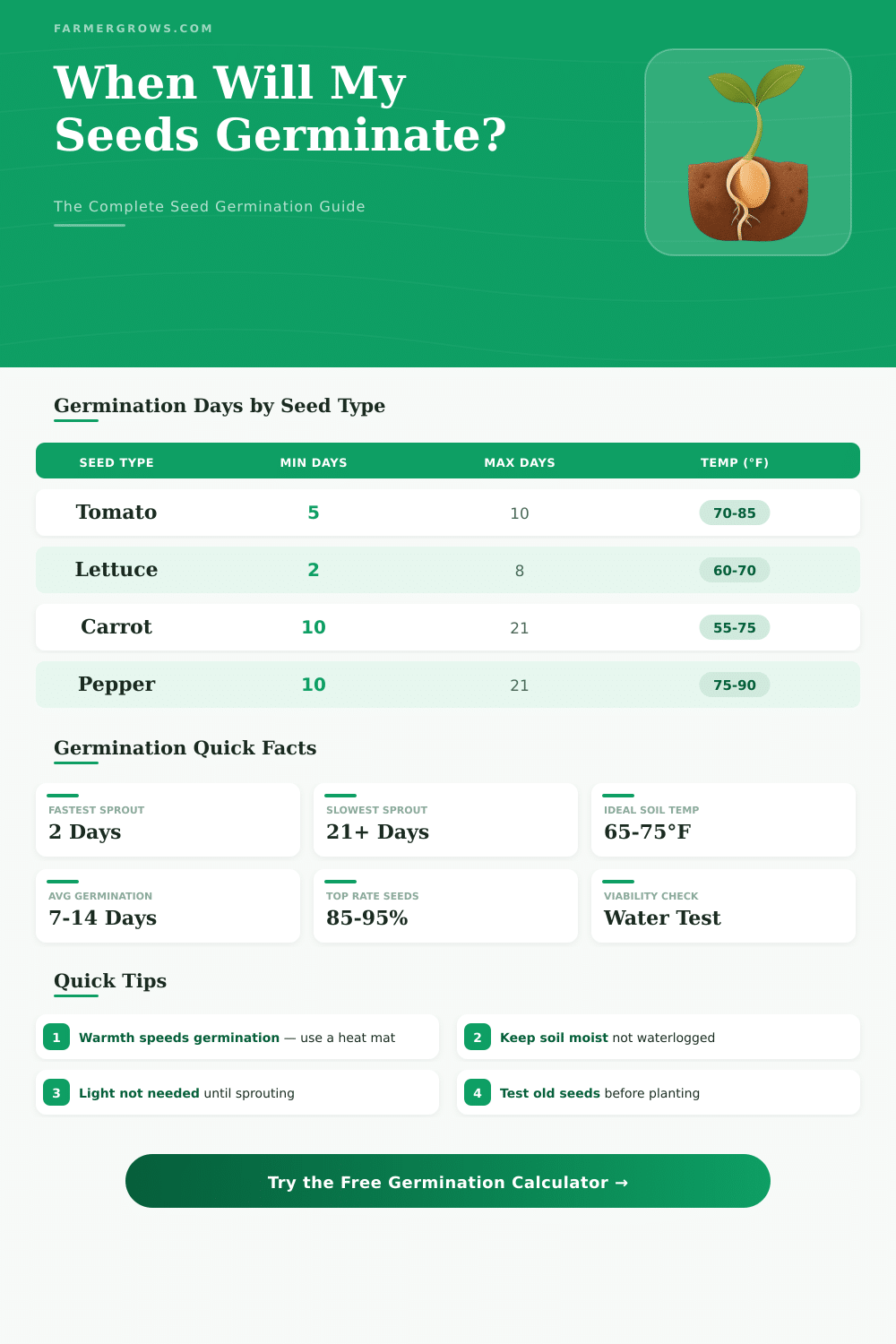
| Seed Type | Min Days | Max Days | Optimal Temp (°F) | Optimal Temp (°C) | Sow Depth (in) | Typical Rate |
|---|---|---|---|---|---|---|
| Tomato | 5 | 10 | 70–85°F | 21–29°C | 1/4" | 90% |
| Bell Pepper | 10 | 21 | 75–90°F | 24–32°C | 1/4" | 85% |
| Lettuce | 2 | 8 | 60–70°F | 15–21°C | 1/8" | 90% |
| Carrot | 10 | 21 | 55–75°F | 13–24°C | 1/4" | 75% |
| Cucumber | 3 | 7 | 70–90°F | 21–32°C | 1/2" | 90% |
| Spinach | 7 | 14 | 50–65°F | 10–18°C | 1/2" | 75% |
| Basil | 5 | 10 | 65–80°F | 18–27°C | 1/8" | 85% |
| Zucchini / Squash | 3 | 7 | 70–90°F | 21–32°C | 1" | 90% |
| Sunflower | 7 | 10 | 65–85°F | 18–29°C | 1" | 90% |
| Marigold | 5 | 7 | 65–80°F | 18–27°C | 1/8" | 85% |
| Beet | 5 | 14 | 50–75°F | 10–24°C | 1/2" | 80% |
| Kale / Cabbage | 5 | 10 | 50–75°F | 10–24°C | 1/4" | 85% |
| Bean / Pea | 7 | 14 | 60–80°F | 15–27°C | 1" | 85% |
| Melon / Watermelon | 5 | 10 | 75–90°F | 24–32°C | 1/2" | 85% |
| Onion / Leek | 10 | 21 | 60–75°F | 15–24°C | 1/4" | 70% |
+50–100% longer
+25% longer
Standard time
–20% faster
–30% faster
Rate drops
Most fail
Most fail
| Seed Type | 1 Year | 2 Years | 3 Years | 4+ Years | Storage Tip |
|---|---|---|---|---|---|
| Tomato | 90% | 75% | 60% | 40% | Cool, dry, dark |
| Pepper | 85% | 65% | 50% | 30% | Airtight container |
| Lettuce | 90% | 70% | 50% | 30% | Refrigerate sealed |
| Carrot | 75% | 50% | 30% | 15% | Short viability |
| Cucumber | 90% | 80% | 65% | 50% | Long viability |
| Onion | 70% | 40% | 20% | 5% | Use fresh only |
| Bean / Pea | 85% | 70% | 55% | 40% | Cool, low humidity |
| Squash / Zucchini | 90% | 80% | 70% | 55% | Very long viability |
| Goal (Plants) | At 95% Rate | At 85% Rate | At 75% Rate | At 60% Rate |
|---|---|---|---|---|
| 5 plants | 6 seeds | 6 seeds | 7 seeds | 9 seeds |
| 10 plants | 11 seeds | 12 seeds | 14 seeds | 17 seeds |
| 20 plants | 22 seeds | 24 seeds | 27 seeds | 34 seeds |
| 50 plants | 53 seeds | 59 seeds | 67 seeds | 84 seeds |
| 100 plants | 106 seeds | 118 seeds | 134 seeds | 167 seeds |
Seeds grow into plants through a process called seed germination. They stay asleep, until the conditions are right. That is the first step of a whole life from a plant.
What marks the start and the finish? Soaking of water on one side and the root pushing from the seed shell on the other.
How Seeds Start to Grow
In every mature seed lives an embryo with a store of saved food, everything kept by a thick outer shell. Think about it as a tiny device from nature. This embryo forms the young plant, that waits to sprout, and those stores of supplies deliver the fuel, that it needs to start.
Most seeds sprout, when the ground moisture rises and the warmth reaches the right level.
When seed germination starts, everything goes quickly. The root drops from the seed shell and stretches down, pulled by weight to water and ground. It sets everything in place.
At the same time, the shoot moves upward after light. Those earliest small leaves are called seed leaves.
Seed germination does not happen by accident. Water, that it absorbs, changes in temperature, times of cold then heat, amounts of oxygen and light, all this starts the process. More than anything else, heat matters.
Seeds sprout more quickly in heat than in cold. Here is something useful to know: the inside ground warmth commonly is around five degrees less then the surrounding air. Like this, a room that seems at seventy degrees really could keep your ground at around sixty-two, which maybe too cold, if your seeds need seventy.
Different seeds germinate at entirely different speeds. Fast ones like radishes and beans can push through the ground in only three to five days. Some need a lot of patience.
Parsley, carrots and peppers? They can take up to three weeks, before showing some sign. Flowers like lavender and hibiscus also sprout slowly.
From start to finish, seed germination lasts from two days to several months, depending on what you grow, though most seeds appear in two or three weeks.
In nature, seeds spread everywhere. Wind carries them away, animals take and scatter them, insects carry them around and water flows them down. No one plants them.
Even so, how many of them really sprout ranges strongly depending on what nature throws at them. Plants solve this problem by making huge amounts of seeds. If only half of your packet sprouts, well, that is how seeds sometimes work.
Planting seeds inside during early spring lets them grow before the outside weather is ready for moving out. This helps a lot here, where winters last a long time. Packets of seeds usually say to plant inside six to eight weeks before the last cool day.
Some plants like beans however prefer going right under sky. Small seeds go shallow, almost not covered, while bigger ones sit half an inch to one inch below. For peas or beansespecially, water once during planting, then let dry until the seed germination, otherwise they rot in too wet conditions.