🌿 Growing Season Calculator
Calculate your frost-free growing days, last & first frost dates, and planting windows
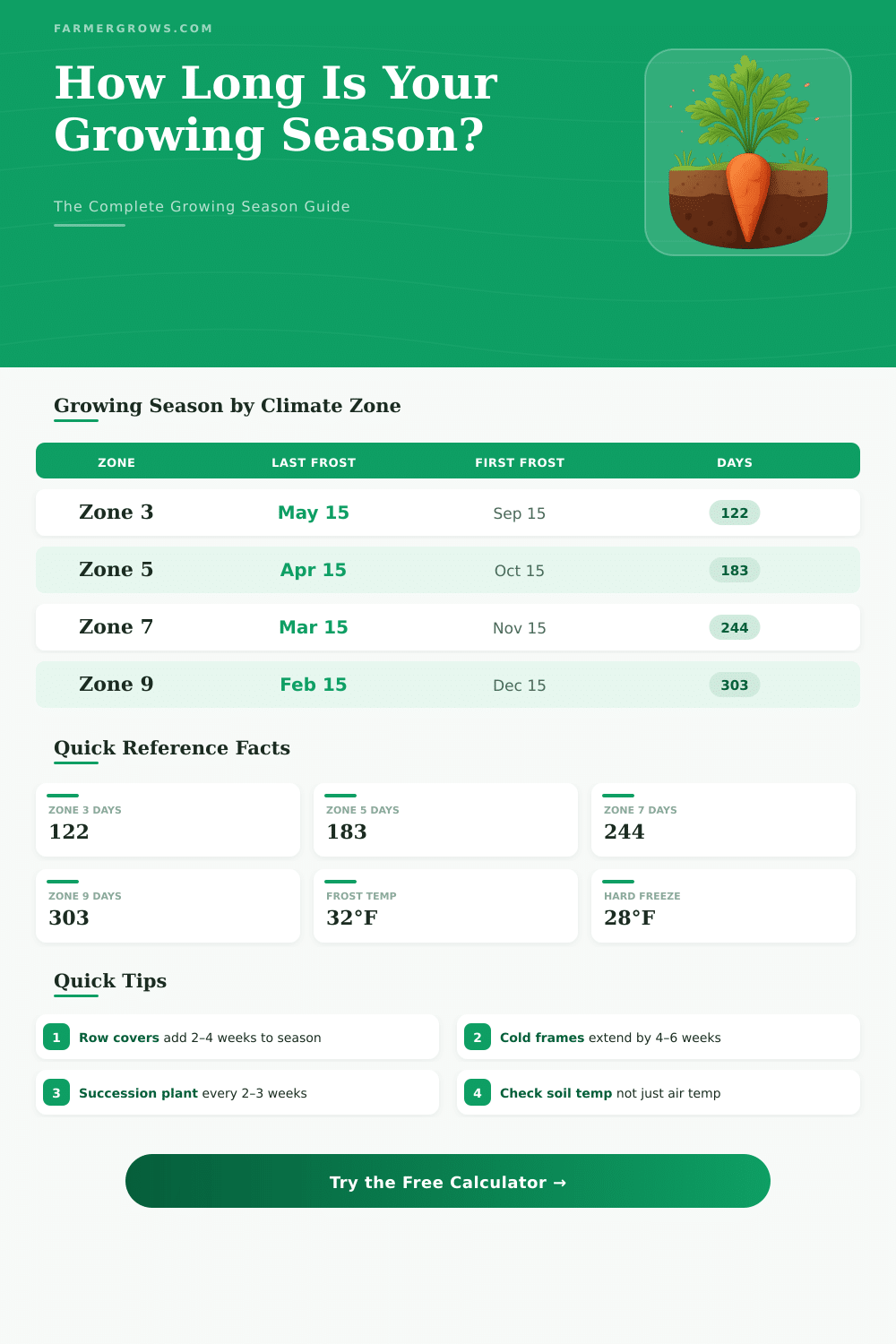
| Zone | Last Spring Frost | First Fall Frost | Frost-Free Days | Avg Min Temp |
|---|---|---|---|---|
| Zone 3 | May 15 | Sep 15 | ≈122 days | -40 to -30°F |
| Zone 4 | May 1 | Oct 1 | ≈153 days | -30 to -20°F |
| Zone 5 | Apr 15 | Oct 15 | ≈183 days | -20 to -10°F |
| Zone 6 | Apr 1 | Oct 31 | ≈213 days | -10 to 0°F |
| Zone 7 | Mar 15 | Nov 15 | ≈244 days | 0 to 10°F |
| Zone 8 | Mar 1 | Nov 30 | ≈274 days | 10 to 20°F |
| Zone 9 | Feb 15 | Dec 15 | ≈303 days | 20 to 30°F |
| Zone 10 | Jan 31 | Dec 31 | ≈334+ days | 30 to 40°F |
| Zone 11–12 | No frost | No frost | 365 days | >40°F |
| Crop Category | Min Temp (°F) | Min Temp (°C) | Weeks Before Last Frost | Examples |
|---|---|---|---|---|
| Very Hardy | 20°F | -7°C | 6–8 wks before | Kale, garlic, spinach |
| Hardy Cool-Season | 26°F | -3°C | 4–6 wks before | Broccoli, cabbage, peas |
| Semi-Hardy | 29°F | -2°C | 2–4 wks before | Lettuce, beets, carrots |
| Tender | 32°F | 0°C | At or after last frost | Beans, corn, cucumbers |
| Very Tender | 50°F | 10°C | 1–2 wks after last frost | Tomatoes, peppers, basil |
| Tropical | 55°F | 13°C | 2–3 wks after last frost | Sweet potato, okra, ginger |
| Method | Days Added | Temp Protection | Cost Level | Best For |
|---|---|---|---|---|
| Row Covers (light) | +14 days | 2–4°F | Low | Frost protection, pests |
| Cold Frames | +28 days | 5–10°F | Low–Med | Seedlings, greens |
| Low Tunnels | +42 days | 8–15°F | Medium | Row crops, transplants |
| High Tunnels | +60 days | 10–20°F | Medium–High | Tomatoes, peppers |
| Heated Greenhouse | +120 days | Full control | High | Year-round growing |
| Season Length | Interval 7 days | Interval 14 days | Interval 21 days | Interval 30 days |
|---|---|---|---|---|
| 90 days | 12 plantings | 6 plantings | 4 plantings | 3 plantings |
| 120 days | 17 plantings | 8 plantings | 5 plantings | 4 plantings |
| 150 days | 21 plantings | 10 plantings | 7 plantings | 5 plantings |
| 180 days | 25 plantings | 12 plantings | 8 plantings | 6 plantings |
| 210 days | 29 plantings | 14 plantings | 10 plantings | 7 plantings |
| 240 days | 33 plantings | 16 plantings | 11 plantings | 8 plantings |
The Growing season presents a magic period, when the local weather, the amount of rain, temperatures and light of day. Truly helps plants bloom. The point is that this period changes a lot based on the place where one lives.
It defines a simple calculation: the gap between the usual last cold spring and the first cold fall. Even so, even if your cold-free time is short, that does not mean that all plants can benefit the whole time.
How the Growing Season Changes Where You Live
Here is the truth: every plant has its own schedule. Crops for cold season, as peas, are very tough, they like cold weather and appear faithfully in gardens through United States in various moments of the year. What about long-lasting crops?
Here start the troubles. Warm crops as tomatoes, peppers and eggplants require more care. Most gardeners start them from seeds inside around eight weeks before the last cool day.
Turn to the region of Cedar City, and you will find that the weekend of Memorial Day marks the usual signal for start to plant. Here the cold-free period lasts almost 90 days for tender plants, and everything happens at a height of 6 000 feet, so snow in June does not genuinely surprise. In central Illinois, Mother’s Day serves as a more reliable guide.
Even so eager gardeners sometimes push and plant in the middle of April or even March for cold-resistant cold-season crops, if they want to risk.
Maryland shows how far that diversity goes. In the distant west Maryland you have around 155 days without cold, while it jumps to 230 days on the Lower East Coast. With a bit of careful planning warm and cold season crops benefit here.
The location creates a big difference across the whole land. States more south receive more sun and heat. In Florida and Texas the climate is so gentle that some crops simply keep producing during the whole year.
On the other hand, everything north of Georgia suffers full winters, that strongly limits the Growing season. Notably, in the zone 8B of California, the Growing season happens naturally, you simply turn the crops as it makes sense. Summer brings tomatoes and cucumbers; winter shifts to leafy vegetables and other cold-tough stuff.
There are practical ways to win more time for yourself. Cold frames well extend the season, although they force you to mind, tender plants left in a closed frame can burn under the son one nice day and die right away. In August or at the beginning of September, one can plant cold-season crops directly in a cold frame.
Greenhouses also help. In the Boston region, a greenhouse can stretch the season from May until October without needing heat during the coldest months. Also, preparing soil in fall, laying black sheet, mulching beds; gives a real early start in spring.
The growth of plants depends on three main things: temperature, humidity and the number of hours of daylight that you receive. The trouble is that changing weather patterns commonly bring either too much rain at wrong moments oralmost nothing when plants genuinely need water.