🌿 Home Depot Mulch Calculator
Calculate exactly how many bags or cubic yards of mulch you need for any project
lbs / cu yd
lbs / cu yd
lbs / cu yd
lbs / cu yd
lbs / cu yd
lbs / cu yd
lbs / cu yd
lbs / cu yd
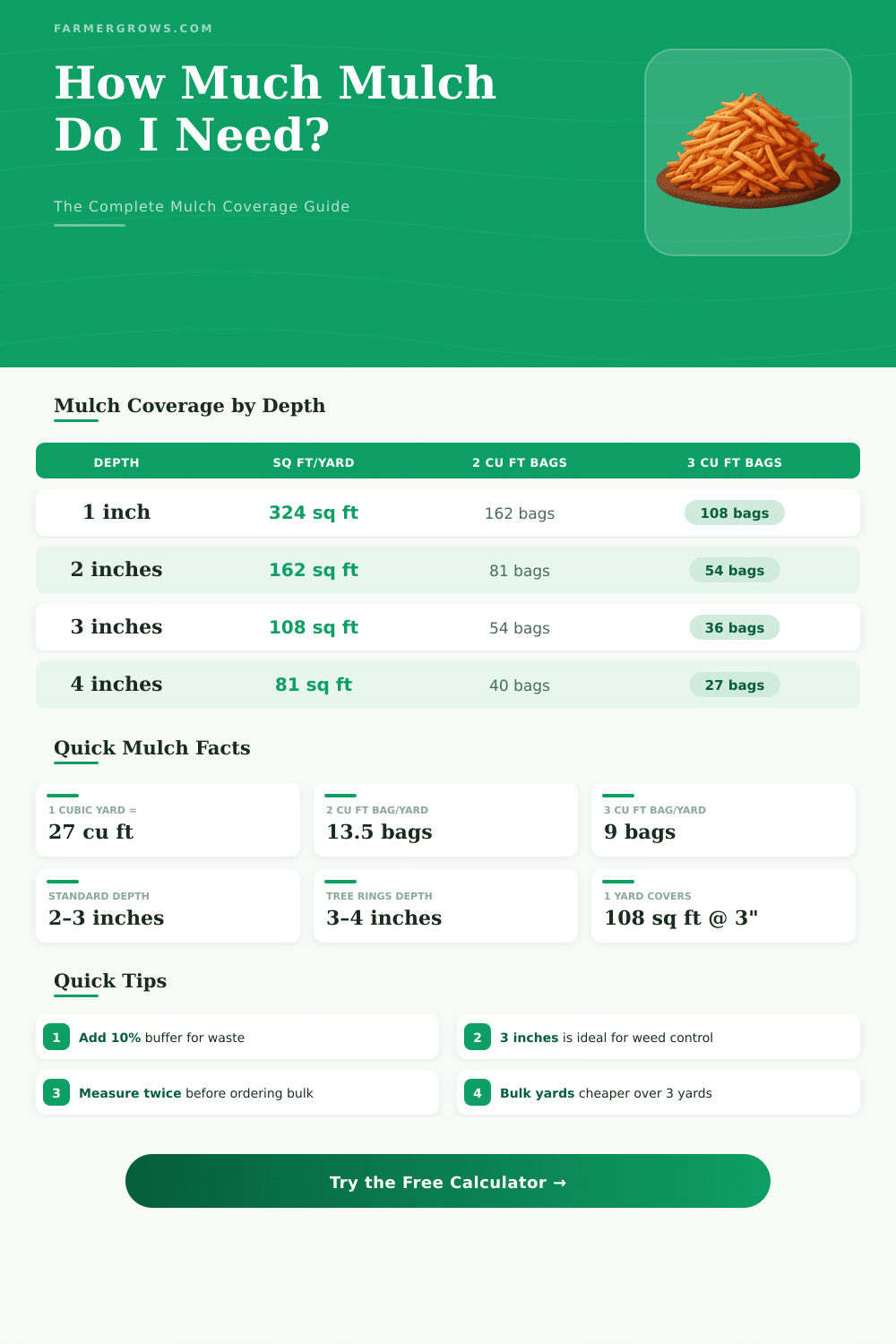
| Depth | Sq Ft Covered | Sq Meters | 2 cu ft Bags Needed |
|---|---|---|---|
| 1 inch (2.5 cm) | 324 sq ft | 30.1 m² | 13.5 bags |
| 2 inches (5 cm) | 162 sq ft | 15.1 m² | 13.5 bags |
| 3 inches (7.6 cm) | 108 sq ft | 10.0 m² | 13.5 bags |
| 4 inches (10 cm) | 81 sq ft | 7.5 m² | 13.5 bags |
| 6 inches (15 cm) | 54 sq ft | 5.0 m² | 13.5 bags |
| Bag Size | Volume Per Bag | Bags Per Cubic Yard | Coverage @ 3 in Depth |
|---|---|---|---|
| 2 cu ft bag | 0.074 cu yd | 13.5 bags | 8 sq ft per bag |
| 3 cu ft bag | 0.111 cu yd | 9 bags | 12 sq ft per bag |
| Bulk (1 cu yd) | 27 cu ft | — | 108 sq ft @ 3 in |
| Bulk (2 cu yd) | 54 cu ft | — | 216 sq ft @ 3 in |
| Project | Area | Cubic Yards | 2 cu ft Bags Needed |
|---|---|---|---|
| Small flower bed | 50 sq ft | 0.46 cu yd | 7 bags |
| Medium garden bed | 100 sq ft | 0.93 cu yd | 13 bags |
| Large border bed | 200 sq ft | 1.85 cu yd | 26 bags |
| Front yard bed | 400 sq ft | 3.70 cu yd | 51 bags |
| Full backyard | 800 sq ft | 7.41 cu yd | 100 bags |
| Tree ring (6 ft dia) | 28 sq ft | 0.26 cu yd | 4 bags |
Mulch is made up of a layer of materials, that sits on the ground surface. Usually it is organic, although not always. The main idea of mulch copies the process, that happens in nature.
In natural woods branches, leaves, twigs and plant stems pile up on the ground and cover it. For a garden or yard you need to on purpose add such organic layers.
How to Use Mulch and Why It Helps
Home depot mulch is useful for many reasons, between that one of the main ones is the control of weeds. It stops them from growing by blocking the access to light. Moreover, mulch helps to keep the soil wet, so that water does not dry up as quickly.
It protects the ground against the blow of rain, what reduces erosion. Over time organic mulch breaks down and adds organic material to the soil, what improves its health and richness.
Mulch also helps to control temperature extremes in the soil. During winter it protects bare ground and protects plants. In spring it keeps the moisture and feeds the soil.
Beyond that, it can work as a marker for garden beds, what helps to avoid damages from lawn mowers and other tools.
One can choose from various kinds of mulch. Wooden mulch commonly comes from sources like pine, cedar and bark. A popular choice is well textured dark brown mulch from almost all hardwood barks, that aged to get a rich colour.
Some mulch materials are finely ground from soft wood of trees and totally without dyes, so they keep the natural wood color. Colored mulch products are also available. Black mulch warms the soil well and helps too keep moisture.
White or silver mulch rather stops weeds from growing.
Rubber mulch offers another option. It does not break down as easily as wooden, yet can be moved with a leaf blower.
Before you apply mulch, it matters to first remove weeds and trash. It works well to spread it evenly with a rake to a depth of two to four inches. If one lays mulch right beside a tree trunk, that can cause rot, so it is best to leave around six inches of bare ground around the trunks.
Too much mulch can create troubles. Piling it at stems or trunks is called volcano mulching, and that is the most common mistake.
Living ground cover plants can replace mulch. Good options are shallow rooted and dense plants, for example small white clover, creeping fescue and woolly thyme. On steep slopes, where loose mulch slips down, crawling plants or heavily planted bushes workbetter.
Add cardboard or newspaper under the mulch to strengthen the blocking of weeds. One can buy mulch in bags or in bulk, and buying in bulk from the store is usually much more cheap than bags.