🌱 Vegetable Garden Spacing Calculator
Calculate exact plant counts, row spacing, and bed capacity for any vegetable garden layout
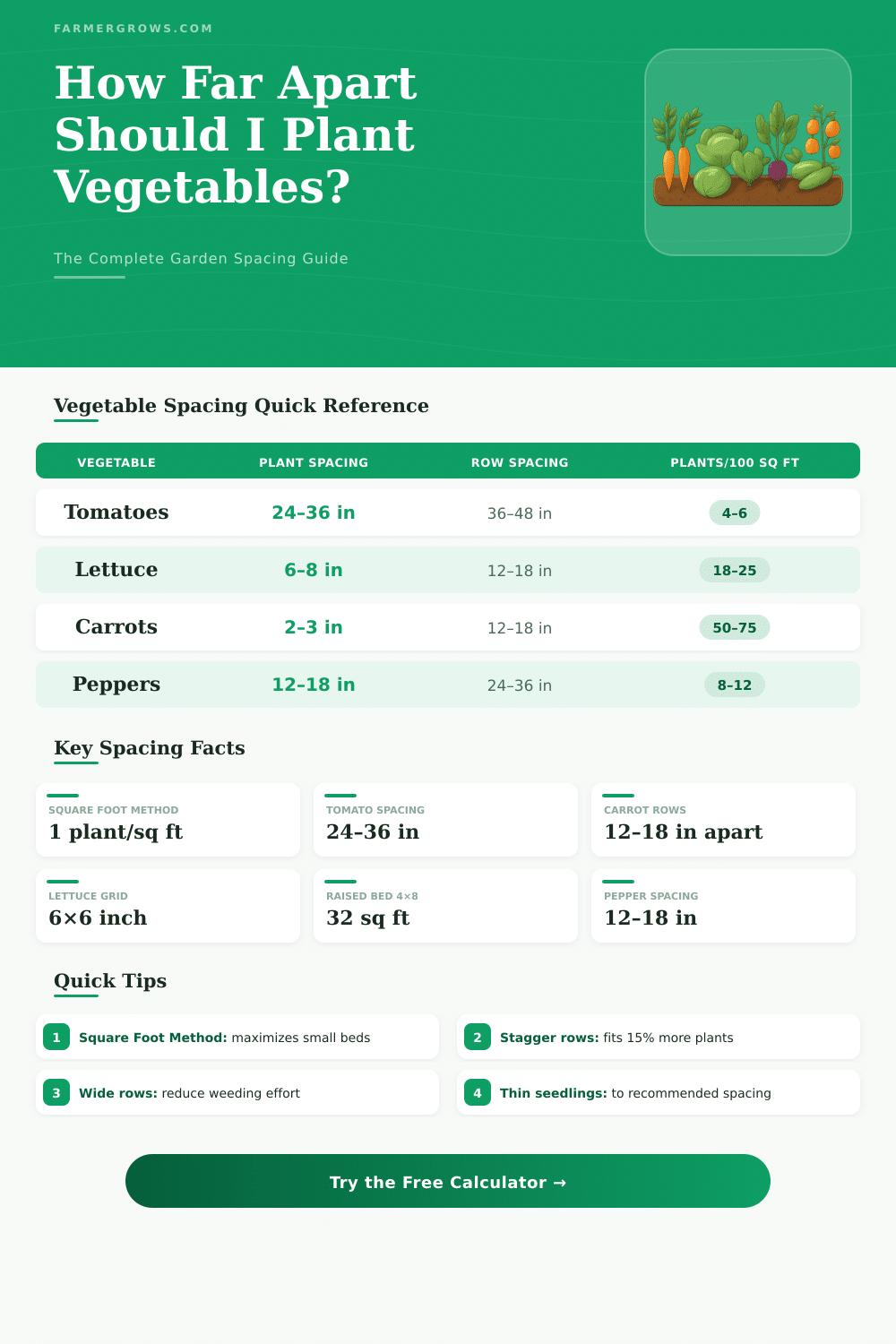
| Vegetable | Plant Spacing | Row Spacing | Plants / 10 sq ft | Plants / 1 m² |
|---|---|---|---|---|
| Tomatoes | 24–36 in (61–91 cm) | 36–48 in (91–122 cm) | 1–2 | 1–2 |
| Lettuce | 6–8 in (15–20 cm) | 12–18 in (30–46 cm) | 8–14 | 9–15 |
| Carrots | 2–3 in (5–8 cm) | 12–18 in (30–46 cm) | 40–60 | 43–65 |
| Peppers | 12–18 in (30–46 cm) | 24–36 in (61–91 cm) | 3–5 | 3–5 |
| Cucumbers | 12–18 in (30–46 cm) | 36–60 in (91–152 cm) | 2–3 | 2–3 |
| Spinach | 4–6 in (10–15 cm) | 12–18 in (30–46 cm) | 13–26 | 14–28 |
| Beans (Bush) | 4–6 in (10–15 cm) | 18–24 in (46–61 cm) | 8–18 | 9–19 |
| Squash | 24–36 in (61–91 cm) | 36–60 in (91–152 cm) | 1–2 | 1–2 |
| Radishes | 2–3 in (5–8 cm) | 6–12 in (15–30 cm) | 40–90 | 43–97 |
| Kale | 12–18 in (30–46 cm) | 18–24 in (46–61 cm) | 4–8 | 4–9 |
| Vegetable | Plants per 1 sq ft | Plants per 4×4 bed (16 sq ft) | Plants per 4×8 bed (32 sq ft) |
|---|---|---|---|
| Tomatoes | 1 | 4–8 (in cages) | 8–16 |
| Lettuce | 4 | 64 | 128 |
| Carrots | 16 | 256 | 512 |
| Peppers | 1 | 16 | 32 |
| Spinach | 9 | 144 | 288 |
| Radishes | 16 | 256 | 512 |
| Bush Beans | 9 | 144 | 288 |
| Cucumbers | 2 | 32 | 64 |
| Kale | 1 | 16 | 32 |
| Squash | 1 | 4 | 8 |
| Bed Size | Area (sq ft) | Area (m²) | Tomatoes | Lettuce | Carrots |
|---|---|---|---|---|---|
| 2 × 4 ft | 8 | 0.74 | 1–2 | 32–42 | 90–140 |
| 4 × 4 ft | 16 | 1.49 | 2–4 | 64–80 | 180–280 |
| 4 × 8 ft | 32 | 2.97 | 4–8 | 128–168 | 360–560 |
| 4 × 12 ft | 48 | 4.46 | 6–12 | 192–256 | 540–840 |
| 8 × 8 ft | 64 | 5.95 | 8–16 | 256–336 | 720–1120 |
| 10 × 20 ft | 200 | 18.58 | 20–50 | 800–1050 | 2250–3500 |
The right Vegetable garden spacing matters much more than newcomers in gardening commonly think. Various vegetables need different amounts of space, and recalling the needs of every type can be truly hard. Using a chart for spacing makes the planning of a garden easier because it shows the ideal positions for vegetables and herbs, to reach good output.
In typical home gardens one plants vegetables in long rows, with equal distance between them. That basic method works well, even though it needs more area than many folks have available today, due to the ways between the rows. Home gardens usually have limited ground.
How to Space Vegetables in Your Garden
Because of that, one commonly grows some vegetables in block form, instead of scattering them in broad rows.
Square foot gardening forms raised frames, where the growth surface splits into one-foot squares. In each square grows at least one plant, placed tightly one beside the other. The principle here is that plants arranged like this need less space and water.
For tiny urban backyards or shared groves, square foot arrangement has more sense. It means more vegetables and flowers in little area, and after the first sowing it becomes fairly easy to take care of. One does not use average spacing plans for that system, because it is dense and plants stand more near.
If the Vegetable garden spacing points say six inches, that means three inches on every side of the plant, not six on both. A tip about 12-inch distance usually shows that the type will reach around 12 inches of width. If one plants too tightly, the outputs decline and the plants compete between themselves.
Vegetables need enough space to grow healthy and give good harvest. The distance between them ensures that each receives sun from the sides, which really helps.
When plants have enough light and air flow, they give the maximum amount of product. Tomatoes can grow three feet apart in the center, if space allows. Kale is useful at 18 inches instead of 12.
Like this one gets bigger and healthy plants, that resist diseases more well.
Broccoli deserves attention. If one spaces the plants more apart, one receives a bigger head. Even so, if one lays more of them in the same area, the total broccoli mass can be bigger, although each head is more small.
Carrots also require thinning. Without good thinning, the roots tangle and become curved. If one sows carrots dense, and later pulls the smallest for salads, the remaining roots have a lot of space.
Carrots don’t transplant well, but when they are young, one can eat the whole plant, including roots and leaves.
Plant low flowers around vegetables to attract pollinators and help control unwanted weeds. Mixed planting and ground cover farming also fills the spaces well. One can sow fast-growing lettuce between slower vegetables, later pull it at the end of spring, to give the main plants more place too spread.
Roots of most vegetables extend much morethan the upper part of the plant, so the Vegetable garden spacing truly is important.