🪟 Post & Rail Fence Calculator
Estimate posts, rails, and materials needed for your fence project — imperial & metric
25–30 yr life
15–20 yr life
30–50 yr life
40–60 yr life
20–30 yr life
25–40 yr life
50+ yr life
30–50 yr life
| Post Spacing | Posts per 100 ft | Posts per 100 m | Sections per 100 ft |
|---|---|---|---|
| 6 ft (1.83 m) | 18 | 55 | 17 |
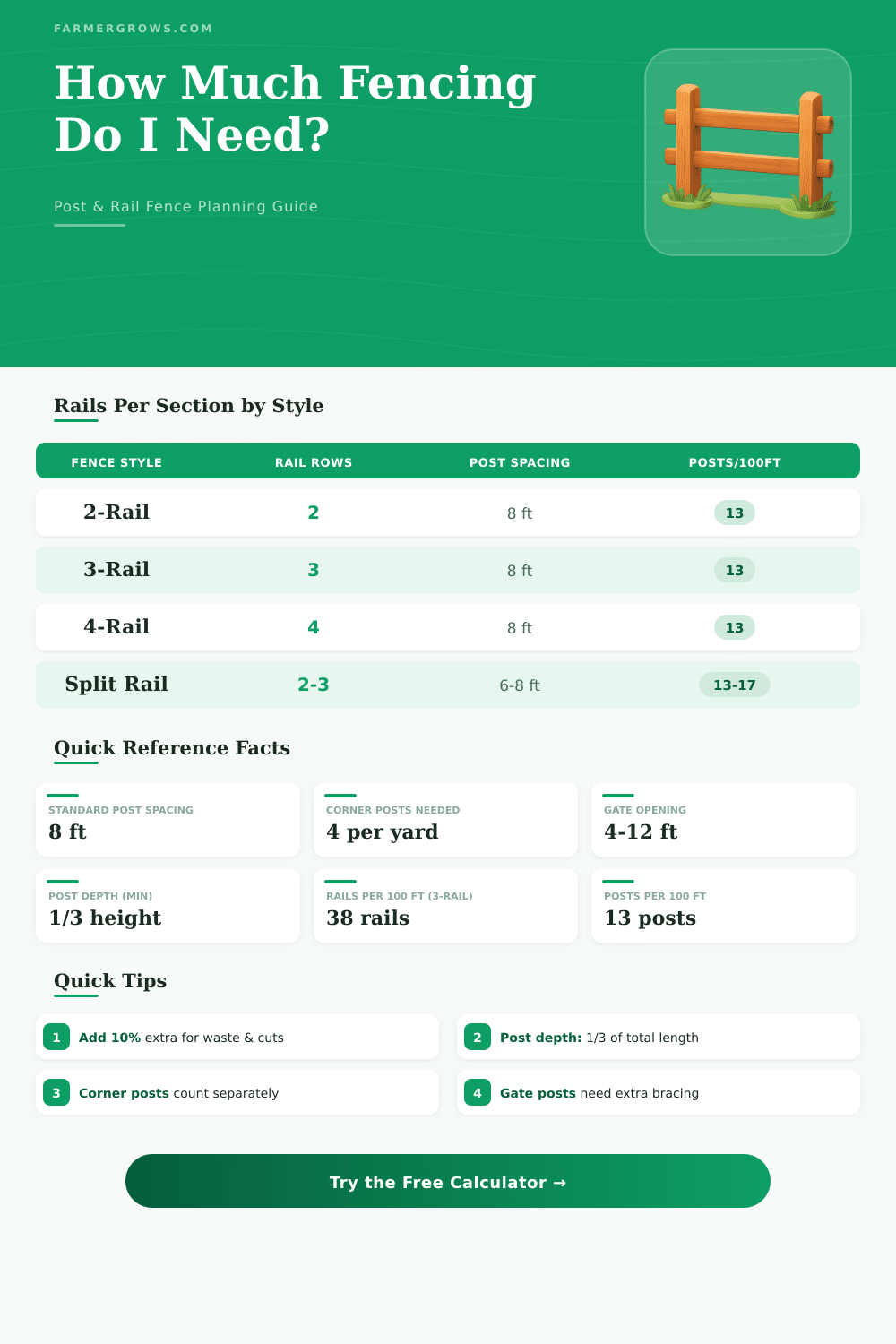
| 8 ft (2.44 m) | 14 | 41 | 13 |
| 10 ft (3.05 m) | 11 | 33 | 10 |
| 12 ft (3.66 m) | 10 | 28 | 9 |
| Rail Rows | 8 ft Spacing | 10 ft Spacing | 12 ft Spacing |
|---|---|---|---|
| 2 Rails | 26 rails | 20 rails | 17 rails |
| 3 Rails | 38 rails | 30 rails | 25 rails |
| 4 Rails | 50 rails | 40 rails | 34 rails |
| 5 Rails | 63 rails | 50 rails | 42 rails |
| Project | Length | Posts Needed | Rails Needed |
|---|---|---|---|
| Small Backyard | 75 ft | 12 | 29 |
| Standard Yard | 150 ft | 21 | 57 |
| Driveway Edge | 200 ft | 27 | 76 |
| Small Paddock | 300 ft | 39 | 114 |
| Horse Pasture | 500 ft | 64 | 190 |
| Ranch Perimeter | 1000 ft | 127 | 380 |
| Post Height (above ground) | Min. Post Depth | Total Post Length | Concrete per Post |
|---|---|---|---|
| 3.5 ft (1.07 m) | 2.5 ft (0.76 m) | 6 ft (1.83 m) | 1 bag (50 lb) |
| 4 ft (1.22 m) | 3 ft (0.91 m) | 7 ft (2.13 m) | 1 bag (50 lb) |
| 5 ft (1.52 m) | 3 ft (0.91 m) | 8 ft (2.44 m) | 1–2 bags |
| 6 ft (1.83 m) | 3.5 ft (1.07 m) | 9–10 ft | 2 bags (50 lb) |
The cost of fence can change a lot based on the material, the work involved and the place of the property. In the whole land one finds good prices in a range of 1 330 until 5 550 dollars for fence what averages around 8 until 46 dollars each linear foot. This calculation includes the materials and the professional assembly.
Homeowners usually spend between 1 857 and 4 776 dollars to install fence. Although the prices can fall until 400 dollars or rise until 13 700 dollars, everything depends on the material and the level of complexity in the work. The main influence on the expensse in any fence project is the choice of materials.
How much does a fence cost?
Wooden fences are commonly chosen. Cedar and pine belong to the favourite species, even so wood requires more care than other materials to escape rot and decay. Wooden fence averages 15 until 30 dollars each linear foot together with the installation.
For standard wooden fence with 155 linear feet the Post and rail fence cost reach 3 600 dollars, while the most many such projects sit between 2 450 and 4 550 dollars.
Vinyl fence costs average 4 300 dollars for the assembly. The range for vinyl projects go from 3 500 until 4 500 dollars, but fancy vinyl installations occasionally reach 6 400 dollars. The vinyl fence material shows itself almost 42% more expensive then wood each linear foot.
Hiring a fencing contractor adds 6 until 30 dollars each linear foot for the work, or around 1 200 until 6 000 dollars for typical fence of 200 linear feet. Contractors do not commonly give bids based on linear feet, but their labor rates average around 40 until 90 dollars each hour. The work can involve until 50% of the whole project expense.
The terrain plays a role also. Slopes or uneven surfaces make the installation more difficult and slow, what expands the price. Local authorities can require permits, that adds their own costs.
Removing old fence usually adds 3 until 10 dollars each foot. Stains, sealing or special fixtures also expand the amount. For simple fencing like barbed wire or knitted wire the prices stay much more low, around 3 until 8 dollars each foot.
Wire fences most commonly show the most cheap, while metallic and vinyl tend to be more expensive.
Doing it yourself can save a lot. One home-made privacy fence spent only 9 dollars each linear foot. Other self-installed fence cost entirely 1 800 dollars.
For doing it yourself one requires tools like a post hole digger, drill, saw and shovel. Planning of a fence project can seem too much, because contractors use different pricing modes. One bid is based on the panel, others on the hours and many count according tolinear foot.