🪴 Container Garden Soil Calculator
Calculate exactly how much potting mix you need for any container, planter, or raised pot
Potting Mix
Premium Mix
Veggie Mix
Cactus Mix
Herb Mix
Coco Coir
Compost Blend
Peat-Based
| Fill Depth | Cu Ft per Sq Ft | Cu In per Sq In | Liters per Sq Meter |
|---|---|---|---|
| 2 inches (5 cm) | 0.167 ft³ | 0.167 in³/in² | 50.8 L/m² |
| 4 inches (10 cm) | 0.333 ft³ | 0.333 in³/in² | 101.6 L/m² |
| 6 inches (15 cm) | 0.500 ft³ | 0.500 in³/in² | 152.4 L/m² |
| 8 inches (20 cm) | 0.667 ft³ | 0.667 in³/in² | 203.2 L/m² |
| 10 inches (25 cm) | 0.833 ft³ | 0.833 in³/in² | 254.0 L/m² |
| 12 inches (30 cm) | 1.000 ft³ | 1.000 in³/in² | 304.8 L/m² |
| 18 inches (46 cm) | 1.500 ft³ | 1.500 in³/in² | 457.2 L/m² |
| 24 inches (61 cm) | 2.000 ft³ | 2.000 in³/in² | 609.6 L/m² |
| Bag Size | Volume (cu ft) | Volume (liters) | Volume (gallons) |
|---|---|---|---|
| 1 quart bag | 0.033 ft³ | 0.95 L | 0.25 gal |
| 1 gallon bag | 0.134 ft³ | 3.79 L | 1.0 gal |
| 4 qt / 1 cu ft bag | 1.0 ft³ | 28.3 L | 7.5 gal |
| 2 cu ft bag | 2.0 ft³ | 56.6 L | 15 gal |
| 3 cu ft bag | 3.0 ft³ | 84.9 L | 22.5 gal |
| Bulk bag (1 yd³) | 27.0 ft³ | 764.6 L | 202 gal |
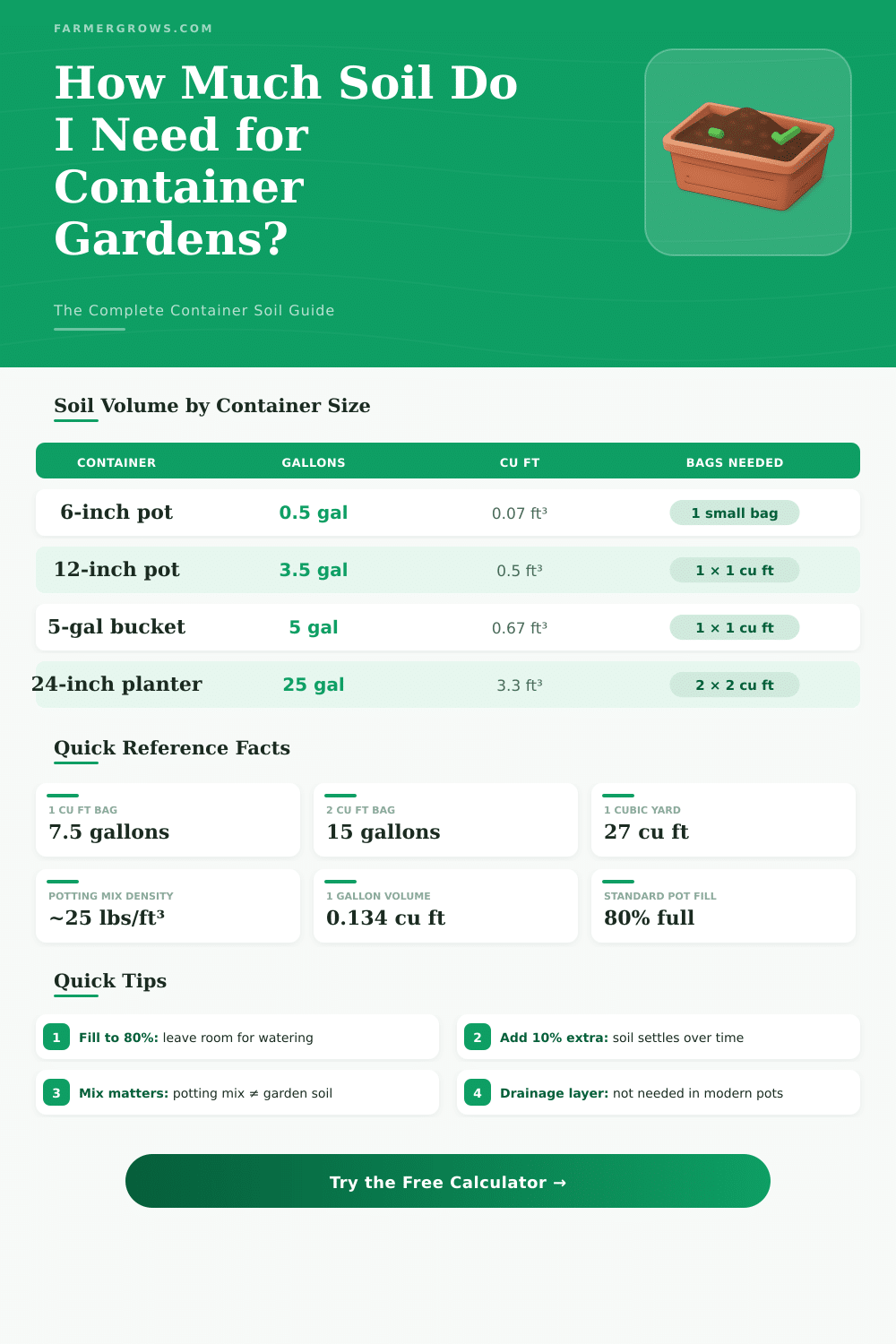
| Container | Footprint | 8" Fill → Cu Ft | Bags Needed (2 ft³) |
|---|---|---|---|
| 6" Round Pot | 0.196 ft² | 0.13 ft³ | 1 small (1 ft³) |
| 8" Round Pot | 0.349 ft² | 0.23 ft³ | 1 small (1 ft³) |
| 12" Round Pot | 0.785 ft² | 0.52 ft³ | 1 bag (2 ft³) |
| 14" Round Pot | 1.069 ft² | 0.71 ft³ | 1 bag (2 ft³) |
| Window Box 24x8" | 1.33 ft² | 0.89 ft³ | 1 bag (2 ft³) |
| 18" Square Planter | 2.25 ft² | 1.50 ft³ | 1 bag (2 ft³) |
| 24" Square Planter | 4.00 ft² | 2.67 ft³ | 2 bags (2 ft³) |
| Raised Bed 4x8 ft | 32 ft² | 21.3 ft³ | 11 bags (2 ft³) |
| Raised Bed 4x12 ft | 48 ft² | 32.0 ft³ | 16 bags (2 ft³) |
Using Container garden soil in pot gardens can help or hurt your success with plants. Here the problem: skip garden banks and soil for pots entirely. They too dense and heavy for use in pots, they pack down, hurt the drainage and bring diseases.
What you really need is mix for pots, made specially for growing in pots.
Use Potting Mix, Not Garden Soil
Good mix for pots feels light airy and fluffy when you touch it. You will find good versions full of things like peat moss, coconut fiber, bark, perlite or vermiculite, often mixed with compost too. When buying in store, search for something with good texture and things friendly to plants, look for perlite, peat and well aged compost in the list of things.
Many folks mix Container garden soil with mix for pots, which is understandable. Here is a simple way to note the difference: if the bag says “soil” or “ground”, it simply means it is meant for the ground, not for pots. Container garden soil holds small chips, that causes problems when trapped (it thickens), chokes the roots and can bring unwanted insects or diseases.
Take instead soilless mix for pots. That is your better choice.
Growing vegetables and herbs? Bought organic mix for pots in store does the task easy. Taking soil from any other garden is not a good idea for pot growing.
Every brand in store works, as long as the label really says “mix for pots” and not “Container garden soil”; that difference matters more then one thinks.
If you want to be creative, you can make your own mix. Many folks swear by equal parts of coconut fiber, organic compost and perlite. Another method combines coconut fiber, compost and peat-based mix for pots in equal parts, then adds extra perlite for better air flow.
Know about materials for drainage, rice husks, pumice, perlite, vermiculite, really help to avoid problems with packing. Different kinds of compost, whether worm or homemade batches, each adds different benefit when one builds good Container garden soil.
Big pots and bought mix for pots? That quickly will empty your wallet. Adding perlite to cheaper mix for pots improves the drainage and stops packing.
Another saving tip: lay flat rocks or small stones in the bottom before filling; simple, but it works well.
You can add compost in pot gardens, window boxes and mix it with mix for pots for home plants. Starting a compost pile at home and adding it to your garden each season is a good long plan. Homemade compost, if well done, reaches heat enough to kill seeds of unwanted herbs and dangerous germs.
Old soil must not be dumped. Mixing used soil from pots in raised beds together with manure, compost and worms helps everything stay productive year after year. Only make sure that you wash the pots well before reusing them; avoid insects andclear the drain holes.
Pot plants use up nitrogen more quickly than those in soil, so your mix for pots needs regular nitrogen feeds. Before buying, read what really is in the bag and check for nitrogen content and helpful fungi, it deserves those few seconds.