🌱 Garden Bed Volume Calculator
Calculate exactly how much soil, mulch, or compost your garden bed needs
✅ Your Garden Bed Volume Results
| Depth | Coverage (sq ft) | Coverage (m²) | Cubic Feet |
|---|---|---|---|
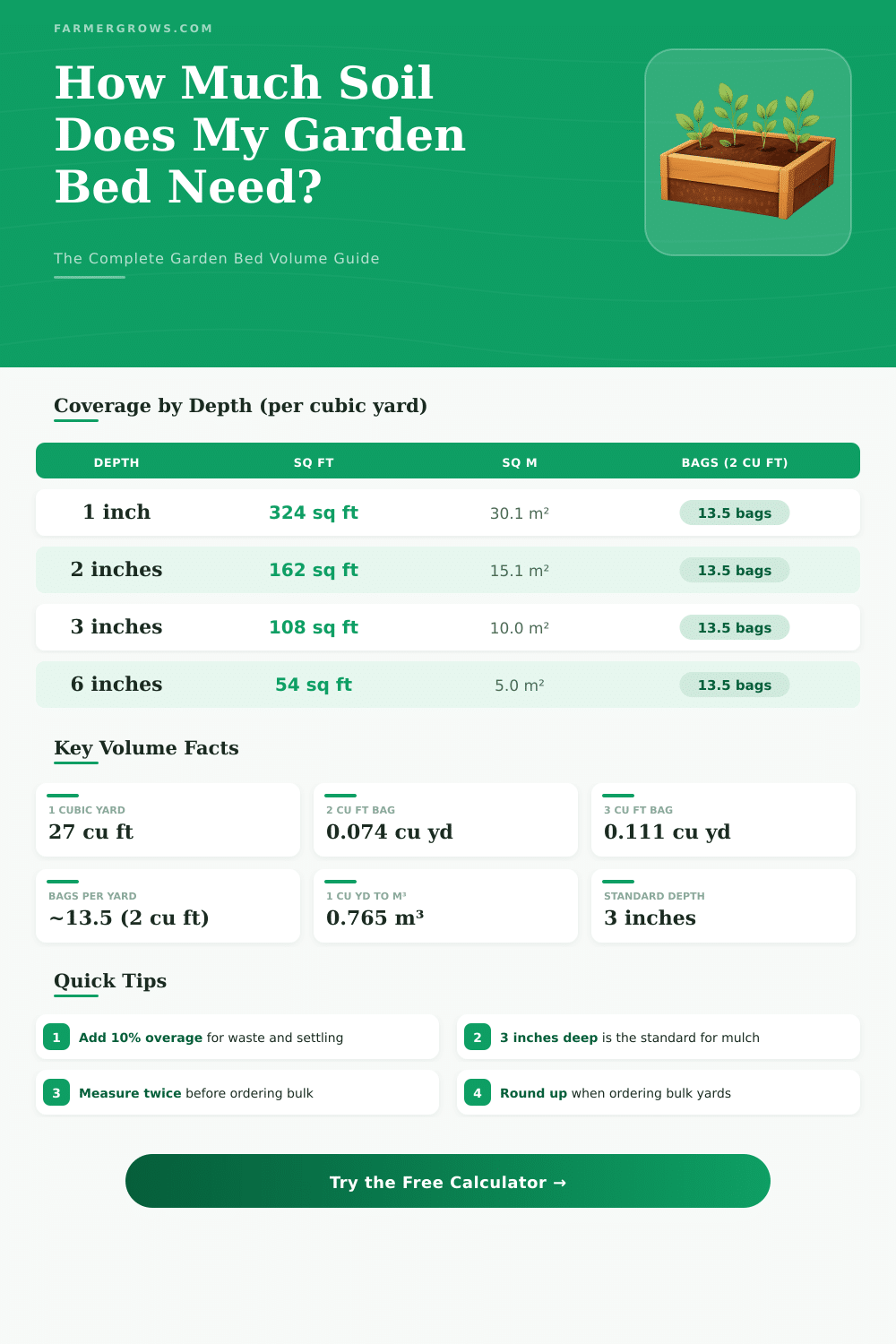
| 1 inch (2.5 cm) | 324 sq ft | 30.1 m² | 27 cu ft |
| 2 inches (5 cm) | 162 sq ft | 15.1 m² | 27 cu ft |
| 3 inches (7.6 cm) | 108 sq ft | 10.0 m² | 27 cu ft |
| 4 inches (10 cm) | 81 sq ft | 7.5 m² | 27 cu ft |
| 6 inches (15 cm) | 54 sq ft | 5.0 m² | 27 cu ft |
| 12 inches (30 cm) | 27 sq ft | 2.5 m² | 27 cu ft |
| Bag Size | Volume per Bag | Bags per Yard | Coverage at 3 in |
|---|---|---|---|
| 0.75 cu ft bag | 0.75 cu ft | 36 bags | 3 sq ft |
| 1 cu ft bag | 1 cu ft | 27 bags | 4 sq ft |
| 1.5 cu ft bag | 1.5 cu ft | 18 bags | 6 sq ft |
| 2 cu ft bag | 2 cu ft | 13.5 bags | 8 sq ft |
| 3 cu ft bag | 3 cu ft | 9 bags | 12 sq ft |
| Bulk (1 yard) | 27 cu ft | — | 108 sq ft |
| Project | Area (sq ft) | Cu Yds at 3 in | 2 cu ft Bags |
|---|---|---|---|
| Small flower bed 4×6 | 24 sq ft | 0.22 yd³ | 3 bags |
| Medium bed 10×4 | 40 sq ft | 0.37 yd³ | 5 bags |
| Raised bed 4×8 | 32 sq ft | 0.30 yd³ | 4 bags |
| Tree ring 6 ft dia | 28.3 sq ft | 0.26 yd³ | 4 bags |
| Border bed 30×3 | 90 sq ft | 0.83 yd³ | 12 bags |
| Large bed 20×8 | 160 sq ft | 1.48 yd³ | 20 bags |
| Playground 15×15 | 225 sq ft | 2.08 yd³ | 28 bags |
| Full yard 50×50 | 2500 sq ft | 23.1 yd³ | 312 bags |
For example, how much soil must your garden bed have depends on the volume. For a rectangular shape the recipe is basic: length times width times depth. Here one gets the Garden bed volume.
Many calculators ask about the length, width and height of the bed then they show how much soil is needed.
How to Measure How Much Soil Your Garden Bed Needs
Because most tools for ground calculation work with cubic feet, it is useful to first change the depth from inches to feet. Simply divide the inches by 12. For instance depth of 6 inches becomes 0.5 feet.
A raised rectangular bed with 6 feet of length, 4 feet of width and 1 foot of depth requires 26.4 cubic feet of soil, after one considers the settling.
Some beds have different shapes and sizes. Usually the sizes work well for guessing the Garden bed volume. Even so, if the inside space differs a lot from the outside, better measure inside.
Otherwise you risk having too much extra siol without use.
For six-sided beds one finds the volume counting the base area and then multiplying by the height. Irregular forms one can split into basic parts, and measure each one separately. Then one adds the results.
When dealing with several beds, measure one and multiply by the amount of them (this is a fast weigh).
Buy soil by cubic feet or cubic yards helps when you fill more than one raised bed. The real total amount could be around 2.1 cubic yards, and one must include delivery cost and tax.
For round pots the diameter of the upper part and the depth are the main measures. A calculator can point how many bags of plant soil to buy, and those bags commonly come in 1.5-cubic-foot volume.
The size of bed affects a lot the Garden bed volume. Commonly used are 4×4 feet or 4×8 feet. A square bed allows you to easily reach all parts.
Beds should not require stretching more than two feet to reach the inside. Some beds are only 2 feet wide, if one has access from one side, or around 3 feet with access from both.
A twelve-inch deep bed works for many vegetables. Square foot gardening works in beds of 6 inches of depth, but rooting vegetables need more. If the bottom of a raised bed is open, the plants grow down into the ground below.
Even a 5-inch-high raised bed gives plants 12 to 18 inches of usable growing depth. Garden soil settles inthe bed over time, and in the first year after settling one can lose 6 to 8 inches of depth.