🫖 Compost Tea Calculator
Calculate exact brew volume, compost ratios, and application rates for any garden area
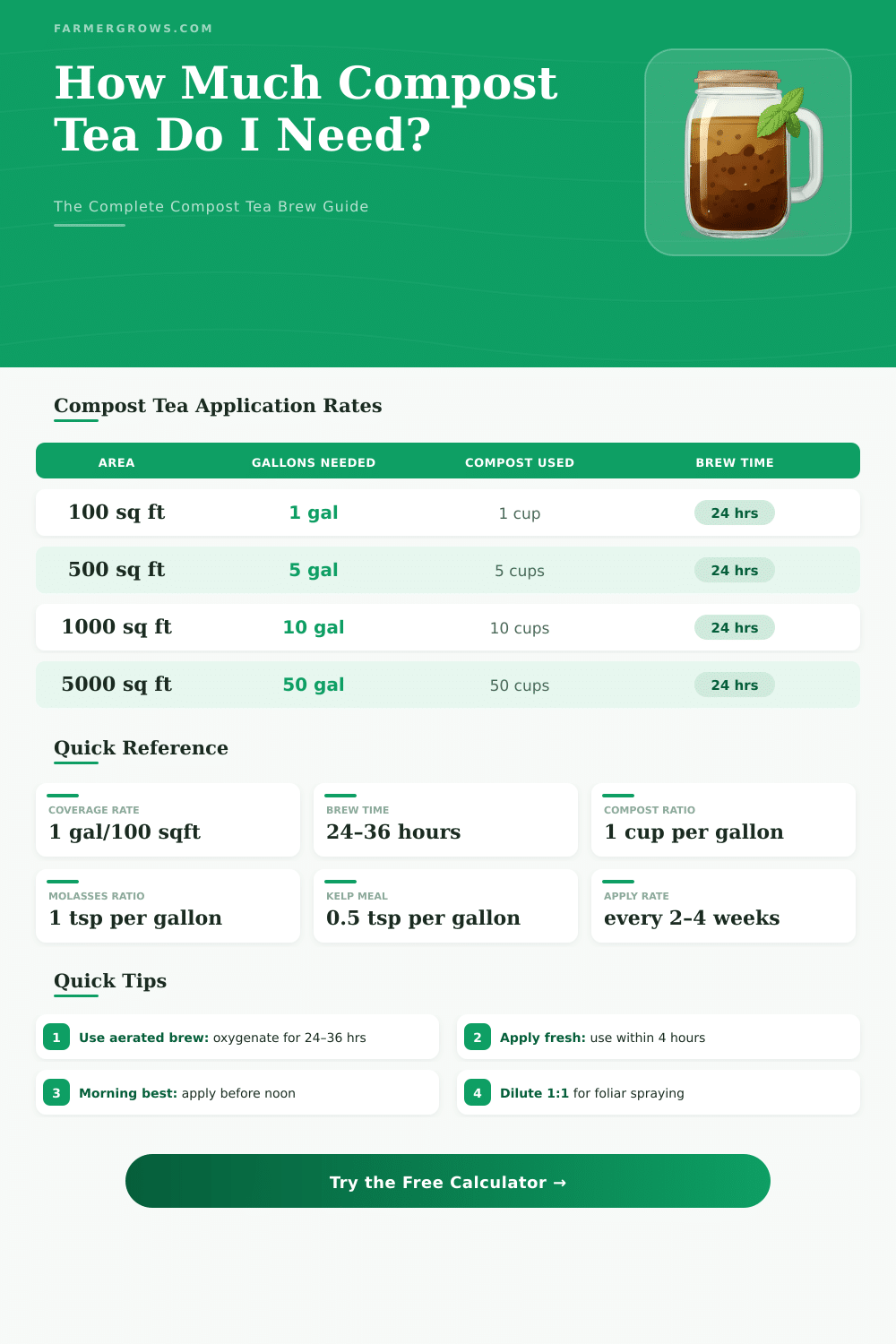
| Rate Type | Gal per 100 sq ft | L per 10 m² | Best Use |
|---|---|---|---|
| Light / Maintenance | 1 gal | 4.7 L | Healthy established plants |
| Standard | 2 gal | 9.5 L | General garden beds, lawns |
| Heavy | 5 gal | 23.7 L | Stressed or recovering plants |
| Intensive / Restoration | 10 gal | 47.4 L | Heavily depleted soils |
| Foliar Spray (diluted 1:1) | 0.5 gal | 2.4 L | Leaf disease prevention |
| Brew Volume | @ 1 gal/100 sqft | @ 2 gal/100 sqft | @ 5 gal/100 sqft |
|---|---|---|---|
| 1 gallon (3.8 L) | 100 sq ft (9.3 m²) | 50 sq ft (4.6 m²) | 20 sq ft (1.9 m²) |
| 5 gallons (18.9 L) | 500 sq ft (46.5 m²) | 250 sq ft (23.2 m²) | 100 sq ft (9.3 m²) |
| 10 gallons (37.9 L) | 1,000 sq ft (92.9 m²) | 500 sq ft (46.5 m²) | 200 sq ft (18.6 m²) |
| 25 gallons (94.6 L) | 2,500 sq ft (232 m²) | 1,250 sq ft (116 m²) | 500 sq ft (46.5 m²) |
| 55 gallons (208 L) | 5,500 sq ft (511 m²) | 2,750 sq ft (255 m²) | 1,100 sq ft (102 m²) |
| Additive | Amount per Gallon | Amount per 5 Gal | Purpose |
|---|---|---|---|
| Compost (1:10 ratio) | 1 cup (237 mL) | 5 cups (1.2 L) | Microbial source |
| Unsulfured Molasses | 1 tsp (5 mL) | 5 tsp (25 mL) | Bacterial food source |
| Kelp Meal | 0.5 tsp (2.5 mL) | 2.5 tsp (12.5 mL) | Micronutrients, hormones |
| Fish Hydrolysate | 1 tsp (5 mL) | 5 tsp (25 mL) | Nitrogen, fungal food |
| Rock Phosphate | 0.5 tsp (2.5 mL) | 2.5 tsp (12.5 mL) | Phosphorus source |
| Humic Acid | 0.5 tsp (2.5 mL) | 2.5 tsp (12.5 mL) | Soil biology enhancer |
| Project | Area (sq ft) | Brew Needed (@ 2 gal/100) | Compost Required (1:10) |
|---|---|---|---|
| Small Raised Bed | 32 sq ft | 0.6 gal (2.4 L) | 0.6 cups (145 mL) |
| Standard Raised Bed | 48 sq ft | 1 gal (3.8 L) | 1 cup (237 mL) |
| Patio Garden | 100 sq ft | 2 gal (7.6 L) | 2 cups (473 mL) |
| Average Front Lawn | 600 sq ft | 12 gal (45.4 L) | 12 cups (2.8 L) |
| Medium Backyard | 1,500 sq ft | 30 gal (113.6 L) | 30 cups (7.1 L) |
| Large Lawn | 2,500 sq ft | 50 gal (189.3 L) | 50 cups (11.8 L) |
Compost tea is a kind of liquid prepared from water and finished compost. It serves as a natural replacement for store-bought food for plants. The main idea consists in pulling useful germs and nutrients from compost, to convert them into liquid fit for use on plants.
Among those germs are bacteria, fungi, protozoa, nematodes and tiny bugs.
How to Make and Use Compost Tea
A typical recipe applies a ratio of 5:1 between water and compost. That is around five parts of water against one of compost. The water itself should not have chlorine Rainwater is even better for that purpose.
Various ways exist to prepare it. Some methods include airing, while others skip that. Adding something like molasses provides food for the germs while they stay in the tea.
Kelp, fish paste and alfalfa meal can also serve to feed the germs during the preparation. Worm castings form another favorite add-in. One of those ways mixes compost with fish paste and leaves the mix to rest a day or two, although that rquires a bit of time.
The kind of compost matters a lot. One can prepare it from several different materials, and each of them has its character. If one does tea from two different composts, one receives two different teas.
Like this the quality of the tea depends mostly on the compost used in it.
Fresh Compost tea is prepared by means of air pumps and air stones, to keep oxygen moving. A simple setup would be made up of a five-gallon barrel with two air stones and two pumps, running for around 24 to 36 hours. Without a truly good air pump, even so, there is not enough air to fully stop bad bacteria from growing.
A more basic way is to simply mix compost, a bit of molasses, extras and clean water in a barrel, without any airing.
Compost tea helps fight diseases of plants, bringing in good bacteria and fungi that compete with dangerous germs. One uses it also too start seeds and grow seedlings. The goal is not truly to fertilize, but to give young plants good germ surroundings that help root growth.
Deeper roots help to keep moisture and reduce drainage. For good soil structure it requires all living groups in the food net be present, and the tea adds those germs.
One can apply it as a soil drench or as a leaf spray. As a leaf spray, it commonly needs to be thinned. Compost tea one can prepare at home or buy at garden stores.
Compost naturally forms liquid runoff called liquid, that sometimes one calls also Compost tea. Soaking compost for various times can decide whether the tea ends upmore rich in bacteria or fungi.