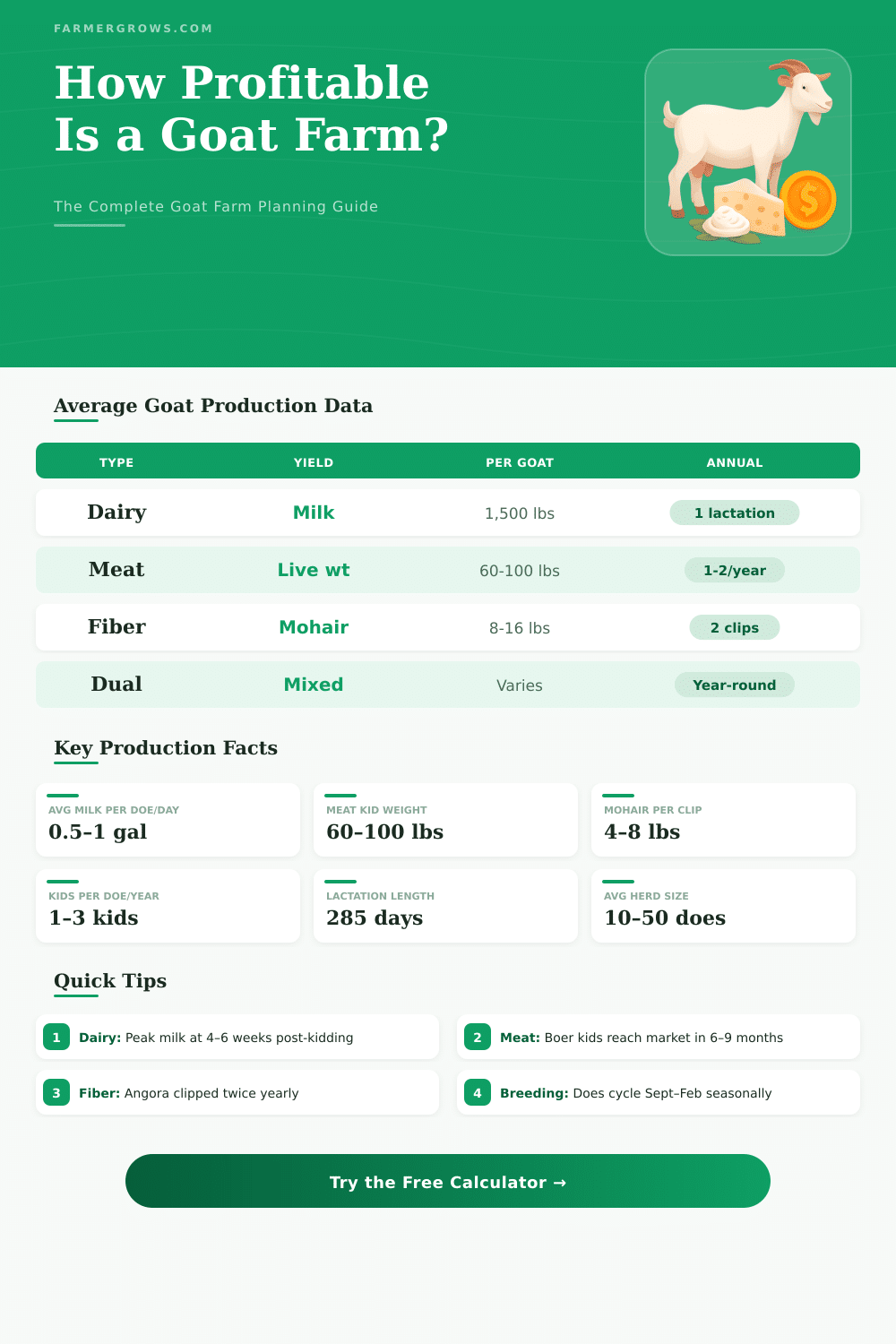
🐐 Goat Farm Profit Calculator
Estimate annual output & revenue potential from your goat herd — dairy, meat, or fiber
| Breed | Avg lbs/yr | Avg gal/day | Lactation Days | Butterfat % |
|---|---|---|---|---|
| Saanen | 2,200–3,600 | 0.9–1.5 | 305 | 3.2% |
| Alpine | 1,800–2,600 | 0.75–1.1 | 290 | 3.4% |
| Nubian | 1,100–1,900 | 0.5–0.8 | 260 | 5.0% |
| LaMancha | 1,700–2,400 | 0.7–1.0 | 285 | 3.9% |
| Toggenburg | 1,600–2,200 | 0.65–0.9 | 280 | 3.2% |
| Oberhasli | 1,400–2,000 | 0.6–0.85 | 275 | 3.9% |
| Breed | Market Weight (lbs) | Dressing % | Kids/Doe/yr | Months to Market |
|---|---|---|---|---|
| Boer | 60–110 | 48–52% | 1.8–2.2 | 6–9 |
| Kiko | 50–90 | 45–50% | 1.6–2.0 | 7–10 |
| Spanish | 40–75 | 44–48% | 1.5–1.9 | 8–12 |
| Myotonic | 40–70 | 46–50% | 1.5–2.0 | 8–11 |
| Boer x Kiko | 65–100 | 47–52% | 1.8–2.2 | 6–9 |
| Breed | Fiber Type | Yield / Clip (lbs) | Clips / yr | Annual Yield (lbs) |
|---|---|---|---|---|
| Angora | Mohair | 4–8 | 2 | 8–16 |
| Cashmere | Cashmere down | 1.5–3 | 1 | 1.5–3 |
| Pygora | Mohair/Down mix | 3–5 | 2 | 6–10 |
| Nigora | Cashmere blend | 2–4 | 2 | 4–8 |
| Does | Annual Kids (180%) | Dairy: Total Milk (gal) | Meat: Total Live Wt (lbs) | Fiber: Total (lbs) |
|---|---|---|---|---|
| 5 | 9 | 1,069 | 675 | 60 |
| 10 | 18 | 2,138 | 1,350 | 120 |
| 20 | 36 | 4,275 | 2,700 | 240 |
| 30 | 54 | 6,413 | 4,050 | 360 |
| 50 | 90 | 10,688 | 6,750 | 600 |
| 100 | 180 | 21,375 | 13,500 | 1,200 |
| Imperial | Metric Equivalent | Notes |
|---|---|---|
| 1 gallon milk | 3.785 liters / 8.6 lbs | Goat milk slightly denser than water |
| 1 lb fiber | 0.454 kg | Raw greasy weight |
| 1 lb live weight | 0.454 kg | Market / live weight |
| 100 lbs milk | 45.4 kg / 11.6 gal | DHIR standard measure |
| 1 cwt (hundredweight) | 45.4 kg | Common meat market unit |
Goat farm profit has real potential as a source of income, although it does not work for all alike. The key to success depends on what you can reach: how much you are willing to invest and honestly, how well you know the business. It is not simply hard work, but a deeper change in your lifestyle.
Basically you have two main possible ways: lead a breeding business or feed animals for sale. Feeding for market works best if you have firm control over raw prices, overhead costs and the needed transportation.
How to Make Money from Goat Farming
Little businesses commonly end in the range of 10 to 20 percent of profit margin. Bigger farms with better efficiency and more complete market relations? They reach 25 to 35 percent.
Here is what makes goat farming such an attractive option. Profit does not measure only once. You can count income above the variable expenses, control profit per head, share it monthly or per acre, check milk incomes or estimate return on investment.
Everything depends on waht answers for your situation.
Market goats truly produce money. Here is the main point: feeding goats to selling weight costs less than doing that with cattle. Meat goats are truly profitable, and some farms even dropped their cattle work to focus only on goats.
Cattle can give bigger amounts in dollars, but they require much more work and attention. Hybrids from Spanish and Tennessee genetics became the favorite choice for meat producers.
Baby goats need more investment and personal attention, that is genuinely true. But they surprisingly benefit, because they breed regularly and give babies, what makes your herd grow together with your incomes. At farm markets, goat meat sells four between 10 and 15 dollars per pound.
Also, some goats sell alive for cultural or religious uses, what adds another source of money.
Fiber offers yet one way to income. One can gather it from shearing or combing, without butchering the animal. Even when your herd does not go to market, fiber still makes money.
There is more than that, goats work as living machines for clearing land. Contracts for clearing with farmers give you pay, plus the benefits of having animals that control the meadow. That benefit goes beyond just meat sale incomes.
Smaller operations profit by focusing on niche markets, that pay more highly. The real advantage comes from skill in learning and good practices against diseases. Basic gear for good care of goats is needed.
The good start? Starting a goat farm does not need huge capital, big workforce or very heavy work. Your return on investment stays high.
Banks (governmental and private alike)… Indeed offer loans for goat farm plans, because the Goat farm profit is that strong.
Clever programs of feeding, smart choices in farming and products with added value can create stable income over time. It requires constant learning and effort, but folks from every background find goat farming very good. Those first few years though?
They are hard. Even carefulcalculations can show profit, when one lives well from incomes of a little herd.