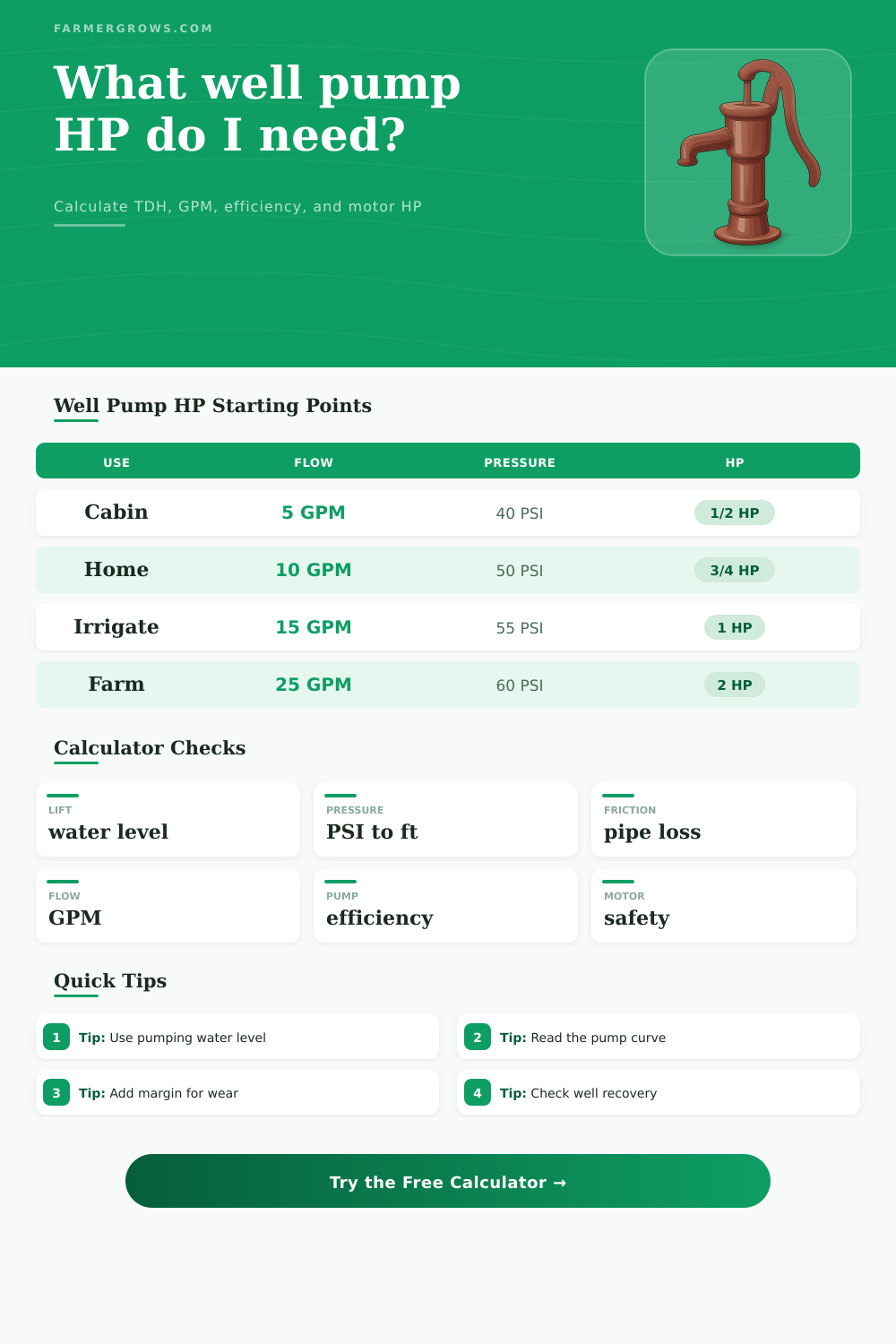
Well Pump Horsepower Calculator
Estimate well pump horsepower from pumping water level, pressure tank PSI, GPM, pipe friction, pump efficiency, motor efficiency, and safety factor.
Use this as a sizing worksheet before comparing pump curves. It estimates hydraulic horsepower from total dynamic head, then adjusts for pump efficiency, motor efficiency, and your safety factor.
Well Pump Horsepower Results
These results use TDH = pumping water level + elevation + pressure head + pipe friction + minor losses, then HP = GPM x TDH / 3960.
| Pressure setting | Head equivalent | Common use | Why it matters |
|---|---|---|---|
| 30 PSI | 69 ft | Low-pressure drip, stock tanks | Lower pressure reduces horsepower but may not suit fixtures. |
| 40 PSI | 92 ft | Cabins, small homes | A common minimum for usable household pressure. |
| 50 PSI | 116 ft | Homes, garden hydrants | Often used as a practical design target. |
| 60 PSI | 139 ft | Sprinklers, long piping | Raises TDH quickly and may require a larger pump. |
| 70 PSI | 162 ft | High-pressure irrigation | Verify pipe ratings and pump curve carefully. |
| Condition | Pumping level | Typical pump | Sizing caution |
|---|---|---|---|
| Shallow well | 0-25 ft | Jet or submersible | Surface pumps are limited by suction lift. |
| Moderate well | 25-100 ft | Submersible | Pressure head can exceed lift head. |
| Deep well | 100-300 ft | Submersible | Small friction errors can change HP selection. |
| Very deep well | 300+ ft | Multi-stage submersible | Use the exact pump curve, wire size, and water level data. |
| Calculated HP | Common next size | Typical flow range | Curve check |
|---|---|---|---|
| 0.30-0.50 HP | 1/2 HP | 5-8 GPM | Good for light domestic demand at modest head. |
| 0.51-0.75 HP | 3/4 HP | 7-12 GPM | Common for homes with moderate lift. |
| 0.76-1.00 HP | 1 HP | 10-18 GPM | Often used when pressure or drawdown is higher. |
| 1.01-1.50 HP | 1 1/2 HP | 12-25 GPM | Useful for irrigation zones and deeper wells. |
| 1.51-2.00 HP | 2 HP | 18-35 GPM | Check starting load, wire size, and well recovery. |
| 2.01+ HP | 3 HP or larger | 25+ GPM | Engineer the system from measured data and curves. |
| Flow and pipe | Typical friction | 100 ft loss | Use as |
|---|---|---|---|
| 8 GPM through 1 in pipe | 2-4 ft per 100 ft | Low | Domestic supply or small garden runs. |
| 12 GPM through 1 in pipe | 5-8 ft per 100 ft | Moderate | Homes and light irrigation branches. |
| 18 GPM through 1 in pipe | 12-18 ft per 100 ft | High | Consider 1 1/4 in pipe to reduce HP demand. |
| 25 GPM through 1 1/4 in pipe | 8-12 ft per 100 ft | Moderate | Good starting point for larger irrigation zones. |
| 35 GPM through 1 1/2 in pipe | 7-11 ft per 100 ft | Moderate | Useful for farmstead mains and stock tanks. |
Use pumping water level, not well depth. Horsepower depends on the water level while the pump is running. Well depth is mainly a reserve and pump-setting check.
Verify the selected HP on a pump curve. The curve must deliver your GPM at the calculated TDH, with enough margin for filters, fittings, and seasonal drawdown.
When you are determining the horsepower that a well pump should have, you must ensure that the motor is powerful enough to move the water from the ground to the surface. A well pump must perform two main function: moving water up from the ground and pushing the water through the pipes to reach the water outlets at the required pressure. If a well pump has too low of a horsepower rating, it will struggle to move the water from the ground to the surface.
However, using a well pump with too high of a horsepower will cause that well pump to work harder then it needs to work. Using too high of a horsepower for a well pump will cause the well pump to wear out quick. The calculator help to determine the correct horsepower for a well pump by using the numbers from the property to avoid guessing.
How to Find the Right Horsepower for a Well Pump
The total depth of the well does not calculate the horsepower for a well pump. The horsepower for a well pump do depend on the water level within the well while the pump is running. The total depth of the well does not factor into the horsepower of the pump.
There are two measurements of the water level within the well. The static water level is the level of the water in the well when the pump is turned off. The drawdown of the well is the amount that the water level drop when the pump is working.
These two measurements must be added together to find the total lift of the well. Using the total depth rather than the pumping level will result in either too large of a pump or too small of a pump to effectively move the water from the ground to the water outlets of the property. The level of pressure that is required from the well pump will increase the total head of the pump.
The total head requirement will also increase with the increase in the target pressure. Each home can have the same depth wells but require different amounts of pressure from those pumps. Therefore, one home could have a well pump with a higher horsepower than the other.
The friction created by the pipes will also play a role in the horsepower required for the pumps. The longer the pipes or the smaller diameter of the pipe, the more friction the water creates moving through those pipes. The greater the friction in the pipes, the harder the pump will have to work to move the water through the pipes.
Using a larger diameter pipe will reduce the friction in the pipe and the horsepower of the well pump will have to work against the water moving through those pipes. The efficiency of the pump and motor will also factor into the horsepower. The efficiency of impeller and the motor will reduce the amount of hydraulic horsepower used by the well pump.
A safety factor should also be included in these calculations. This factor will ensure that the well pump can handle fluctuations in the voltage that is provided to the motor, wear on the pump, and variations in the water level throughout the different season. The rate at which the well can recover water is independent of the horsepower calculations for the well pump.
However, this rate will still affect the performance of the well pump. Even with the appropriate horsepower for the head and flow of the well, the well pump may cause issue if the recovery rate is set too low. Using too low of a recovery rate can lead to short cycling of the well pump, air in the lines of the pump, and even motor failure of that well pump.
The different applications of the well pump have different requirement. For instance, the household system will have different requirements than the irrigation system. The different demand will require a change in the horsepower of the well pump.
The grid within the calculator will allow individuals to easily read the various scenarios without memorizing the different horsepower requirements for different applications of the well pump. The reference tables will assist in making the different choices for the well pump. The pressure-to-head conversion table will help with understanding why increasing the pressure from forty PSI to sixty PSI is such a significant change.
The lift condition table will allow individuals to understand what type of pump should be used based on the depth of the well. The motor size table will assist with ensuring the size of the motor does not get rounded down to a smaller size than what is calculate by the well pump. It is not the final step in determining the horsepower for the well pump.
The pump curve for the well pump must still be determined based on the total dynamic head and flow of the water. The motor may appear to be the appropriate size for the well based on the calculations, but if the impeller for the motor is not of the correct size and efficiency, it may not be able to handle the required flow of water from that well. Therefore, the calculated horsepower is not the final decision but the pump curve is the tool that will be used to determine the appropriate size for the well pump.
The calculator can also determine the velocity of the water moving through the discharge pipe. If the velocity of the water through the discharge pipe is too high, there will be increased turbulence and wear on the pipes. Too high of a velocity through the discharge pipe will also cause increased wear on the water in the discharge pipe.
Too low of a velocity of water moving through the discharge pipe will allow for the sediment in the water to settle in that pipe. Therefore, the velocity of the water must be within a range that avoid these issues. The change of the seasons will also impact the performance of the well.
The well may be able to provide water for the property in the springtime, but in the summer, there will be a greater drawdown of the water in that well. Including a safety margin in the horsepower calculations will account for these changes caused by the different seasons. Overall, the goal is to find the right well pump for the water and the needs of the property.
The horsepower indicate the amount of load on the motor. Using the calculations and the well pump calculator, you can find the appropriate size for the motor. The calculator will handle the mathematics of the problem so that you can focus on the other important decision for your water pumping system.
Calculating the proper horsepower for the well pump is only one step in creating an effective pumping system. Other steps involve the choice of the pipe size and the pressure that is to be created at the outlets of the water system. These variable are interrelated so choosing one will impact the others.