Water Tank Overflow Size Calculator
Estimate storm inflow from catchment area and rainfall intensity, then compare overflow pipe capacity from orifice head and gravity pipe slope with screen loss, freeboard, and emergency spillway allowance.
Rational runoff uses Q = C x I x A, where rainfall intensity is inches per hour and catchment area is acres. Pipe capacity is checked two ways: an orifice estimate from head above outlet and a full-pipe gravity estimate from slope.
Overflow Size Result
Enter rainfall, pipe, head, and freeboard inputs to estimate overflow capacity.
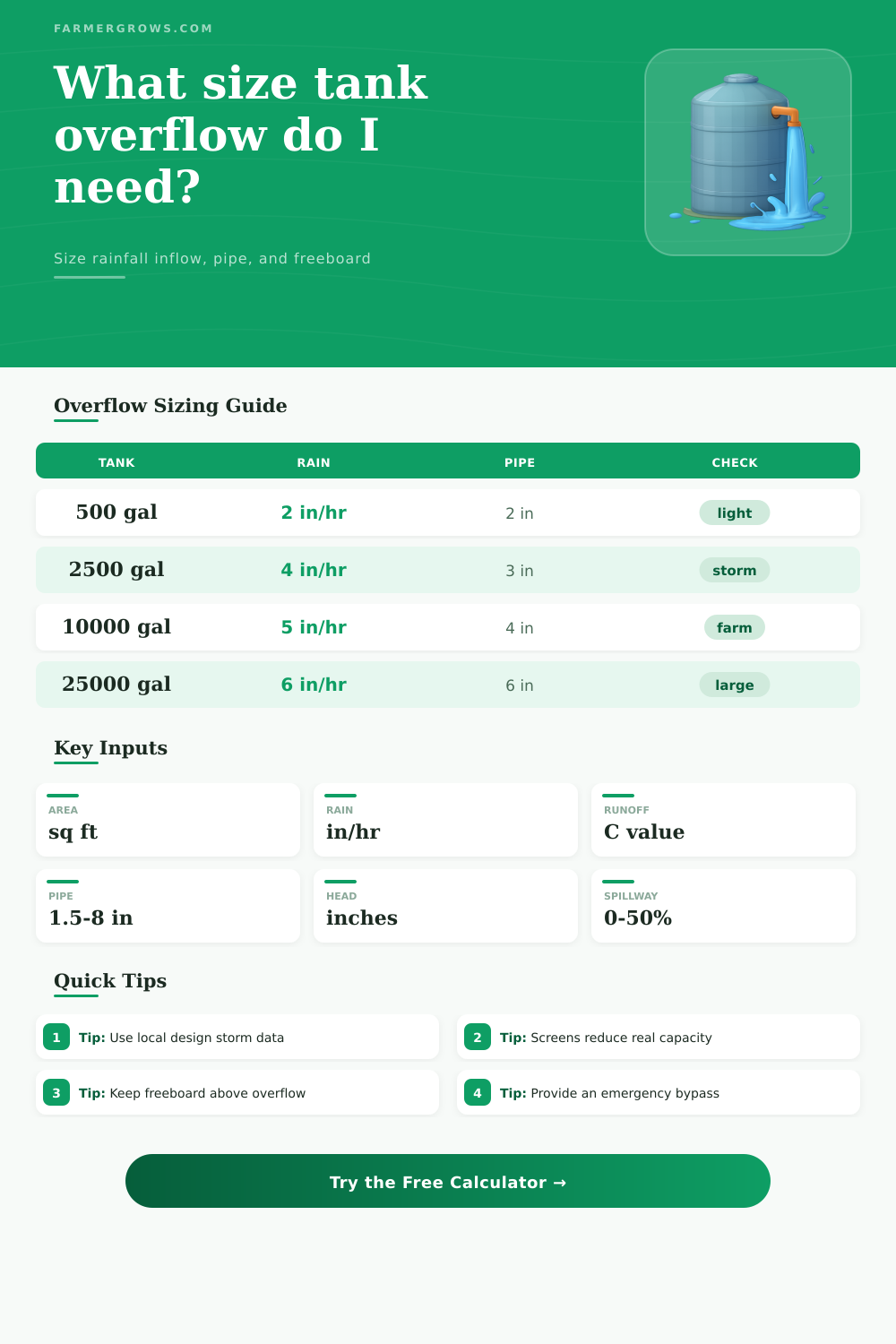
The grid compares nearby pipe sizes under the same rainfall, catchment, screen factor, pipe slope, and head assumptions. Capacity shown is the limiting value after screen adjustment.
| Nominal pipe | Typical inside diameter | Gravity capacity at 1% slope | Orifice capacity at 3 in head |
|---|---|---|---|
| 1-1/2 in | 1.610 in | About 18 GPM | About 31 GPM before screen factor |
| 2 in | 2.067 in | About 38 GPM | About 51 GPM before screen factor |
| 3 in | 3.068 in | About 124 GPM | About 112 GPM before screen factor |
| 4 in | 4.026 in | About 284 GPM | About 193 GPM before screen factor |
| 6 in | 6.065 in | About 968 GPM | About 438 GPM before screen factor |
| 8 in | 7.981 in | About 2180 GPM | About 758 GPM before screen factor |
| Catchment area | 2 in/hr storm | 4 in/hr storm | 6 in/hr storm |
|---|---|---|---|
| 500 sq ft roof, C 0.90 | 9 GPM | 19 GPM | 28 GPM |
| 1000 sq ft roof, C 0.90 | 19 GPM | 37 GPM | 56 GPM |
| 2500 sq ft roof, C 0.90 | 47 GPM | 94 GPM | 140 GPM |
| 5000 sq ft roof, C 0.90 | 94 GPM | 187 GPM | 281 GPM |
| Design item | Typical planning range | Calculator role | Field note |
|---|---|---|---|
| Head above outlet | 2 to 6 in | Raises orifice flow as water depth rises | Keep below unsafe rim or lid openings |
| Screen factor | 0.55 to 1.00 | Reduces theoretical pipe capacity | Use lower values for leaf guards or fine mesh |
| Freeboard | 4 to 18 in | Shows time buffer if the overflow is blocked | More freeboard helps during debris events |
| Emergency spillway | 10% to 50% | Raises target capacity above design inflow | Route bypass water where erosion is controlled |
| Surface type | Coefficient | Good default | Overflow sizing effect |
|---|---|---|---|
| Gravel yard or mixed surface | 0.40 to 0.60 | 0.50 | Some rainfall infiltrates or is delayed |
| Compacted pad or packed lane | 0.60 to 0.80 | 0.70 | Fast runoff with limited infiltration |
| Greenhouse plastic or hoop house | 0.80 to 0.90 | 0.85 | Smooth sheet flow to gutters |
| Metal roof or smooth roof | 0.90 to 0.95 | 0.90 | High direct inflow to tanks |
This calculator provides planning estimates for atmospheric water tanks and gravity overflows. Verify final overflow, venting, structural, erosion, backflow, mosquito control, and local code requirements before construction.
To size an water tank overflow correctly, you must make sure the overflow pipe can handle more water than falls into the tank. If the volume of water falling into the tank are more than the volume of water that the overflow pipe can remove, the water level will rise above the tank’s rim and create flooding within an area. To avoid flooding, you must ensure the overflow pipe can match the amount of water flow into the tank.
The size of the areas that collects the water is the first factor to consider in sizing the overflow pipe. Areas that collects the water, such as sheds, will produce less water than large barn roofs. The larger the area that collects the water, the more that will enter the tank.
How to Size a Water Tank Overflow Pipe
Therefore, the overflow pipe must be large enough to handle the additional amount of water that enters the tank. The second factor to consider are the intensity of rainfall. The overflow pipe must handle the highest rate of rainfall because a period of intense rainfall will produce the highest volume of water through the overflow pipe.
Rainfall over a longer period will produce less water through the pipe than the same amount of rainfall over a short period. Additionally, you must account for the runoff coefficient of the area that collect the water. Roofs made of metal will allow most of the rain to become runoff.
Gravel surfaces will absorb some of the rainwater. The overflow pipe’s capacity depend on its size and the number of restrictions to the water that pass through it. Overflow pipe flow can be calculated based off the head of water or the slope of the pipe.
However, the actual flow will always be less than the calculated flow due to the screens and other debris guard built into the overflow pipe. You must include a factor that calculate for the screen size because screens will reduce the amount of water that pass through the overflow pipe if they are fine in size or become clogged with leaves. Freeboard is the space between the water and the tanks rim.
This portion of the tank allow for extra time to manage the water if the overflow pipe cannot keep up with the water entering the tank. The freeboard will tell you how many minutes it will take for the tank to fill to the rim if the overflow pipe is unable to remove all of the water from the tank. To increase the safety margin for extreme rainfall, add an emergency spillway so that the tank have an extra means of releasing water during storms heavier than the design storm for the tank.
Common mistakes when sizing an overflow pipe include selecting a size that will fit a specific fitting rather than the water flow that passes through it. Additionally, people often fail to account for rainfall that fall directly on the tanks surface. Another mistake is to assume that the screen will allow the same amount of water to pass through it as calculated.
Screens can get blocked with leaves and pollen that settle on the screen and will significantly reduce the overflow pipe’s capacity when it become blocked. Finally, you must consider the environment in which the tank will be built. The area in which the overflow pipe will empty the tanks water must be able to handle that volume of water.
Additionally, you must inspect the overflow pipe after a large rainfall so that you can determine any clogs in the screen or the size of the pipe. By ensuring that the inflow of water into the tank is matched with an appropriately sized overflow pipe and taking into account the various restrictions on the overflow pipe, the tank will remain under control during periods of heavy rainfall.