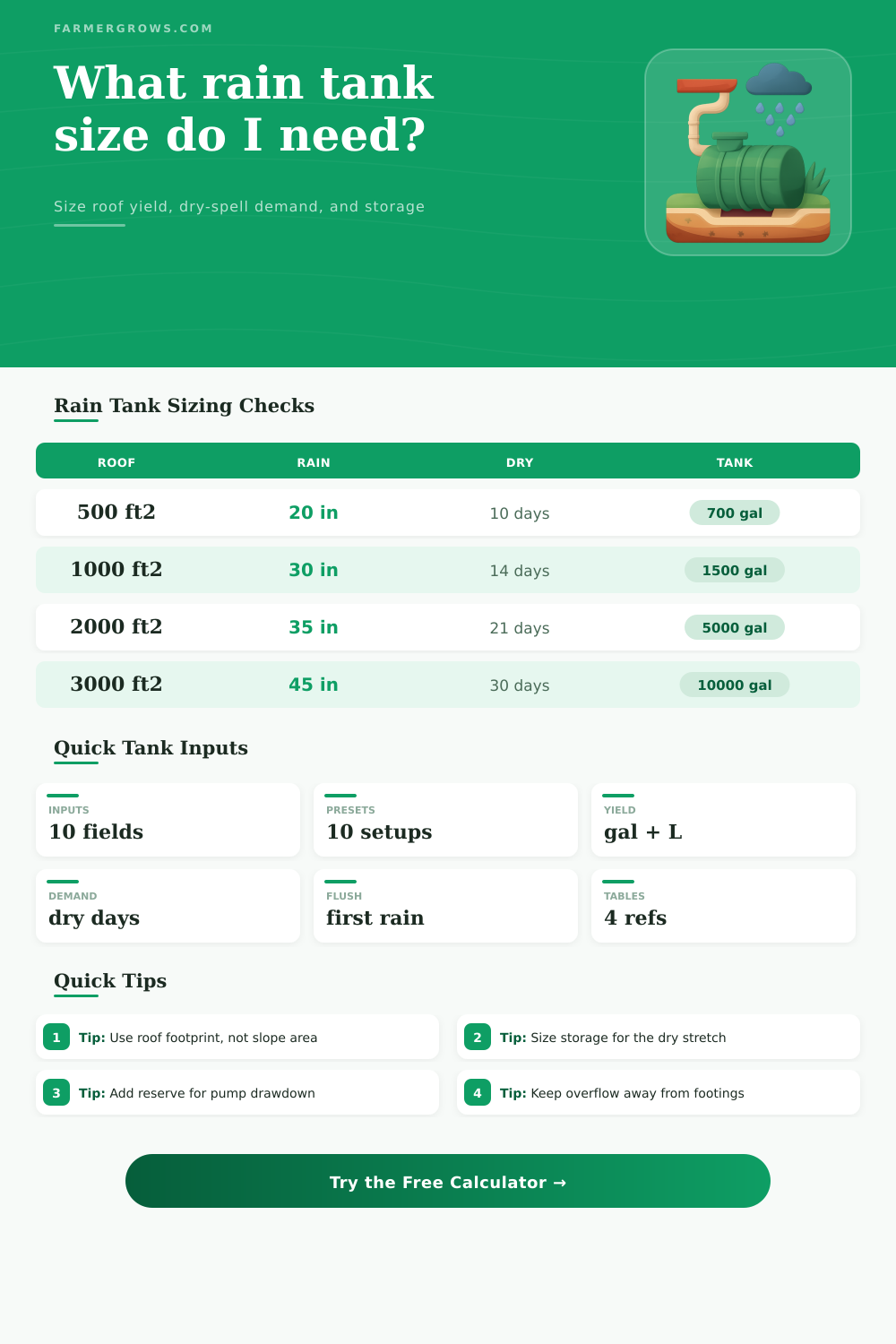
Rainwater Harvesting Tank Size Calculator
Estimate roof yield, dry-spell storage, first-flush diversion, and overflow capacity for farm sheds, barns, greenhouses, livestock wash areas, and garden irrigation tanks.
Use roof footprint area for catchment, not the sloped roof surface. The calculator applies the standard 0.623 gallon per square foot per inch of rain conversion, then adjusts for roof runoff and collection efficiency.
Rainwater Tank Sizing Results
The recommended size compares dry-spell demand with storm capture capacity, then adds reserve and rounds up to a practical tank volume.
| Catchment area | 1 inch rain at 100% | Metal roof at 90% collection | Asphalt roof at 90% collection | Metric equivalent |
|---|---|---|---|---|
| 250 sq ft | 156 gal | 133 gal | 119 gal | 592 L before losses |
| 500 sq ft | 312 gal | 266 gal | 238 gal | 1,179 L before losses |
| 1,000 sq ft | 623 gal | 533 gal | 477 gal | 2,358 L before losses |
| 2,000 sq ft | 1,246 gal | 1,065 gal | 953 gal | 4,717 L before losses |
| 4,000 sq ft | 2,492 gal | 2,131 gal | 1,906 gal | 9,434 L before losses |
| Use case | Typical daily demand | 10 dry days | 21 dry days | Sizing note |
|---|---|---|---|---|
| Starter trays and hand watering | 10 to 30 gal/day | 100 to 300 gal | 210 to 630 gal | Small tanks work if refills are frequent |
| Kitchen garden drip zone | 40 to 100 gal/day | 400 to 1,000 gal | 840 to 2,100 gal | Match storage to hot-week demand |
| High tunnel drip irrigation | 80 to 250 gal/day | 800 to 2,500 gal | 1,680 to 5,250 gal | Crop stage changes demand quickly |
| Nursery benches or starts | 150 to 500 gal/day | 1,500 to 5,000 gal | 3,150 to 10,500 gal | Use reserve for pump reliability |
| Washdown and utility water | 50 to 300 gal/day | 500 to 3,000 gal | 1,050 to 6,300 gal | Peak use may matter more than average |
| Dry spell length | Risk level | Best storage approach | Reserve guidance | Field note |
|---|---|---|---|---|
| 3 to 7 days | Low | Storm capture may control tank size | 0% to 10% | Good for roofs with frequent refill events |
| 8 to 14 days | Moderate | Balance dry demand and storm capture | 10% to 15% | Common for vegetable gardens and orchards |
| 15 to 30 days | High | Dry-spell demand usually controls size | 15% to 25% | Useful for high tunnel and nursery planning |
| 31 to 45 days | Very high | Use multiple tanks or backup supply | 20% to 30% | Confirm annual rain can refill the storage |
| Over 45 days | Seasonal | Seasonal cistern or alternate source | 25% to 35% | Tank volume alone may not solve shortage |
| Component | Common sizing rule | Calculator formula | Practical range | Why it matters |
|---|---|---|---|---|
| First flush diverter | Divert first dirty roof runoff | Area x flush depth x 0.623 | 0.02 to 0.05 inch | Reduces dust, pollen, and bird residue entering tank |
| Usable tank storage | Daily demand x dry days plus reserve | Demand x days x (1 + reserve) | 10% to 30% reserve | Leaves water below outlet and pump cycling margin |
| Storm capture volume | Hold target rain after first flush | Area x storm x runoff x efficiency - flush | 0.5 to 2.0 inch storm | Shows whether overflow starts during common storms |
| Overflow path | Move excess away from structures | Storm capture minus tank space | Match gutter flow | Prevents erosion, wet footings, and tank undermining |
| Seasonal yield check | Annual supply should exceed planned use | Annual yield / annual demand | 1.0 or higher is best | Warns when a larger tank still will not refill enough |
For roof yield: Measure the building footprint covered by gutters. Roof pitch does not increase rainfall falling on the site; the horizontal catchment area is what counts.
For overflow: Route the overflow to a stable drain, swale, or infiltration area that can accept a full storm after the tank is already topped off.
To perform rainwater harvesting, you must understand a relationship between the irregular timing of rainfall and the steady timing of water demand. Rainfall comes in irregular periods, yet water demand are steady. A rainwater harvesting tank act as a buffer between these two variable, and the size of the rainwater harvesting tank will determine how much water is available to you during dry period.
If the rainwater harvesting tank is too small to meet your demand during dry periods, you will experience a shortage of water within your system. However, if you correctly size the tank according to your area and water requirement, dry periods wont lead to a water shortage. To calculate amount of water that your tank should be able to hold, you must first calculate the area of the roof that will contribute to the rainwater that is collected.
How to Size a Rainwater Tank
The flat footprint of the building should be measured, not the area of the roof that slope into the building. You should multiply the flat footprint of the building by the amount of rainfall that occur in your area to calculate the gross yield of the roof. However, the material of the roof reduce the amount of water that can be collected.
Metal roofs will produce a higher yield than roofs with asphalt or green roofs, for instance; the asphalt or green roofs will reduce the amount of water that fall onto the roof and the tank later collects by a quarter or more. Any drop in the amount of water that is collected is a drop in the amount of water that humans can use later; thus, it is an important factor in calculating the system. Another factor to consider is the length of the dry periods between rainfall event.
Most rainwater harvesting tanks can manage short periods of drought, but dry periods of two or three week require a much larger tank. Additionally, some water should be maintained in the tank as a reserve. The reserve is a small percentage of water that is left in the tank below the outlet that distribute the water to areas outside of the tank.
Maintaining water in the tank as a reserve provide for dry periods that last for extended periods of time. Another factor to consider is the process of first-flush diversion. When water fall on the roof, the initial amount of water to fall on the roof may contain substance that make the collected water dirty.
These substances include dust, pollen, and other bit of residue that may fall on the roof. By diverting the first flush of water that falls on the roof, the remainder of the water that is collected will remain cleaner. By keeping the stored water within the tanks size cleaner, you reduce the chance of the water becoming dirty enough to clog the drip line that may distribute that water to other area.
Another factor is the difference between storm capture and dry spell demand. Storm capture is the idea of collecting as much rainwater from the rainfall events as possible. This require the rainwater harvesting tank to have enough headroom to capture all of the rainwater without overflowing from the tank.
Dry spell demand is the retention of enough water to last through dry periods. These two factor require different amounts of water to be captured, but each of these demand should be represented in the calculations for the size of the rainwater harvesting tank. Additionally, you must also make plans for how the water will overflow from the tank; you should route it away from the foundations of the building to avoid erosion that could undermine the tank over time.
One last factor to consider is the annual yield of the roof versus the seasonal demand of the individual who intend to use the harvested rainwater. The rainwater harvesting tank may be of a size that can last through dry periods, but if the roof does not produce enough water to refill the tank during the dry season, the rainwater harvesting system will dry up during the middle of the summer. Thus, it is important to ensure that the ratio of water supply (from the roof) to water use is properly calculated and understood.
Any imbalance in the ratio of supply and use will lead to the system drying up during certain month of the year. Many individuals make mistakes when calculating the amount of rainwater that should be harvested. Some of the most common mistake include harvesting from the wrong area of the roof, ignoring the material of the roof, or assuming that the amount of rainfall will be sufficient to refill the rainwater harvesting tank.
You can avoid these mistakes by referring to a reference table that indicates how the area of the roof, the material of the roof, and the amount of rainfall will affect the total amount of water that will be harvested. By understanding these variable, it is possible to better calculate the size of the rainwater harvesting tank that is required for the site. In addition to calculating the size of the rainwater harvesting tank, there are some benefit that will result from correctly sizing the tank.
For instance, the system will allow for the watering of seedlings during periods of hot weather without the water in the tank dropping to the outlet. Additionally, overflow will not result in the creation of mud at the base of the building. Thus, mathematical calculation are an essential part of transforming the concept of harvesting rainwater into a practical concept.