
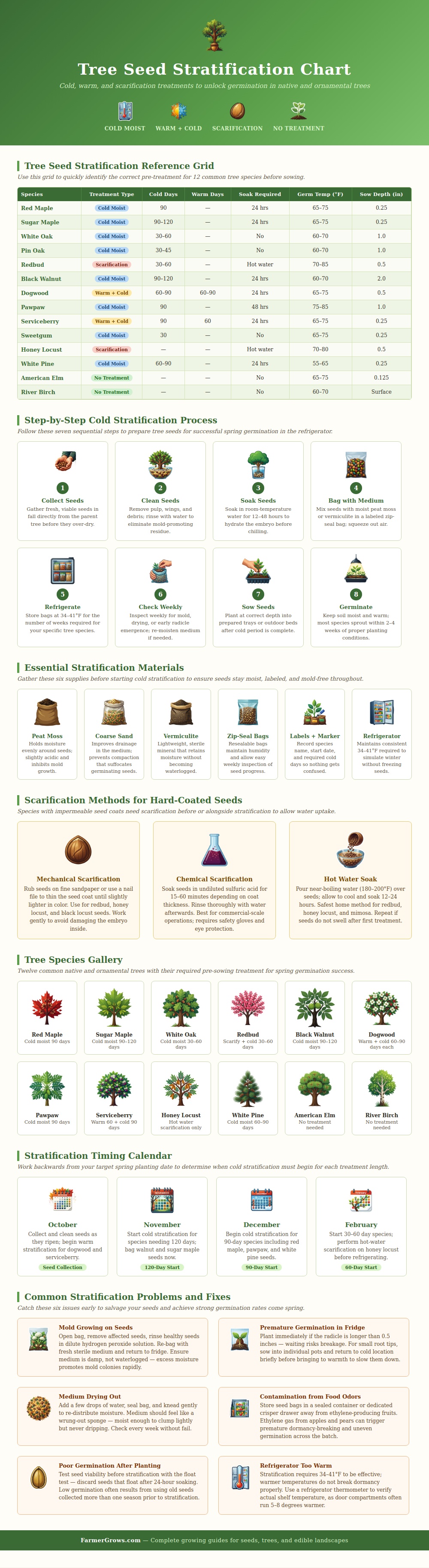
Growing trees from seeds require a process called stratification since the seeds of most tree species is dormant. Many tree species has evolved to remain dormant during the winter months. These tree species have developed a biological ability to remain in a dormant state until the seeds experience certain signal that indicate it is safe for the seeds to sprout.
For instance, if a person do not provide these signals to the seeds, the seeds will remain in the soil for many year without germinating. Therefore, stratification is a process in which a person mimics the winter conditions necessary to make the embryo that is within the seed to “wake up” and begin to grow. Stratification is important to assist in the germination of the tree species that utilize stratification because stratification allow for the germination of tree seeds to be a predictable process.
How to Make Tree Seeds Sprout
Instead of planting the seeds and waiting for them to sprout, a person can provide for each species of tree the treatment that is necessary to allow their seeds to germinate. Furthermore, such treatments allow for the sowing of those seeds according to the climate in which the growing individual live. As each species of tree requires different stratification treatment, a person can utilize a chart to determine the treatment required for each specific species.
Using such a chart allows for the individual to avoid the use of trial and error method to germinate the seeds. One of the most common forms of stratification is known as cold moist stratification. To perform cold moist stratification, the seeds must first be soaked in water to rehydrate the seeds.
After the seeds have been soaked, the seeds are mixed with damp peat moss or vermiculite. The person places the mixture of the seeds with the moist moss or vermiculite into a sealable plastic bag, and the bag is placed into a refrigerator for a specific number of weeks. The temperature within the refrigerator should be just above freezing and cold enough to simulate the leaf litter that often cover the ground within a forest, which retains moisture yet avoids hard freeze.
Many tree species that require cold moist stratification include maples, walnuts, and white pines. However, the length of time that the seeds require to stratify may vary with each species according to the adaptations of the trees to their regional winters. For instance, some species of oak trees may require a short period of stratification, while species like walnuts may require three or four month of stratification prior to germination.
Some species of trees may require a process called scarification prior to stratification. For instance, species like redbuds and honey locust trees has seed coats that are very dense, preventing the embryonic cells from being able to be hydrated even after the seeds have undergone stratification within a refrigerator for several months. In such instances, a person can perform scarification by either rubbing the seeds with sandpaper to thin the seed coats, or by soaking the seeds in water that is near-boiling temperature until the water cools.
After a person performs scarification, the seeds can be stratified according to the methods discussed above. Timing is critical in the stratification process. For instance, if an individual desire to have their seedlings emerge from the soil and begin to grow in the ground in April, then any seeds that require a period of ninety days of cold stratification should be placed into the refrigerator in early January.
If the species of tree requires a shorter period of stratification, it is possible to begin the process in February. Starting the stratification process too early may result in the germination of the seeds prior to being placed into the soil. Starting the process too late, however, will prevent the newly-emerged seedlings from experiencing the best period within the growing season.
Checking the bags on a weekly basis will allow for any mold to be detected early enough to treat. Additionally, adding water to the bags prevents desiccation of the embryos within the seeds, and any seeds that have tiny root tip can be transplanted into pots. The main materials for stratification include the stratification medium (peat moss and vermiculite), the containers for the seeds (zip bags), a refrigerator shelf or crisper drawer (to store the bags), and protection of the seeds from ethylene gas (which ripening fruit releases).
Finally, bags need to be labeled to ensure that each species of tree that is stratified in the bags is correctly recognized in the refrigerator. For instance, if there are many bags of seeds in various locations within the refrigerator, an individual should not have difficulty recognizing which bags contain the seeds that require thirty day of stratification (as opposed to the species that require ninety days of stratification). Common mistakes include adding too much water to the seeds prior to stratification (which can lead to mold), adding too little water to the seeds (which can lead to desiccation of the embryo within the seeds), using a refrigerator that is too warm to provide an effective stratification cycle for the seeds (which can lead to poor germination of the seeds), and failing to properly stratify the seeds prior to placing them into soil.
The viability of the seeds can be tested through the use of a float test prior to stratification. Seeds that are viable will sink when soaked in water, while hollow seeds will float and can be discarded prior to stratification. Success in stratification will allow for the emergence of a root that is thin and white.
Following emergence of the root, a pair of seed leaf will begin to grow from the sprouted seeds. Following stratification, the seeds need to be provided with moisture and protected from late frosts until they have matured into saplings. Thus, the result of stratification is the emergence of a tree from the seeds that was collected and stratified.