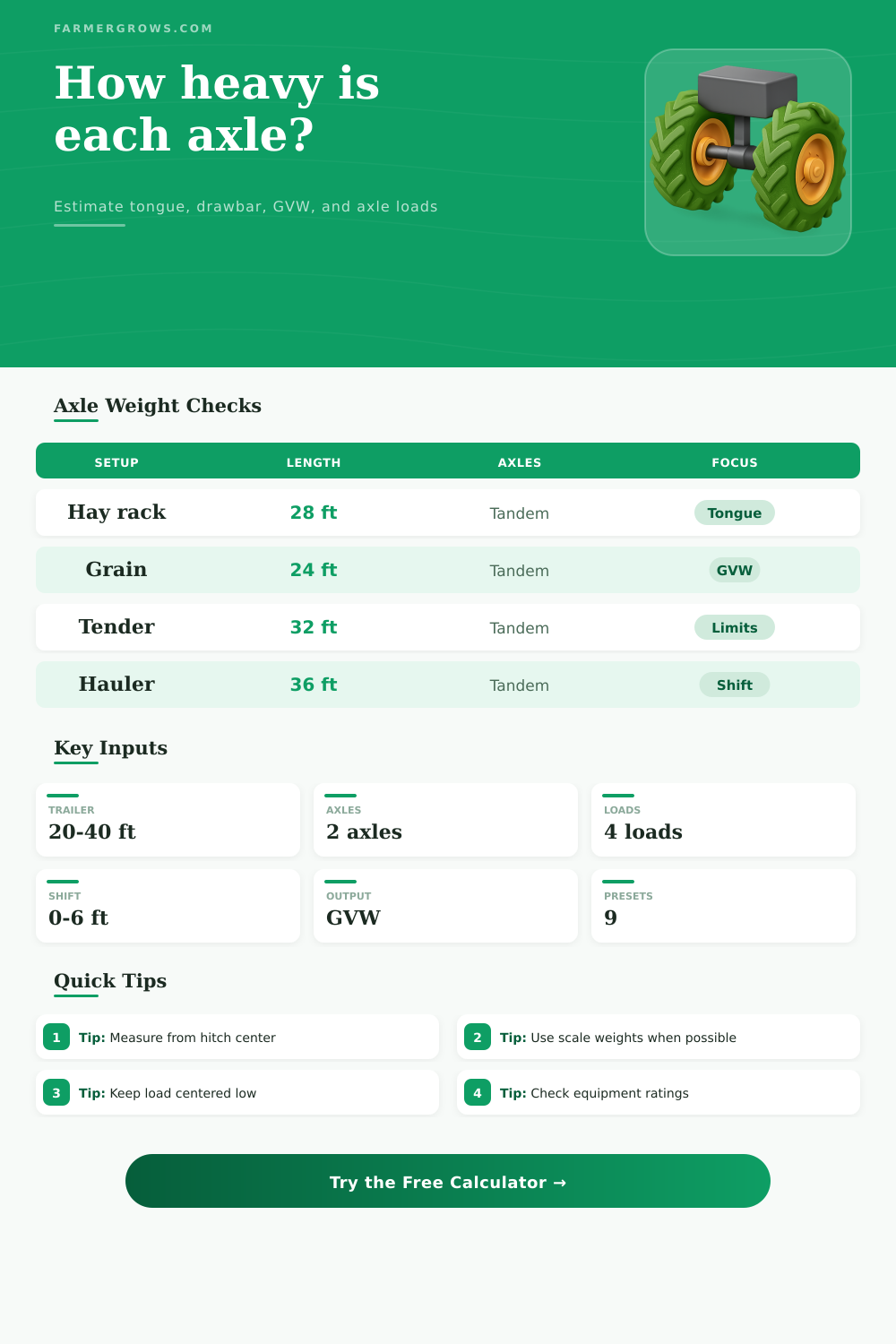
Tractor Trailer Axle Weight Calculator
Estimate trailer tongue weight, tractor drawbar load, tandem axle reactions, gross vehicle weight, reference limit usage, and the effect of shifting cargo forward or rearward.
This planning calculator treats the trailer as a beam from hitch to equalized tandem axle group. Enter measured distances from the hitch centerline, then compare calculated reactions with your own equipment ratings and posted reference limits.
Reference limits are screening inputs only. Check the actual tractor manual, trailer tag, tire sidewalls, drawbar rating, bridge posting, and route rules before moving equipment.
Axle Weight Results
Your axle weight estimate will appear here.
| Calculation | Formula used | What it means | Input notes |
|---|---|---|---|
| Total trailer weight | W = empty trailer + load weights | Weight carried by hitch plus trailer axles. | Include cargo, tanks, racks, and trailer body. |
| Moment about hitch | M = empty x CG + sum(load x position) | Rearward loads increase axle reaction and reduce tongue share. | Measure every position from the hitch centerline. |
| Trailer axle group | Rgroup = M / axle group center | Equalized tandem group reaction before front/rear split. | Axle group center is front axle plus half spacing. |
| Tongue weight | T = W - Rgroup | Vertical trailer load transferred to the tractor drawbar. | Manual tongue mode replaces calculated T with scale weight. |
| Tractor axle transfer | Rear gain = P x (WB + OH) / WB | Drawbar load adds rear axle weight and unloads front axle. | P is drawbar load, WB wheelbase, OH overhang. |
| Limit type | Calculator input | Compared result | Screening note |
|---|---|---|---|
| Single axle reference | Single axle limit | Each tractor and trailer axle | Useful for tire, axle, and route screening. |
| Tandem group reference | Tandem group limit | Front trailer axle + rear trailer axle | Spacing, bridge tables, and exemptions can change actual limits. |
| Drawbar / hitch rating | Drawbar rating | Calculated or entered vertical drawbar load | Use the lowest rating among hitch, pin, drawbar, and tongue. |
| Tractor GVW rating | Tractor GVW rating | Tractor front axle + tractor rear axle | Includes tongue transfer and extra vertical drawbar load. |
| Combined GVW reference | Combined GVW reference | Tractor, trailer, cargo, and added drawbar load | Use scale tickets when moving from field estimates to route planning. |
| Preset | Trailer length | Typical cargo pattern | Best check |
|---|---|---|---|
| Empty hay wagon check | 20 ft | Trailer only, centered empty CG | Confirms geometry and baseline tongue weight. |
| Small square bale rack | 28 ft | Three load zones across the rack | Shows tongue percent before stacking higher. |
| Gravity wagon grain | 24 ft | Bulk mass centered near the hopper | Checks tandem group usage and drawbar transfer. |
| Water nurse trailer | 32 ft | Tank load centered and dense | Useful for GVW and rear trailer axle comparison. |
| Equipment haul flatbed | 36 ft | One major machine plus attachments | Highlights load shift sensitivity. |
| Load move | Tongue effect | Trailer axle effect | When to test it |
|---|---|---|---|
| Shift cargo forward | Usually increases tongue and drawbar load. | Usually reduces trailer tandem reaction. | When trailer axles are close to a reference limit. |
| Shift cargo rearward | Usually reduces tongue and front tractor axle weight. | Usually increases trailer tandem reaction. | When drawbar or rear tractor axle load is high. |
| Move load between tandem axles | Small total tongue change if near group center. | Changes front/rear trailer axle split. | When tire sidewalls or axle tags differ by axle. |
| Keep heavy loads low | Weight math is unchanged by height. | Axle reactions stay similar, handling can change. | Use with operator judgment and manufacturer instructions. |
Measure load positions from the hitch centerline to the load center, not to the front edge of the pallet, bale row, tank, or machine.
After a field estimate looks close to a rating, confirm the tractor axles, trailer axles, and tongue with scale readings before travel.
In order to achieve a correct weight balance on a tractor and trailer rig, an operator must consider the effect that a correct weight balance has upon the handling of that trailer and the wear of the trailer’s tire. If the load of the trailer isnt balance correctly, the weight distribution of the trailer will change once the trailer begin to move. This change in weight distribution can lead to problems with the trailer’s tires, as well as with the compliance of the trailer with the weight requirement of weigh stations.
Beyond the total weight of the trailer and trailer contents, other considerations for weight distribution include how that total weight is distributed between the tractor’s front and rear axles, as well as the trailer’s tandem group of axles. The geometry of the trailer will have an impact upon the initial distribution of the weight of the trailer while it is empty of any cargo. Factors such as the distance from the trailers hitch to its front trailer axle, the distance between the two trailer axles, and the center of gravity of that empty trailer will impact how much of the trailer’s weight is contribute to the tongue weight of the trailer, and how much of the trailer’s weight is distributed to the trailer axles.
How to Balance a Tractor and Trailer
If a piece of cargo is placed on the trailer, the tongue weight will change, which will impact the load placed upon both the tractor’s rear and front axle. A driver can utilize a calculator to calculate these weights, which will save the driver the effort of performing the calculations in his or her head. In addition to the trailer’s tandem of axles, which is the group of axles on a trailer that often has the most number of wheel, a driver must also consider the weight that is distributed to the tractor’s axles.
The drawbar of the trailer creates a lever against the rear axle of the tractor, meaning that the load of the trailer impacts the load placed upon the tractor’s rear axle and front axle. As a result, the tractor’s front axle may experience a lighter load than expected from the weight of the trailer alone. Furthermore, each item of cargo placed upon the trailer contribute to the weight of the trailer that is placed upon the hitch.
Moving the cargo will impact the amount of weight placed upon the trailer’s tandem axles, as well as upon the tongue of the trailer. A calculator can be used to determine these shifts in the trailer’s weights. Beyond calculating the weights of the trailer’s axles, the driver must compare those calculated loads against the reference limits of the trailer and tractor.
These reference limits include the single axle rating, tandem group ratings, and equipment ratings for the tractor and trailer. The actual weights of the trailer may change from these specifications due to the ratings of the trailer’s tires, bridges, and roads. Additionally, the hitch also has a vertical load rating, which may be less than the ratings of the axles of either the tractor or trailer.
The weights of the empty trailer, as well as the center of gravity of the empty trailer, are two factors that the driver should consider. If the empty trailer has a center of gravity that is located towards the rear of the trailer, then that empty trailer will have a higher tongue weight. As a result, the addition of cargo to the trailer will increase that tongue weight of the trailer.
Each of these figure can be found by simply balancing the empty trailer on a single axle, or by utilizing a scale under the trailer’s hitch. Once this number is found, that same number can be used in determining the weights of any other trailer that are to be loaded with cargo. One of the main method of adjusting the weights of the trailer’s axles is to move the cargo that is within the trailer.
Moving the cargo forward will increase the tongue weight of the trailer, increase the load on the drawbar of the trailer, but decrease the load on the trailer’s tandem axles. Conversely, moving the cargo towards the rear of the trailer will decrease the tongue weight, decrease the load on the tractor’s rear axle, but increase the load on the trailer’s tandem axles. Moving the cargo can be used to make small adjustments in the weight of the trailer (in amounts of a few hundred lbs, for instance), but moving the cargo may not be enough to fix any problems created by a trailer that is overloaded with cargo.
The wheelbase of the tractor, as well as the drawbar overhang of the tractor, will impact the load placed upon each axle of the tractor. A tractor that has a short wheelbase will experience a greater transfer of weight from the tongue of the trailer to the tractor than a tractor whose wheels are more distant from one another. Thus, the same trailer may create different loadings upon different tractor and trailer rig.
Thus, each trailer should be checked against the specifications of its specific tractor model. When loading trailers, it is recommended that the driver make the first calculation of the weights to be distributed to each axle of the trailer prior to loading the trailer with any cargo. This initial calculation will allow the driver to plan the loading of the trailer to achieve the best weight distribution.
After performing the initial plan with a calculator, the driver can confirm the actual weights of the trailer with the use of a weighing scale. A calculator can be used to plan the weights, but the final confirmation of the actual weights must be made with the use of a scale.