🚜 Tractor Tire Pressure Calculator
Find the correct PSI for your tractor tires based on load, tire size, and operating conditions
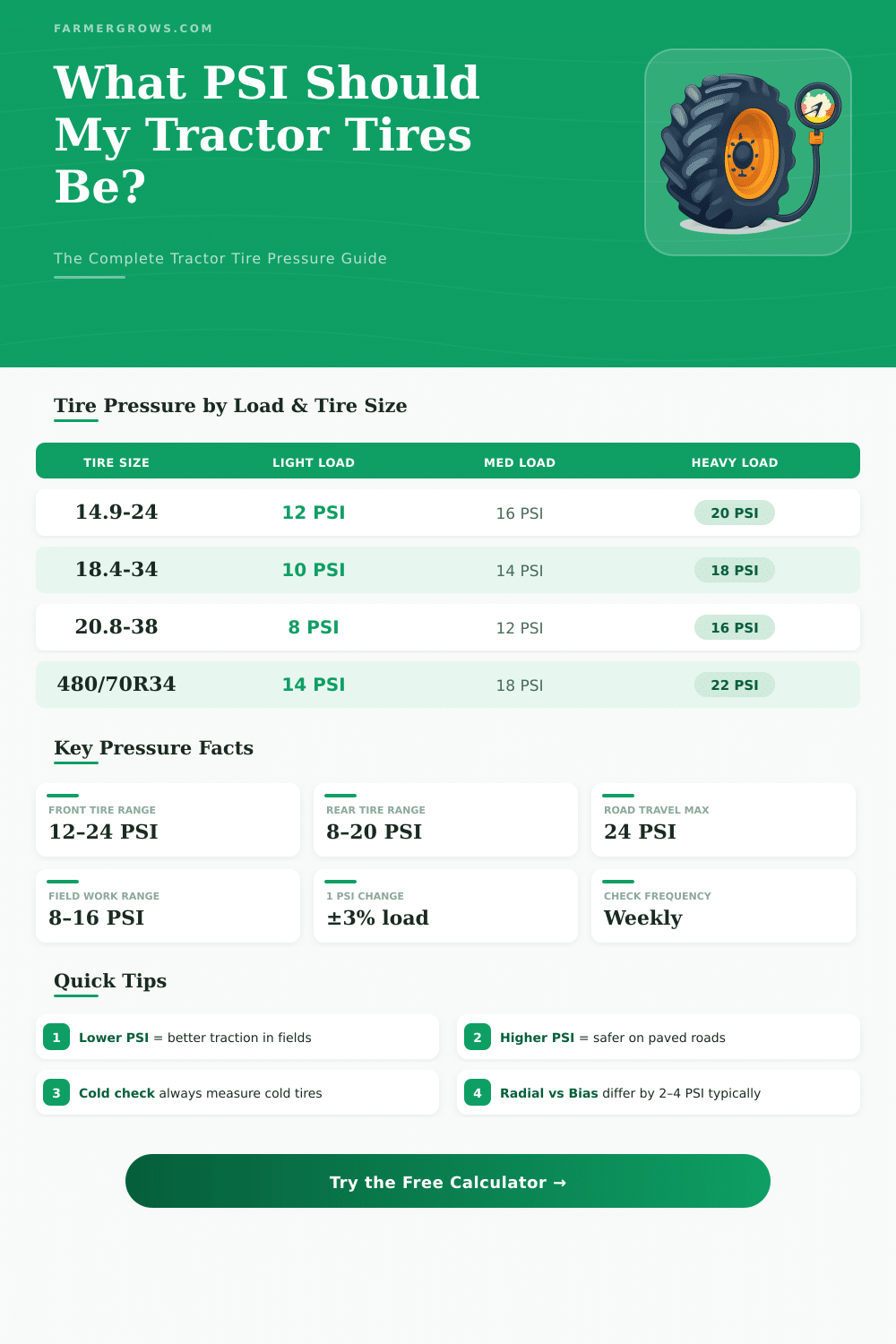
| Tire Size | Type | Light Load PSI | Med Load PSI | Heavy Load PSI | Max PSI |
|---|---|---|---|---|---|
| 14.9-24 | Bias Rear | 10 | 14 | 18 | 26 |
| 18.4-34 | Bias Rear | 10 | 14 | 18 | 24 |
| 18.4-38 | Bias Rear | 10 | 14 | 18 | 24 |
| 20.8-38 | Bias Rear | 8 | 12 | 16 | 22 |
| 480/70R34 | Radial Rear | 12 | 16 | 20 | 35 |
| 520/70R38 | Radial Rear | 10 | 14 | 18 | 32 |
| 620/70R42 | Radial Rear | 8 | 12 | 16 | 30 |
| 710/70R42 | Radial Rear | 6 | 10 | 14 | 28 |
| 11.2-24 | Bias Front | 16 | 20 | 24 | 32 |
| 12.4-28 | Bias Front | 14 | 18 | 22 | 30 |
| 380/70R24 | Radial Front | 16 | 20 | 24 | 36 |
| 420/70R28 | Radial Front | 14 | 18 | 22 | 34 |
| PSI | Bar | kPa | Typical Load Range (lbs) | Best Use |
|---|---|---|---|---|
| 6 | 0.41 | 41 | 2,000 – 3,500 | Soft/muddy field |
| 8 | 0.55 | 55 | 3,000 – 5,000 | Soft field traction |
| 10 | 0.69 | 69 | 4,000 – 7,000 | General field work |
| 12 | 0.83 | 83 | 5,000 – 9,000 | Firm field / light road |
| 14 | 0.97 | 97 | 6,500 – 11,000 | Mixed conditions |
| 16 | 1.10 | 110 | 8,000 – 13,500 | Road transport |
| 18 | 1.24 | 124 | 9,500 – 16,000 | Heavy road load |
| 20 | 1.38 | 138 | 11,000 – 18,000 | Max transport load |
| 24 | 1.65 | 165 | 13,000 – 22,000 | High-speed highway |
| Speed | Condition | Pressure Adjustment | Notes |
|---|---|---|---|
| Under 6 mph | Soft Field | Use base – 2 PSI | Max traction, min compaction |
| 6–10 mph | Firm Field | Use base PSI | Standard field pressure |
| 10–25 mph | Road/Gravel | Base + 2 to +4 PSI | Reduce sidewall flex |
| Over 25 mph | Highway | Base + 4 to +6 PSI | Check tire speed rating |
| Any speed | Mud / Wet | Base – 2 PSI | Increases footprint grip |
| Any speed | Dual Wheels | Base – 3 to –4 PSI | Load shared between tires |
| Tire Size | Width (mm) | Rim (in) | Typical Tractor HP | Field PSI | Road PSI |
|---|---|---|---|---|---|
| 14.9-24 | 378 | 24 | 40–60 HP | 10–14 | 18–22 |
| 18.4-34 | 467 | 34 | 60–90 HP | 10–14 | 16–20 |
| 18.4-38 | 467 | 38 | 70–100 HP | 10–14 | 16–20 |
| 20.8-38 | 528 | 38 | 90–120 HP | 8–12 | 14–18 |
| 480/70R34 | 480 | 34 | 80–110 HP | 10–16 | 18–24 |
| 520/70R38 | 520 | 38 | 100–140 HP | 8–14 | 16–22 |
| 620/70R42 | 620 | 42 | 130–175 HP | 6–12 | 14–20 |
| 710/70R42 | 710 | 42 | 160–250 HP | 6–10 | 12–18 |
The right pressure in tractor tires matters much more than many folks reckon. For field work you need low pressure to avoid compaction of the ground but on roads you require higher pressure for fuel savings and less wear. Tools like the Michelin Agropressure online calculator help: it finds the ideal pressure according to load, speed and usage for every case
For every axle of tractor tires the pressure changes according to circumstances, so there is no one solution for everything. Fill the air to the level that works for the most severe usage of every tire. That information you find in the books of the manufacturer.
Right Tire Pressure for Tractors
Here show the ranges for speed, pressure and load for every type. If tractor tires operate outside those limits, probelms soon will come.
When fuel prices rise and weather delays sowing, you should inflate radial tires to the lowest recommendation for the load that they bear before starting in the field; that improves output and fuel savings. In a test a tractor did 14 passes in 28 psi and other 14 in 12 psi above 7.2 acres. In 28 psi it consumed 1.6 gallons of fuel each acre.
16-row corn planters can add 10,000 until 15,000 pounds of weight to the rear axle. Hence for road drive the pressure commonly must reach 30… 35 psi.
In agricultural work you usually use around 15 psi, occasionally 20 psi on roads. More high, between 20 and 25 psi, are typical for work with loaders or forks.
If you commonly drive on roads with a tractor, add 0.4 bar to the table values to help protect the rubber against hard asphalt. In fields with a lot of traction reduce to 1 bar or less works well. Some modern tractors even go down until 0.75 bar for field work.
Too inflated tires reduce pull and increase compaction. Too deflated wear sides quickly. Using double or triple wheels you lower the weight on each tire, which allows lower pressure and less deep compaction.
The ideal is a lightly ballasted tractor with minimal pressure for security, long tire life and soil protection.
A gauge helps to control the pressure, because even 2 psi difference is 10 % of the recommendation. Ballasting balances the tractor and gives maximum pull. For tractors with front mechanical drive 40 % of weight front and 60 % back operate best.
If the weight does not work, you can add suitcase weights in front or wheel weights inback.