Topsoil Calculator
Estimate screened or unscreened topsoil for lawn topdressing, new turf, bed raising, low-spot repair, and grade correction with slope leveling, compaction, overage, bulk yards, tons, and bags.
Load a common lawn or bed scenario, then adjust the area, finished depth, grade correction, slope leveling, density, compaction, bag format, and overage.
Topsoil Results
Enter the area, depth, grade correction, and topsoil density to estimate the order.
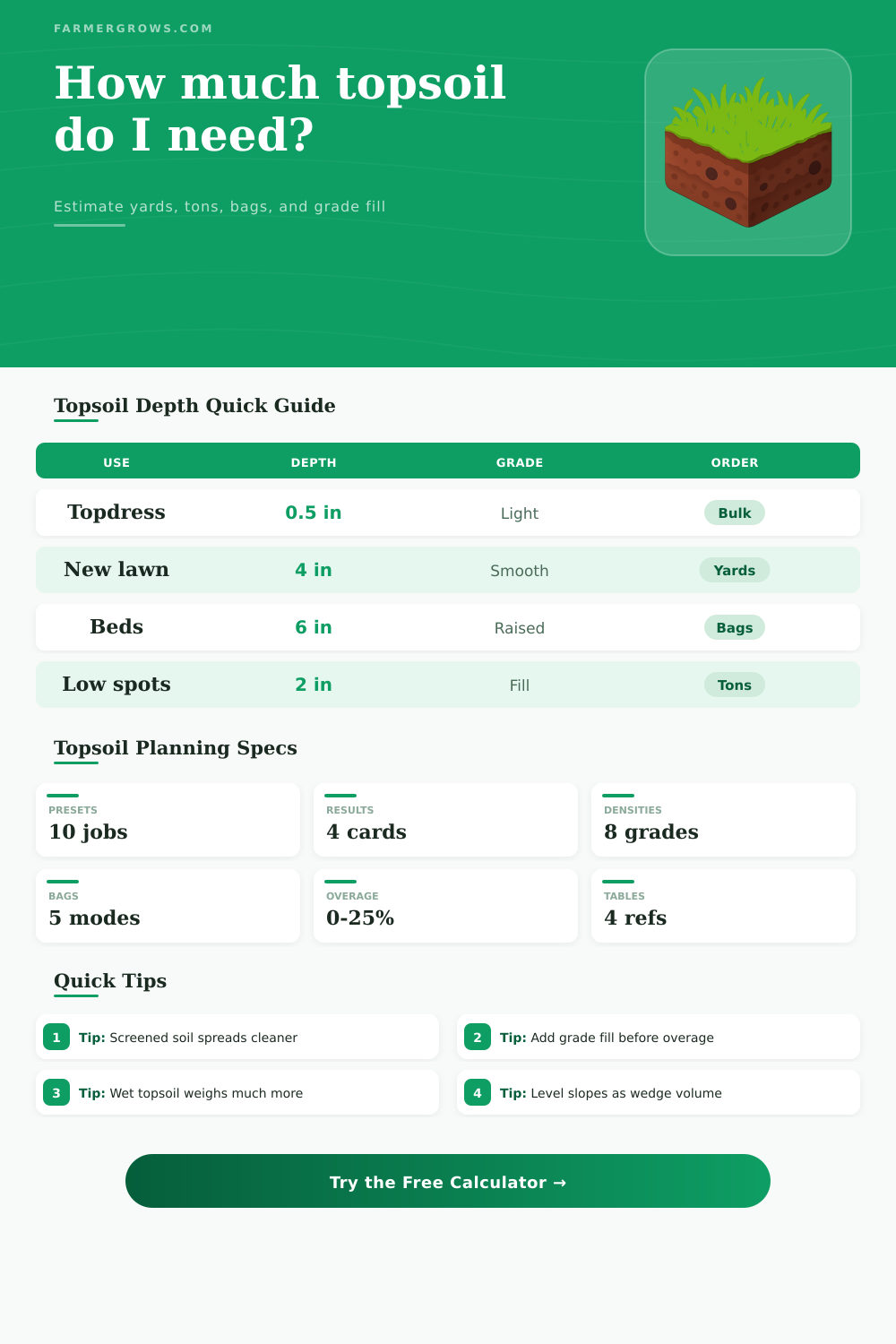
| Topsoil depth | Coverage per 1 cu yd | Metric coverage | Typical use |
|---|---|---|---|
| 0.5 inch | 648 sq ft | 60.2 sq m | Light lawn topdress over existing grass |
| 1 inch | 324 sq ft | 30.1 sq m | Thin refresh, overseeding, small leveling pass |
| 2 inches | 162 sq ft | 15.1 sq m | Low spot repair or renovation skim |
| 4 inches | 81 sq ft | 7.5 sq m | New lawn seed base over prepared subgrade |
| 6 inches | 54 sq ft | 5.0 sq m | Landscape bed top-up or deeper planting zone |
| Topsoil grade | Density used | Approx tons per yard | Best planning use |
|---|---|---|---|
| Screened lawn topsoil | 2,100 lb/cu yd | 1.05 tons | Seed beds, topdressing, lawn finish layer |
| Screened loam topsoil | 2,200 lb/cu yd | 1.10 tons | General beds and turf base with better texture |
| Unscreened field topsoil | 2,500 lb/cu yd | 1.25 tons | Rough shaping under a screened finish layer |
| Clay-heavy topsoil | 2,700 lb/cu yd | 1.35 tons | Heavier loads where compaction risk is higher |
| Wet unscreened topsoil | 2,900 lb/cu yd | 1.45 tons | Conservative hauling estimate after rain |
| Grade correction | What to enter | How it changes volume | Field note |
|---|---|---|---|
| Existing grade is low | Positive inches | Adds to target depth | Use an average low-spot depth, not the deepest hole only |
| Existing grade is high | Negative inches | Subtracts from target depth | Useful where soil already stands above edging |
| 1% slope over 20 ft | Run 20 ft, slope 1% | About 1.2 in average wedge if 100% covered | Wedge depth is half the total fall across the run |
| Half-area leveling | Coverage 50% | Uses half the wedge fill | Good for filling one side of a lawn panel |
| No slope leveling | Coverage 0% | Ignores wedge fill | Use when the topsoil layer follows the existing grade |
| Bag or bulk unit | Volume basis | Per cubic yard | Coverage at 2 in |
|---|---|---|---|
| 0.75 cu ft bag | 0.0278 cu yd | 36 bags | 4.5 sq ft per bag |
| 1 cu ft bag | 0.0370 cu yd | 27 bags | 6.0 sq ft per bag |
| 1.5 cu ft bag | 0.0556 cu yd | 18 bags | 9.0 sq ft per bag |
| 40 lb bag | Density based | About 53 bags at 2,100 lb/yd | Depends on moisture and grade |
| Bulk delivery | 1 cu yd | 1 loose yard | 162 sq ft before compaction allowance |
Measure the target layer, average low spots, and any slope wedge first. Then apply compaction and overage so the ordered loose volume matches the real finished grade.
Use screened topsoil for lawns and final raking. Use unscreened topsoil only where clods, roots, or stones will be buried below a cleaner surface layer.
Calculating the volumes of topsoil that will be needed for a project are a necessary task for any individual that begins to develop a lawn or gardens. Should a person order to little topsoil for the area to be covered, the grass will not take hold proper. Should a person order to many topsoil, however, the person will waste money on purchasing topsoil that is not require for the project, and will have to find a place to dispose of the excess topsoil.
The amount of topsoil that will be required to complete a project is depend upon various factor related to the site that will be treated with the topsoil. Three of the factors that a person must consider when calculating the amount of topsoil that is required include the area of the project, the depths that the topsoil will be applied to the ground, and the slope of the land. Area is one of the first factors that is required to be enter into the calculator that will calculate the volume of topsoil that will be required.
How Much Topsoil Do You Need
The area must be measured to ensure that the volume of the topsoil that is calculated for that project are accurate. While many people believes that any area that has the same square footage will require the same amount of topsoil to cover it, this is only true if that topsoil is to be spread even. The individual using the calculator must consider the shape of that area in the calculation.
For instance, an area that is in the form of a circular tree ring will have different measurements of area than if it is a rectangular garden bed. Depth is another of the critical factor in calculating the amount of topsoil that will be required for a project. Depth is often one of the factors that is incorrectly set for many individual.
For instance, setting a depth of only a half-inch of topdressing may cover a large area, but a depth of four inches are required for areas of new lawns may require a large amount of topsoil. The grade of the land must be taken into consideration for the depth that is applied to the land. If the grade of the land is low, more topsoil is required than if the area feature a high grade that is near an edging or path to the area.
Slope is another of the factor that must be considered when calculating the amount of topsoil that will be required for an area. Slope leveling is often required for create even ground. Even if the slope is small, a wedge of topsoil must be ordered for leveling that slope.
The calculator will average the amount of topsoil that is needed to fill in that wedge of topsoil to level the area. Another of the factor that must be considered is compaction and density of the topsoil. Topsoil that is screened is often less dense than topsoil that is take directly from the ground.
Screened topsoil tends to be lighter in weight. Additionally, areas that will receive sod will compact the soil more than areas that are to only be seed. In these cases, an overage of the amount of topsoil that is calculated may be required so that the extra topsoil can be ordered to account for any topsoil that may be compact during movement of the topsoil.
In many case, an overage of ten or fifteen percent of the calculated topsoil is often sufficient for these situation. Another of the factors is the decision of whether the individual will purchase bags of topsoil or bulk topsoil. The size of the project will determine these purchasing option.
For small projects, bags of topsoil may be the best choice due to the cost of delivery of bulk topsoil. Bulk topsoil may be a better idea for large project, however, and the calculator can calculate both the number of bags or bulk to determine which is the best purchase. The weight of the topsoil that will be use is another factor that should be consider for the individual.
Wet topsoil will weigh more than dry topsoil. Additionally, if the topsoil is screened rather than heavy loam, the screened soil will drain faster than heavy loam. Drainage is often critical for garden that will cultivating vegetables that are to be grown in full sun.
The purpose of calculating the amount of topsoil that will be required for a project is to ensure the individual measure the site as it actualy is. Rather than measuring the high spot in the land, the low spots should be measured. Additionally, rather than measuring the flat portion of the land, the slope of the land should be measured.
By measuring each of these factor, the calculator will provide the individual with the amount of topsoil that will be required for that project.