🌿 Squash Spacing Calculator
Calculate exactly how much space your squash plants need based on variety, growth habit, and garden method
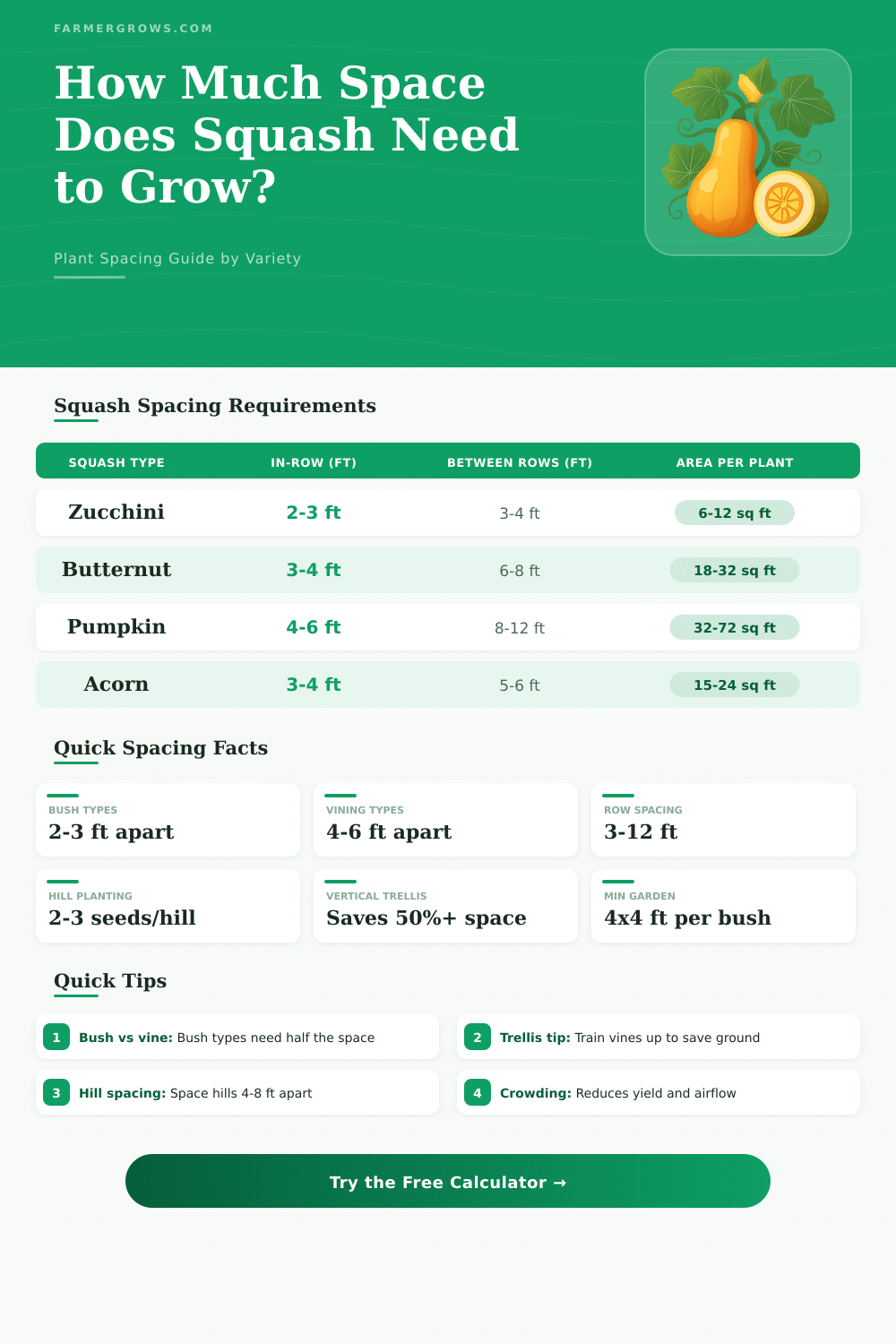
| Squash Type | Growth Habit | In-Row Spacing | Row Spacing | Area Per Plant |
|---|---|---|---|---|
| Zucchini | Bush | 2–3 ft (60–90 cm) | 3–4 ft (90–120 cm) | 6–12 ft² |
| Yellow Squash | Bush | 2–3 ft (60–90 cm) | 3–4 ft (90–120 cm) | 6–12 ft² |
| Pattypan | Bush | 2–3 ft (60–90 cm) | 3–4 ft (90–120 cm) | 6–12 ft² |
| Butternut | Vining | 3–4 ft (90–120 cm) | 6–8 ft (180–240 cm) | 18–32 ft² |
| Acorn | Semi-Vining | 3–4 ft (90–120 cm) | 5–6 ft (150–180 cm) | 15–24 ft² |
| Spaghetti | Vining | 3–4 ft (90–120 cm) | 6–8 ft (180–240 cm) | 18–32 ft² |
| Hubbard | Vining | 4–6 ft (120–180 cm) | 8–12 ft (240–360 cm) | 32–72 ft² |
| Pumpkin | Vining | 4–6 ft (120–180 cm) | 8–12 ft (240–360 cm) | 32–72 ft² |
| Delicata | Semi-Vining | 2–3 ft (60–90 cm) | 4–6 ft (120–180 cm) | 8–18 ft² |
| Method | Best For | Space Savings | Notes |
|---|---|---|---|
| Rows | All varieties | Standard | Traditional spacing, easy to maintain and harvest |
| Hills (Mounds) | Vining types | Standard | 2–3 seeds per hill, thin to strongest; improves drainage |
| Raised Bed | Bush types | 10–20% denser | Better soil allows slightly closer spacing |
| Vertical Trellis | Small vining types | 50–70% savings | Best for delicata, acorn, small spaghetti; not for heavy fruit |
| Container | Bush types only | 1 plant per pot | Minimum 5-gallon pot (24 in / 60 cm wide) |
| Garden Size | Bush Plants | Semi-Vine Plants | Vine Plants |
|---|---|---|---|
| 4 × 4 ft (1.2 × 1.2 m) | 2–4 | 1–2 | 1 |
| 4 × 8 ft (1.2 × 2.4 m) | 4–6 | 2–4 | 1–2 |
| 4 × 12 ft (1.2 × 3.7 m) | 6–8 | 4–6 | 2–3 |
| 10 × 10 ft (3 × 3 m) | 8–12 | 4–6 | 2–3 |
| 20 × 20 ft (6 × 6 m) | 20–30 | 12–18 | 6–10 |
| 50 × 50 ft (15 × 15 m) | 80–120 | 50–70 | 25–40 |
| Squash Type | Yield Per Plant | Days to Harvest | Vine Spread |
|---|---|---|---|
| Zucchini | 6–10 lbs (2.7–4.5 kg) | 45–55 days | 3–4 ft (0.9–1.2 m) |
| Yellow Squash | 5–8 lbs (2.3–3.6 kg) | 45–55 days | 3–4 ft (0.9–1.2 m) |
| Pattypan | 4–6 lbs (1.8–2.7 kg) | 50–60 days | 3–4 ft (0.9–1.2 m) |
| Butternut | 10–20 lbs (4.5–9 kg) | 85–100 days | 10–15 ft (3–4.6 m) |
| Acorn | 5–10 lbs (2.3–4.5 kg) | 80–100 days | 6–10 ft (1.8–3 m) |
| Spaghetti | 8–15 lbs (3.6–6.8 kg) | 90–100 days | 10–15 ft (3–4.6 m) |
| Hubbard | 15–40 lbs (6.8–18 kg) | 100–120 days | 12–18 ft (3.7–5.5 m) |
| Pumpkin | 10–30 lbs (4.5–13.6 kg) | 90–120 days | 12–20 ft (3.7–6 m) |
| Delicata | 5–8 lbs (2.3–3.6 kg) | 80–100 days | 6–8 ft (1.8–2.4 m) |
squash plants are big space-takers in the garden. When you sow summer squash like zucchini or yellow crookneck and care about the right conditions, it will spread itself over around 25 square feet, truly too much for one single plant. That happens because of the big leaves that unroll on long stems and extend quickly outward so they need a lot of ground to grow.
The spacing matters a lot for the health of squash. Summer types grow best planted 45 to 60 centimeters one from the other, while the rows themselves should be 90 to 120 centimeters apart. Some gardeners choose an easier way…
How to Plant and Space Squash Plants
Simply leave three feet between the plants, whether for summer or winter types. For the seeds, press them two centimeters deep in the ground. A good method that widely works is sowing three seeds each spot, then leaving the strongest plant after the sprouting.
When the space is limited, bush types of squash help a lot. They have shorter setms than their spreading relatives, so they fit in small areas without problems. One can even place them in square raised beds, though enough room stays along the edge so that they extend a bit.
Raised beds became popular because ground squash takes too much area instead.
Farming vertically saves a lot of space. Summer squash like zucchini grow well when led on poles or trellises, and the benefit is clear, better flow of air reduces the risk of mildew. Also the search four squash vine insect eggs becomes simpler.
Vertically led plants can rise above six feet and keep producing fruits during the whole season. The downside? They need work.
Attach the stems all six to ten inches during the growth as part of your daily routine. Around two or three such plants standing up take the space of one single spreading.
Winter squash follows totally different rules. The stems extend far because the growing lasts between 90 and 110 days. Those plants love heat and at least six to eight hours of direct sunshine daily.
Sow the seeds half an inch deep. They need either freedom to spread or solid support for vertical leading. Interesting fact, vertical farming of winter squash works well thanks to their vine nature, that works for arches and tall frames.
Arch nets; those metal loop structures of around four to sixteen feet, became a favorite option now.
Planting quickly growing vegetables between squash plants is a key trick. Lettuce, radishes and beetroots grow so fast that one can harvest them before the squash needs more space. After harvest of winter squash, store it in dry space between 50 and 55 degrees Fahrenheit.
Do not stack the fruits more than two layers high, ideally, place them alone on thesurface so that they do not touch.