Soybean Moisture Shrink Calculator
Estimate saleable soybean bushels and tons from wet bushels or scale weight, initial moisture, final storage target, 13% market base, foreign material, handling shrink, test weight, and dry matter.
This soybean shrink model removes foreign material first, preserves dry matter through moisture shrink, normalizes the clean crop to market basis, then applies handling shrink. Use the buyer's ticket rules when they differ.
Soybean shrink summary
Saleable bushels update from dry matter, 13% market base, dockage, handling shrink, and test weight inputs.
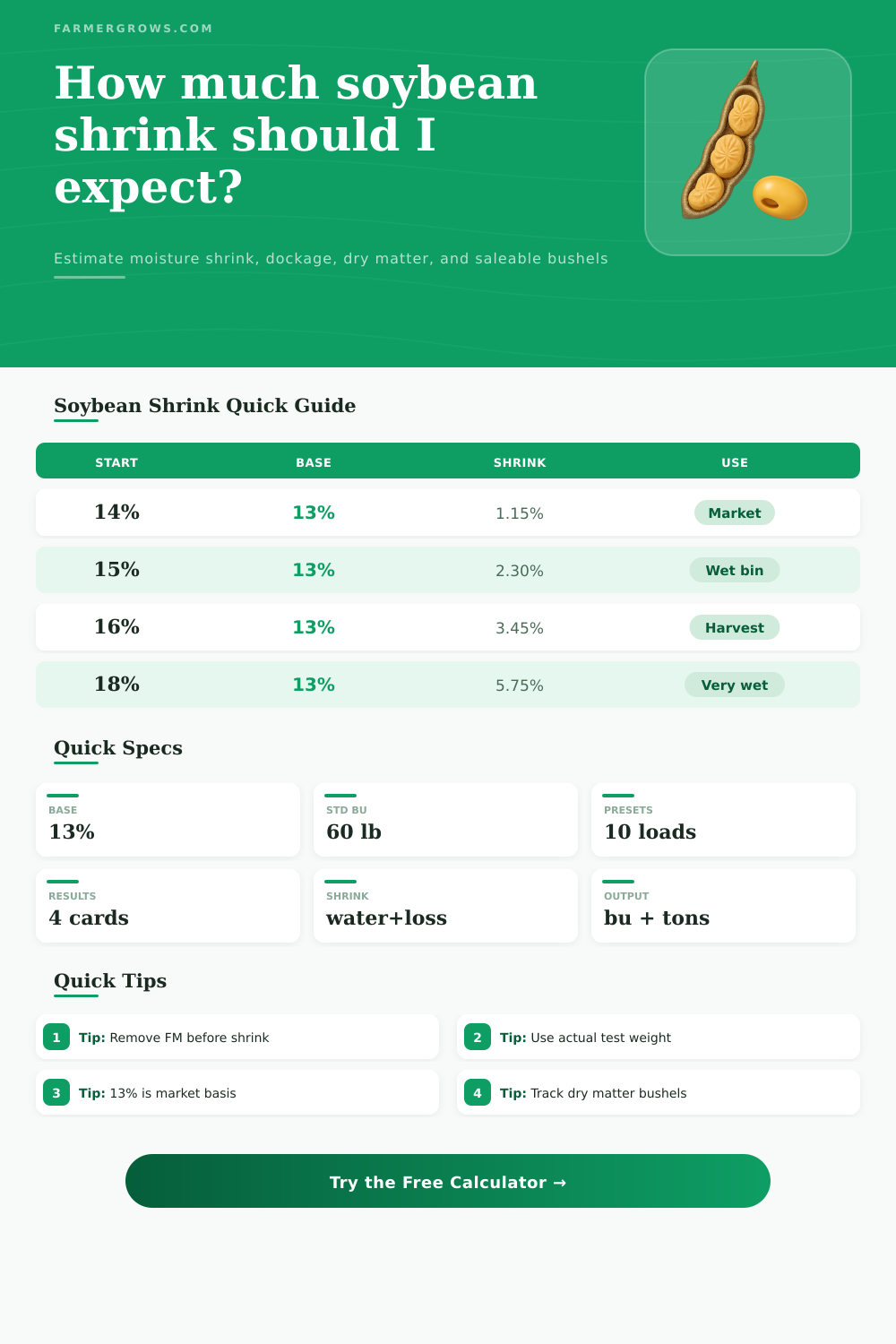
| Initial moisture | Water-only shrink | 60 lb wet bu becomes | Field note |
|---|---|---|---|
| 13.0% | 0.00% | 60.00 lb | Already at soybean market base |
| 14.0% | 1.15% | 59.31 lb | Light above-basis adjustment |
| 15.0% | 2.30% | 58.62 lb | Common early harvest soybeans |
| 16.0% | 3.45% | 57.93 lb | Drying or aeration likely needed |
| 18.0% | 5.75% | 56.55 lb | High-moisture harvest planning case |
| Moisture band | Typical use | Shrink focus | Storage caution |
|---|---|---|---|
| 11% to 12% | Very dry delivery or carryover | No water shrink to 13% in this model | Watch split beans and lost sale weight |
| 12.5% to 13.0% | Market-ready soybeans | Small or zero basis shrink | Good near-term delivery range |
| 13.5% to 14.5% | Short-term bin holding | Moderate water shrink | Aerate and monitor temperature |
| 15% to 16% | Early harvest or damp field edge | Water removal drives loss | Dry or move promptly |
| 17% plus | Wet harvest rescue load | Large shrink and handling risk | Confirm buyer or dryer limits |
| Input | Applied where | Example impact | Calculator treatment |
|---|---|---|---|
| Foreign material | Before dry matter calculation | 1% removes 600 lb from a 60,000 lb lot | Subtracted before moisture shrink |
| Handling shrink | After market-basis weight | 0.5% removes 5 bu from 1,000 basis bu | Extra shrink after 13% basis |
| Test weight | Wet bushel conversion | 58 lb/bu makes fewer pounds than 60 lb/bu | Used only to convert wet bushels to pounds |
| Standard weight | Final bushel conversion | Soybean standard is usually 60 lb/bu | Used for saleable basis bushels |
| Load profile | Starting point | Assumptions | Approx saleable result |
|---|
Settlement order matters: Keep foreign material separate from moisture shrink. Removing dockage before the water calculation gives a clearer dry-matter picture.
Dry beans are not free: Soybeans below 13% may avoid moisture shrink, but the missing water is also missing sale weight. Compare dry-matter bushels when timing harvest.
Soybean moisture shrink is teh reduction in the total weight of the soybeans as a result of the fact that soybeans contains water. The soybeans that are harvested contain some amount of water within the beans. As the soybeans are dried or stored, the water is removed from the soybeans, which leads to a reduction in the weight of the soybeans.
This reduction is referred to as soybean moisture shrink. This moisture shrink must be accounted for in the soybean transaction because the buyer will not pay for the weight of the water that are removed from the soybeans. If moisture shrink isnt accounted for, the total weight of the soybeans will be higher than the weight that the buyer will credit to the soybean grower.
What Is Soybean Moisture Shrink and How to Calculate It
Another type of reduction in the total weight of the soybeans is due to the presence of foreign material within the soybean load. Foreign material refers to any substance other than soybeans that are within the load of soybeans to be sold, such as sticks, dirt, or metal material. The buyer will remove the weight of the foreign material prior to calculating the moisture shrink of the soybean load.
Thus, foreign material will reduce the total weight of the soybeans prior to any subtraction for moisture shrink. Additionally, handling shrink will also reduce the total weight of soybean. Handling shrink is the weight of soybeans that is lost as the soybeans passes through the augers, the legs, or the aeration fans that is used to transport the soybean load from one location to another within the facility.
Another factor that can impact the total weight of the soybeans is the test weight of the soybeans. If the quantity of soybeans is entered into the soybean moisture shrink calculator in units of bushels rather than pounds, the test weight will impact the total weight of the soybeans that are sold. The higher the test weight of the soybeans, the more denser the soybeans are, and more pounds of soybeans will be present in each bushel of soybeans.
Conversely, the lower the test weight of the soybeans, the less pounds will be contained within each bushel of soybeans. Thus, test weight impacts the total weight of the soybeans that the grower calculates to be sold. The soybean moisture shrink calculator will help a soybean grower to understand each of these factor that contribute to the total weight of the soybeans that are sold.
Each calculator allows for the wet quantity, the test weight, and the moisture percentage of the soybeans to be entered. Based off these entries, the calculator will automatically calculate and subtract the weight of any foreign material that was sold, as well as the weight of the water that evaporated from the soybeans during drying and storage. Thus, the calculator will present a more clearer picture of the total soybean transaction than if the calculator did not include factors related to foreign material, moisture shrink, and handling shrink.
Many people make errors in calculating the total weight of there soybean crop by only considering the moisture percentage of the soybeans. Instead, the total weight that should of been considered in calculating moisture shrink includes variables related to foreign material and test weight. For instance, soybean loads that were harvested early in the season may contain high percentage of moisture and foreign material, while loads of soybeans that are harvested in the late season may have low percentages of moisture but a low test weight for the soybeans.
By using the soybean moisture shrink calculator, these differences in soybean loads can be considered, enabling the soybean grower to make decisions regarding when to deliver his soybeans to his buyers. Dry-matter bushels is a measurement of the total weight of the soybeans that grew in the crop field once the moisture and foreign material is removed from the soybeans. Dry-matter bushels will remain the same within a soybean growers field despite any change in the moisture content of that soybean field.
Soybean farmers should track dry-matter bushels because dry-matter bushels represent the true yield of each field of soybeans. By understanding dry-matter bushels and saleable bushels (which are calculated in the moisture shrink calculator), soybean farmers can more easy judge the performance of each field over time.