Soy Wax Candle Calculator
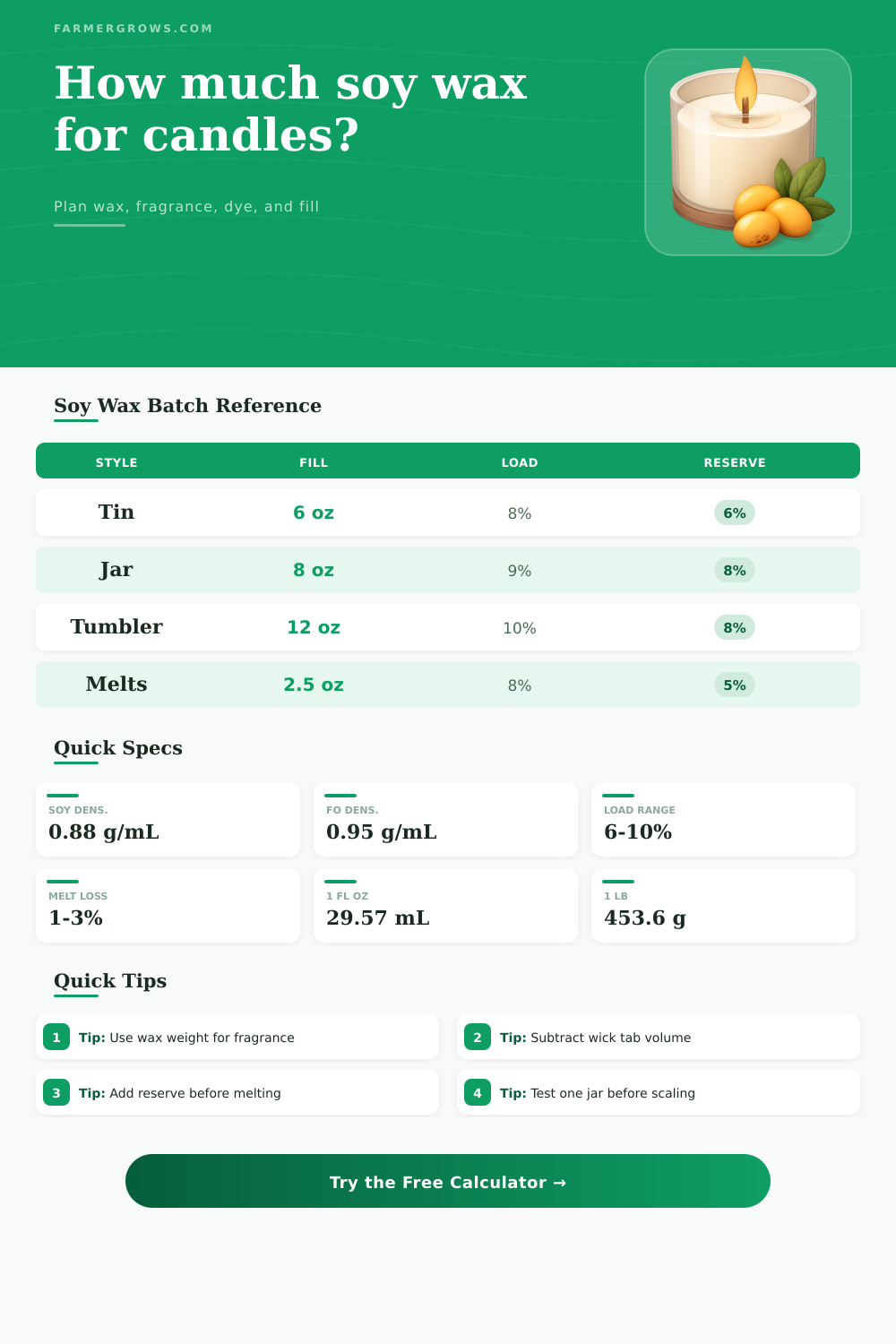
Size soy wax, fragrance oil, dye chips, fill volume, wick tab displacement, reserve, and process loss for container candles, tins, tea lights, and wax melts.
Choose a real batch style, then fine tune the vessel dimensions and formula settings for your exact container.
Formula Breakdown
| Soy wax format | Density used | Typical fragrance load | Planning note |
|---|---|---|---|
| GB 464 container soy | 0.88 g/mL | 6-10% of wax | Reliable for jars, tins, and tumblers |
| NatureWax C-3 | 0.89 g/mL | 6-10% of wax | Smooth container wax with strong adhesion |
| EcoSoya CB Advanced | 0.87 g/mL | 6-9% of wax | Use a test burn for high fragrance loads |
| Pillar soy blend | 0.91 g/mL | 5-8% of wax | Harder blend for freestanding shapes |
| Soy wax melt blend | 0.90 g/mL | 8-12% of wax | No wick, so fragrance limits may be higher |
| Container | Common net fill | Approx soy wax | Batch planning detail |
|---|---|---|---|
| 4 oz jelly jar | 3.2-3.6 fl oz | 2.8-3.2 oz wax | Leave room for lid liner and label tolerance |
| 6 oz travel tin | 4.5-5.0 fl oz | 4.0-4.4 oz wax | Wide tins need careful wick testing |
| 8 oz straight jar | 6.5-7.1 fl oz | 5.7-6.3 oz wax | Most labels call this an 8 oz jar by brim size |
| 12 oz tumbler | 9.5-10.5 fl oz | 8.3-9.3 oz wax | Often benefits from a slightly larger reserve |
| Tea light cup | 0.45-0.55 fl oz | 0.40-0.50 oz wax | Small batches lose more to pitcher coating |
| Conversion | Exact factor | Used for | Calculator application |
|---|---|---|---|
| Cubic inch to milliliter | 16.3871 mL | Jar geometry | Diameter and fill height volume |
| Fluid ounce to milliliter | 29.5735 mL | Container fill | Per candle net blend volume |
| Ounce to gram | 28.3495 g | Wax and fragrance | Ingredient weights and metric output |
| Pound to gram | 453.592 g | Dye rate | Dye chips per pound of soy wax |
| Cylinder volume | pi x r x r x h | Round vessels | Inside diameter and target fill height |
| Batch | Containers | Net blend target | Starting point |
|---|---|---|---|
| Market sample set | 12 x 4 oz jars | 42 fl oz | About 36-38 oz wax before reserve |
| Travel tin batch | 24 x 6 oz tins | 120 fl oz | About 105-110 oz wax before reserve |
| Straight jar case | 12 x 8 oz jars | 84 fl oz | About 74-78 oz wax before reserve |
| Large tumbler run | 8 x 12 oz tumblers | 80 fl oz | About 70-74 oz wax before reserve |
| Wax melt tray | 18 x clamshells | 45 fl oz | About 38-42 oz wax before reserve |
Jars
Best for repeatable cylinder math. Measure inner diameter and actual fill height after wick placement.
Tins
Short, wide fills often need more testing. Keep reserve slightly higher because surface area is broad.
Tea Lights
Very small fills make gram rounding important. Process loss can be a larger share of the batch.
Wax Melts
No wick tab displacement is needed. Fragrance load may be higher when your wax supplier supports it.
Making candles at home require people to use accurate measurements when gathering the materials for the candles. Inaccurate measurements will lead to wasted materials and candles that are not fully complete. Many people that attempt to make candles at home use guesswork to determine the amount of wax that is required to fill the containers.
Guessing the amount of wax that is needed can lead to problems in the finished candles, such as excess wax remaining in the melting pitcher or not having enough wax to fill each container with the required amount of wax. In order to successfully make candles at home, it is essential for an individual to have an understanding of the mathematics behind the candle-making process. The volume of space within the container determines the size of each container.
How to Measure Materials for Making Candles at Home
The label weight of the container dont necessarily account for the volume of the container. The container diameter and the height of the container determine the volume of the container. Additionally, it is important to account for the volume of the wick tabs and glue dots that are to be included within each container.
The volume of the container needs to account for this additional volume to ensure that the containers will be filled with wax to an apropriate height. Soy wax density is another critical measurement to take into account when making candles at home. The density of soy wax determine the relationship between the volume of the soy wax and the weight of the soy wax.
The densities of various types of soy wax are not the same, which indicates that the same volume of soy wax will have different weights. Therefore, it is critical to use the density value for the specific type of soy wax that is being used to determine the weight of the soy wax that will fill the containers. The percentage of fragrance oil (fragrance load) needs to be calculated as a percentage of the weight of the soy wax, not the total weight of the finished candle.
For instance, if an individual choose to use an eight percent fragrance load, the weight of the fragrance oil will be eight percent of the soy wax. The weight of the fragrance oil must be calculated as a percentage of the weight of the soy wax because the fragrance oil will add to the total weight of the finished candle. Additionally, using a calculator ensures that you can calculate the weight of the soy wax and the fragrance oil simultaneous so that there is no need to manually adjust the calculated amounts.
Another factor to account for is the amount of wax that will be lost during the candle making process, known as the reserve and the process loss. The reserve loss is the amount of wax that will remain in the melting pitcher, on the thermometer, or in the pitcher after the wax is poured into the containers. The process loss is the amount of wax that can be lost during the process due to spillage or skinning the wax.
Percentages for each of these losses should be added to the total calculated amount to ensure that the individual does not run out of wax before each container is filled. If the individual desires to use dye chips in the candles, the weight of the dye chips will need to be accounted for in the total weight of the candle materials. The individual will add the weight of the dye chips to the total weight of the candles if the individual decides to use dye chips.
If the individual does not use dye chips in the candles, the input for dye will remain at zero to ensure that the mathematics behind the candle making process is accurate. Some of the common mistakes made by individual candle makers is in the measurement of the materials. For instance, some individual candle makers may need to weigh the wax flakes, but the melted wax will have a different density than the wax flakes.
Additionally, the percentage of fragrance load is often calculated as a percentage of the total weight of the finished candle, not the weight of the soy wax. If these mistakes are made in the calculation process, it is possible that the fragrance load will be too high for the soy wax. The high fragrance load can lead to frosting of the candles.
The temperature at which the soy wax is poured into the containers can have an impact on the finished candles. If the soy wax is poured while too hot, sinkholes can form within the poured soy wax. Additionally, if the soy wax is poured while too cool, air bubbles can form within the soy wax.
These issues are not related to the calculated weight of the soy wax. It is recommended that the first candle of a batch of candles is made as a test candle. By pouring the first candle, allowing it to cure, and burning the candle, an individual can ensure that the calculated measurements will provide similar results to those that are calculated.
By knowing the accurate measurements of each ingredient in the candle making process, an individual is able to shop for those materials efficient. For instance, if the weight of the soy wax is calculated, it is possible to determine if five pound bags of soy wax should be purchased, or if soy wax in smaller amounts should be purchased. Additionally, if the weight of the fragrance oil is calculated, it is possible to purchase the correct amount of bottles of fragrance oil.
Knowing each of these ingredients and their weights ensure that supplies are not purchased in excess of what is necessary for each batch of candles to be created. The process of making candles at home relies upon the relationship between the volume of the container, the density of the soy wax, the percentage of fragrance oil, the reserve and process loss, and the weight of any dye chips. By understanding the relationship between these variables, an individual is able to create a process for making candles that can be repeatedly followed to ensure that each batch of candles has the same size and quality.