USDA Soil Texture Calculator
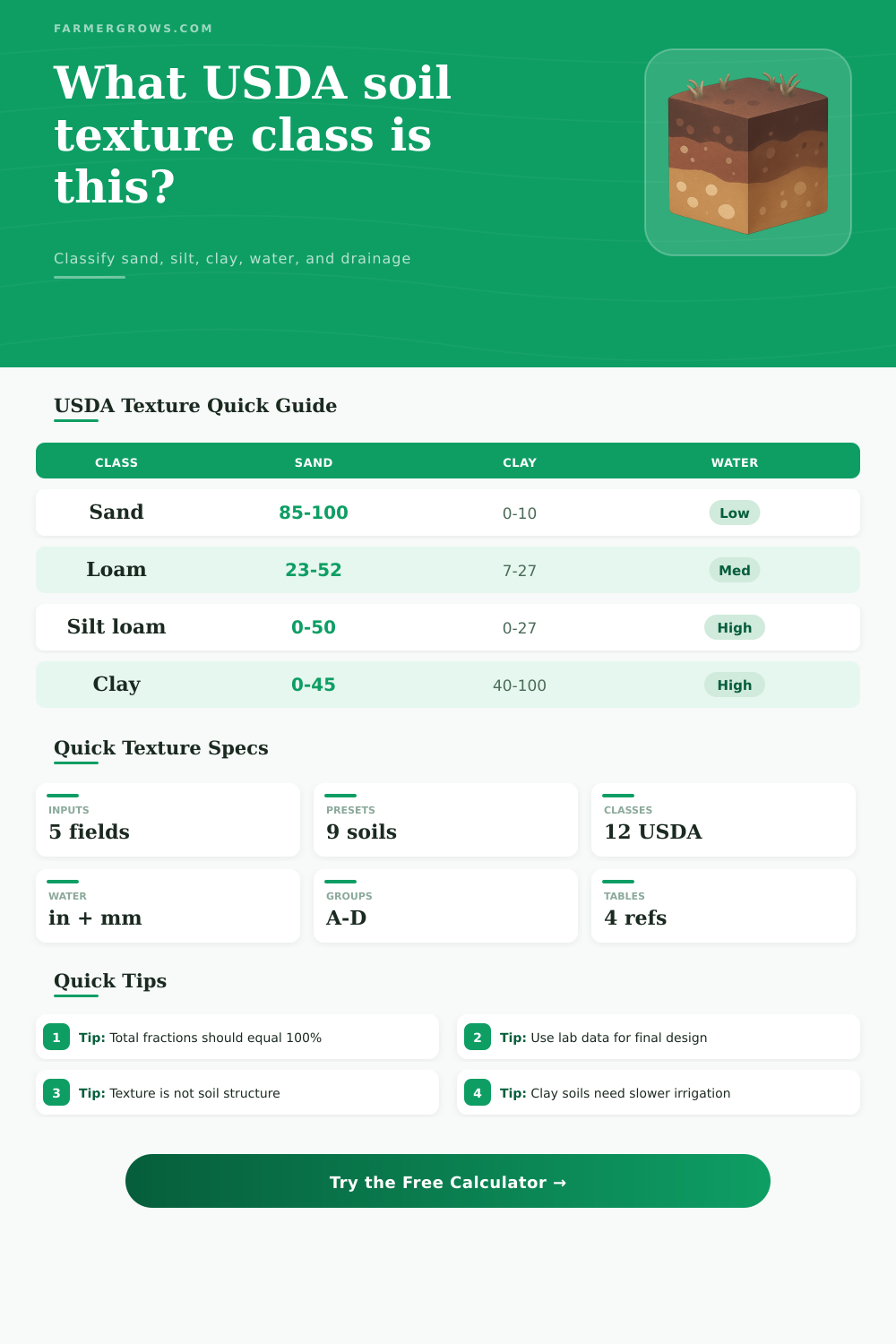
Enter sand, silt, and clay percentages to classify the USDA textural region, estimate hydraulic group, available water, drainage behavior, tillage timing, and crop irrigation notes.
Use lab particle-size data when available. This calculator uses USDA sand, silt, and clay fractions under 2 mm; organic matter, compaction, salinity, sodicity, gravel, and structure can change real field behavior.
Texture Classification Results
Results combine the USDA textural class decision tree with texture-based water and management estimates.
| USDA separate | Particle diameter | Field feel | Water behavior |
|---|---|---|---|
| Sand | 0.05 to 2.00 mm | Gritty, visible grains | Fast intake, low storage, low capillary rise |
| Silt | 0.002 to 0.05 mm | Smooth or floury when dry | High available water but prone to crusting |
| Clay | Less than 0.002 mm | Sticky and plastic when wet | Slow intake, high holding, stronger shrink-swell risk |
| Fine earth | Less than 2.00 mm | Texture fraction used here | Exclude gravel before using percentages |
| USDA class | Typical triangle region | Available water | Practical drainage note |
|---|---|---|---|
| Sand | Sand-dominant lower corner | 0.04 to 0.07 in/in | Very rapid drainage and low nutrient buffering |
| Loamy sand | Coarse lower-left band | 0.06 to 0.09 in/in | Rapid drainage with slightly better storage |
| Sandy loam | Sandy lower-middle band | 0.10 to 0.13 in/in | Moderately rapid drainage; irrigate in light sets |
| Loam | Central balanced region | 0.16 to 0.20 in/in | Moderate drainage and broad crop flexibility |
| Silt loam | Silty center-right band | 0.18 to 0.23 in/in | Good storage; protect surface from crusting |
| Clay loam | Fine central band | 0.16 to 0.20 in/in | Slow to moderate drainage; avoid wet compaction |
| Silty clay | Fine silty upper-right | 0.14 to 0.18 in/in | Slow intake; use longer, gentler watering cycles |
| Clay | High clay upper region | 0.13 to 0.18 in/in | Slow drainage, high runoff risk, narrow tillage window |
| Hydrologic group | Texture-only signal | Infiltration pattern | Runoff risk |
|---|---|---|---|
| Group A | Sand, loamy sand, coarse sandy loam | High infiltration when not compacted | Low, unless slope or crusting dominates |
| Group B | Loam, silt loam, silt, many sandy loams | Moderate infiltration and storage | Moderate under intense rain |
| Group C | Clay loams and finer sandy clay loams | Slow infiltration after wetting | Moderate to high on tilled slopes |
| Group D | Clay, sandy clay, silty clay | Very slow infiltration or perched wetness | High unless drainage and cover are strong |
| Texture family | Tillage guidance | Crop note | Irrigation note |
|---|---|---|---|
| Coarse sandy | Can be worked early, but dries fast | Good for roots and early vegetables with fertility support | Short, frequent sets reduce leaching |
| Medium loamy | Work near friable moisture, not sticky | Broadly suited to corn, soybean, pasture, vegetables | Moderate sets match storage and intake |
| Silty | Avoid pulverizing dry seedbeds that crust | Strong yield potential where erosion is controlled | Watch surface sealing during hard rain or sprinklers |
| Clayey | Delay tillage until soil crumbles, not smears | Deep-rooted crops need structure and drainage | Slow application avoids ponding and runoff |
Before changing irrigation: Compare the texture result with infiltration tests, crop rooting depth, slope, residue cover, compaction, and actual soil moisture readings.
Before tillage: Texture sets the tendency, but structure sets the day-to-day workability. A clay loam with good aggregation may behave better than a compacted loam.
Understanding soil texture are important to growing plants because understanding soil texture allow you to more better manage the water and soil for your plants. Soil texture determine how fast water will move through the soil, and soil texture determine how much water that soil can hold. Furthermore, soil texture will determine whether the plant in that soil will experience a lack of water or too much water.
For many individual, understanding soil texture is learned after drying field or seedbeds that dry out too quick. Soil texture will impact how often the fields is irrigated, when those field can be worked, and which plant will thrive in those field. Soil texture use sand, silt, and clay as its three main building blocks for soil; however, each of those component of soil behave differently from the others.
Soil Texture and How It Affects Plants
Sand allow for fast drainage of water due to the large particle of sand. Clay, on the other hand, hold water due to the tiny particle of clay that pack together to allow little room for air to be present in that soil. Silt is in the middle of sand and clay in texture and feel smooth when dry but may form a crust when wet.
The combination of sand, silt, and clay particle, not just the percentage of sand or clay particle that are within the soil sample, determine the behavior of soil. The tool provided to user will calculate the texture of soil sample based off these three soil component. After adding sand, silt, and clay percentage into the provided tool, user will recieve an output that indicates the soil sample fall into one of twelve different USDA soil class.
Each of those class is associate with different behavior for the soil. For instance, the tool will determine the hydraulic group for soil sample; the hydraulic group determine how readily water move through the soil. Another feature of the tool indicate the available water that can be present in the soil for the specified depth of the plants root.
Finally, the tool calculate the trigger depth for the soil; the trigger depth will allow farmer to determine at what rate crop will begin to experience stress from lack of water. Soil texture determine soil tillage and irrigation. Depending on soil texture, land may be able to be worked during different period of the year.
For instance, clay loam soil may only be able to be worked for a short period of time following period of rain. Additionally, different irrigation strategy must be used for soil that contain more clay or sand than others. Coarse soil will require short irrigation set to avoid leaching nutrient from the soil, while fine soil will require slower irrigation application rate so that the water land on the soil rather than running off the land.
These strategy are provide as a list within the tool. Fields may not contain the same percentage of sand, silt, and clay as entered into the tool. Other component of the field, like organic matter, compaction, slope, and tillage will impact water movement in the soil and how that soil behave.
For instance, a clay loam that incorporate cover crop may behave more like a loam. Alternatively, a sandy loam field that experience compaction may behave more like clay. While the tool can determine the texture of the soil, adjustment will need to be made based on the specific soil that you will manage.
While the tool will change from field to field in relation to soil component other than sand, silt, and clay, the tool and the knowledge of soil texture is still helpful for farmer and land manager. For instance, if soil sample indicate that a field contain silt loam soil, management practice must include preventing the soil from sealing after heavy rain. If soil sample indicate clay soil for a field, irrigation strategy will have to be establish to allow for long and gentle irrigation set for that land.
Additionally, the percentage of sand, silt, and clay will differ from field to field, but different soil type exhibit the general behavior of soil texture. Soil texture can be use as a baseline against which management practice can be establish for that soil; good soil management involve working with the tendency of soil texture rather than against them.