PVC Pipe Load Calculator
Estimate water weight, pipe weight, soil or live load, beam bending, span deflection, and support-spacing risk for Schedule 40 or Schedule 80 PVC pipe layouts.
This is a planning calculator, not a stamped structural design. It treats the pipe as a simply supported beam for exposed spans and adds a practical ring-load check for buried or loaded pipe.
PVC Pipe Load Estimate
Enter the pipe size, span, fill level, load, and temperature to see the support and deflection estimate.
The comparison cards recalculate nearby sizes using the same span, load, temperature, safety factor, and orientation.
| Nominal Size | OD | Sch 40 ID | Sch 80 ID | Best Use |
|---|---|---|---|---|
| 1/2 in | 0.840 in | 0.622 in | 0.546 in | Small emitters, conduit, short exposed runs |
| 3/4 in | 1.050 in | 0.824 in | 0.742 in | Bench irrigation and low-flow hose headers |
| 1 in | 1.315 in | 1.049 in | 0.957 in | Greenhouse mains and light washdown branches |
| 1-1/2 in | 1.900 in | 1.610 in | 1.500 in | Small farm transfer and gravity drain runs |
| 2 in | 2.375 in | 2.067 in | 1.939 in | Common irrigation mains and drainage headers |
| 3 in | 3.500 in | 3.068 in | 2.900 in | Buried laterals, culvert sleeves, and drains |
| 4 in | 4.500 in | 4.026 in | 3.826 in | Drainage, sleeves, and larger buried lines |
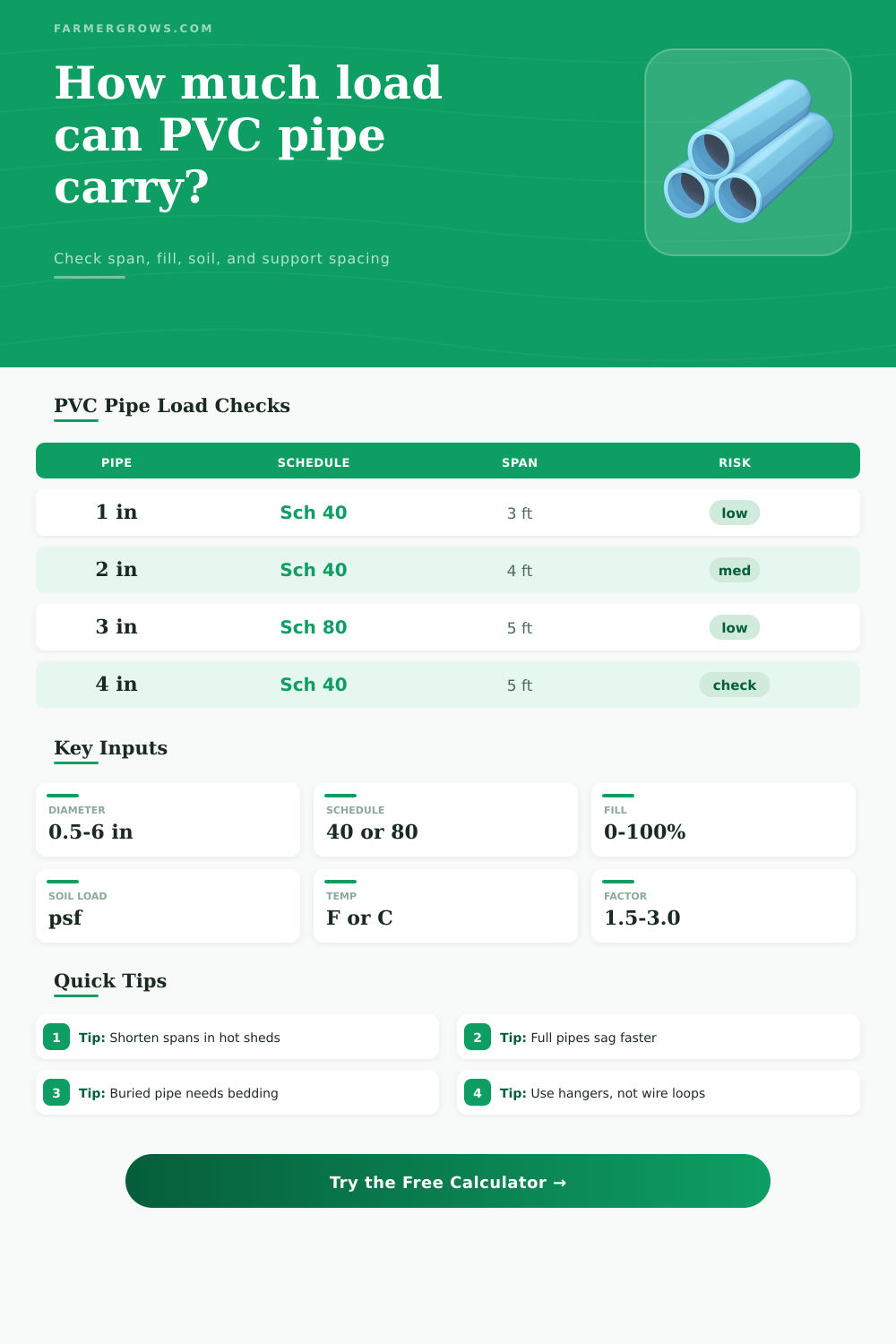
| Nominal Size | Typical Cool Spacing | Warm Area Spacing | Full Water Note | Field Check |
|---|---|---|---|---|
| 1/2 to 3/4 in | 3 ft | 2 ft | Use close hangers | Look for clamp dents |
| 1 to 1-1/4 in | 3.5 ft | 2.5 ft | Watch hot ceilings | Check sag after filling |
| 1-1/2 to 2 in | 4 ft | 3 ft | Support valves separately | Add saddles at tees |
| 3 in | 5 ft | 4 ft | Filled pipe is heavy | Use wide cradles |
| 4 to 6 in | 5 to 6 ft | 4 to 5 ft | Drain runs need grade | Confirm slope remains |
| Situation | Starting Load | Orientation | Calculator Entry | What To Watch |
|---|---|---|---|---|
| Open greenhouse pipe | 0 to 5 psf | Horizontal | Loaded width near OD | Thermal sag and hanger spacing |
| Pipe under seed trays | 10 to 25 psf | Horizontal | Tray width touching pipe | Point loads from racks |
| Buried garden lateral | 30 to 60 psf | Buried | Cover depth in inches | Soil bedding and rocks |
| Light vehicle crossing | 100 to 250 psf | Buried | Use live-load estimate | Shallow cover needs protection |
| Vertical riser | 0 psf beam load | Vertical | Use clamps by height | Brace against side impact |
| Pipe Temperature | Strength Factor | Stiffness Factor | Support Advice | Farm Example |
|---|---|---|---|---|
| 40 to 73°F | 1.00 | 1.00 | Standard spacing | Buried or cool barn line |
| 80 to 90°F | 0.88 | 0.82 | Shorten spans slightly | Warm greenhouse bench |
| 100 to 110°F | 0.72 | 0.62 | Add more hangers | Sunny hoop house roof |
| 120 to 130°F | 0.50 | 0.42 | Avoid long loaded spans | Hot attic or solar room |
For pressure piping, also check pressure rating, solvent-weld quality, thrust restraint, code requirements, and manufacturer support tables.
A PVC pipe load calculator is an tool that will help a person to determine if the PVC pipe will maintain its shape given the water that flow through the pipe and the effect that the environment will have upon the pipe. If the PVC pipe is hung within a greenhouse or buried beneath a driveway, for example, the weight of the water and the PVC pipe itself can cause the PVC pipe to sag. The weight of the water, the weight of the PVC pipe, the temperature of the environment in which the PVC pipe is located, and any external load that may act upon the PVC pipe act upon the PVC pipe at the same time.
As a result of these loads, the PVC pipe may sag in the middle of its span, which can lead to the leakages of the fittings that is connected to the PVC pipe. To use the PVC pipe load calculator, there are several different inputs that must be made. For instance, you must enter the diameter and the schedule of the PVC pipe into the load calculator; these two measurements will determine the wall thickness of the PVC pipe.
How to Use a PVC Pipe Load Calculator
The wall thickness will determine the amount of bending that the PVC pipe can allow before the stress upon the pipe becomes unsafe for that given length of pipe. The percentage of the PVC pipe that is filled with fluid must also be entered; the percentage will allow the load calculator to determine the weight of the water that is within the PVC pipe. Additionally, you must enter the type of fluid that will be within the pipe into the calculator; fluids of different densities will create different weights of the water within the pipe.
The temperature of the fluid within the pipe must also be entered; at higher temperatures, the PVC pipe will become less stiffly and less strong. Information regarding the external load upon the pipe and the depth at which the pipe is to be covered can also be entered into the calculator. Finally, the quality of the supports upon which the pipe will rest and the safety factor for the pipe must also be entered into the calculator.
The PVC pipe load calculator will provide several different outputs based off the information that is entered into the load calculator. For instance, the load calculator can determine the total beam load that the PVC pipe will experience. Additionally, the calculator can determine the working capacity of the PVC pipe.
The PVC pipe load calculator can also determine the deflection risk; this indicates whether the pipe will sag too much. Furthermore, the water weight that will act upon the PVC pipe can be determined. Finally, the comparison cards that are provided can help to compare the strengths of PVC pipes of different size.
Although the PVC pipe load calculator can provide an accurate indication of the strength of the PVC pipe under the conditions that are described within the calculator, it cannot account for every condition within the actual installation of that PVC pipe. For instance, the PVC pipe may have fittings along its length that will add to the weight of the PVC pipe at a single point. Other conditions, like the placement of a hanger at a joint along the length of the pipe will also add to the load of the pipe at a single point.
Additionally, the soil in which the PVC pipe is buried may settle over time, which may transform the load upon the pipe from being distributed evenly to a single point of pressure upon the pipe. Thus, while the PVC pipe load calculator cannot account for these factors, it is still a useful tool in recognizing the major variables that will impact the PVC pipe within its installation. One of the most critical factors to consider when using a PVC pipe load calculator is the impact that temperature can have upon the PVC pipe.
At higher temperatures, the PVC pipe will be less stiff. Thus, if the PVC pipe is to carry warm water as opposed to cool water, the PVC pipe will lose some of its stiffness. For these reasons, it is important for the load calculator to account for the temperature of the fluid that will be within the pipe.
Another critical factor is the type of support for the PVC pipe. For instance, a narrow clamp placed upon the pipe can dent the pipe, while a wide support will distribute the weight of the support upon the pipe such that the pipe isnt dented. In order to assist those who use the calculator, there are several reference tables that can be accessed within the calculator.
One set of tables provide the outside diameter of PVC pipes of different sizes; these dimension tables can help those who use the calculator to select the proper type of hangers that will support the PVC pipe. Another set of tables provides information regarding the spacing between supports for PVC pipes of different temperatures. A third set of tables provides examples of the external load that may act upon the PVC pipe; these examples can help to convert the external load into the correct load for the PVC pipe load calculator.
Finally, another set of tables provides the derating of the strength of the PVC pipe with different temperatures; these tables help to ensure that the PVC pipe will not break if the temperature of the water within the pipe rises to levels above 90 degrees. Mistakes may be made in planning a PVC pipe installation. For instance, one mistake may be to leave a valve that is connected to the PVC pipe unsupported; such an unsupported valve may place additional weight upon a single point of the PVC pipe.
Another mistake that may be made is to use wire loops as supports for the PVC pipe instead of saddles; the wire loops may cause the PVC pipe to crack at the point of support. To avoid such mistakes, the conditions of the installation of the PVC pipe can be entered into the PVC pipe load calculator. By entering those conditions, an individual will be able to ensure that the PVC pipe will not sag within its installation, and that the fittings upon the PVC pipes will not leak due to those sagging issues.
You should of checked the fittings too.