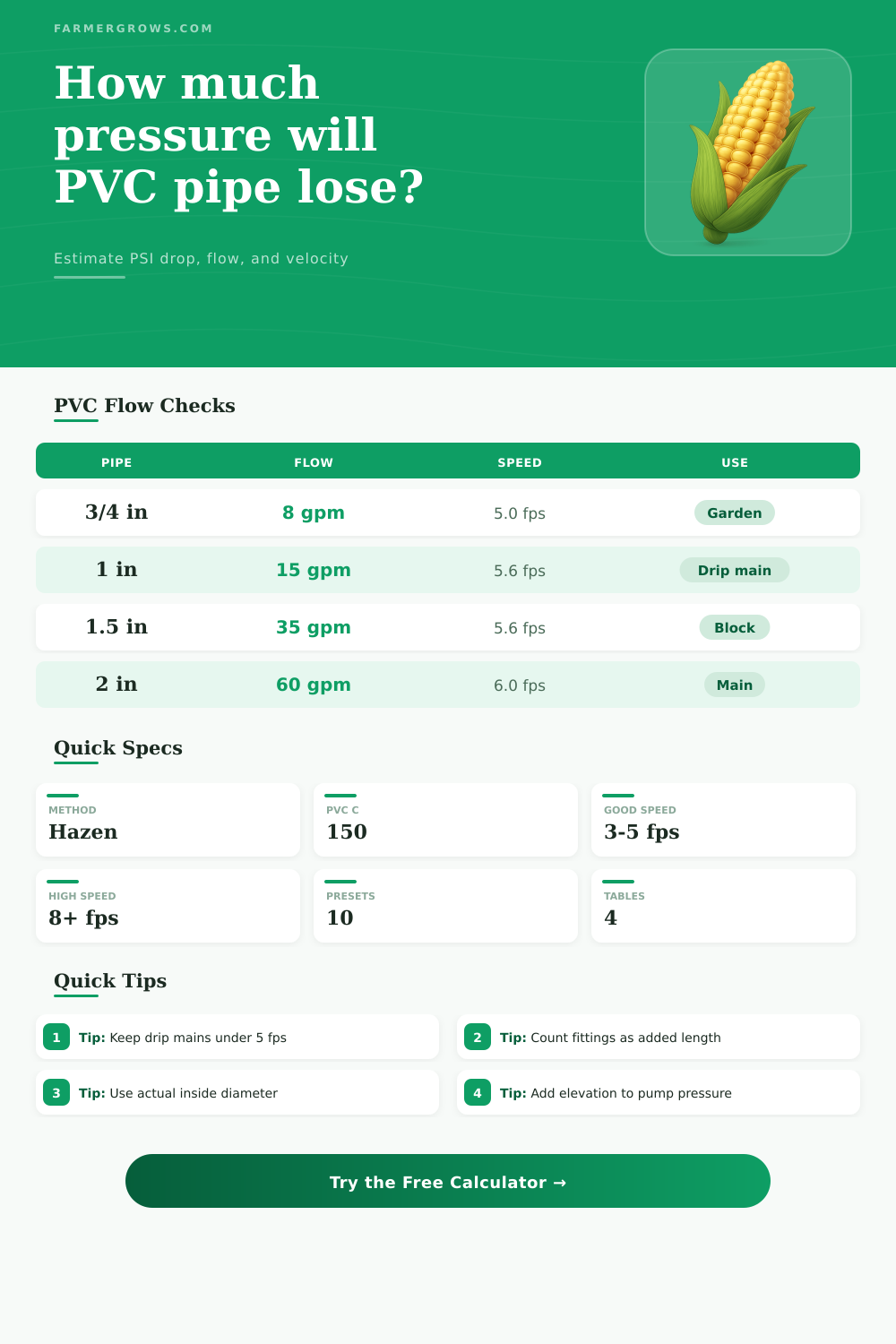
Friction Loss Calculator for PVC Pipe
Estimate Hazen-Williams pressure loss, water velocity, fitting allowance, elevation head, and required inlet pressure for PVC irrigation and farm water lines.
Use the nominal size and schedule to fill a typical inside diameter, then adjust actual ID if your pipe marking or manufacturer chart is different.
Friction Loss Results
The pressure loss includes straight pipe, equivalent fitting length, a small temperature adjustment, and elevation head.
| Nominal PVC | Schedule 40 ID | Schedule 80 ID | Class 200 ID |
|---|---|---|---|
| 1/2 inch | 0.622 in | 0.546 in | 0.632 in |
| 3/4 inch | 0.824 in | 0.742 in | 0.902 in |
| 1 inch | 1.049 in | 0.957 in | 1.189 in |
| 1-1/4 inch | 1.380 in | 1.278 in | 1.532 in |
| 1-1/2 inch | 1.610 in | 1.500 in | 1.754 in |
| 2 inch | 2.067 in | 1.939 in | 2.193 in |
| 3 inch | 3.068 in | 2.900 in | 3.230 in |
| 4 inch | 4.026 in | 3.826 in | 4.154 in |
| Fitting | Allowance Used | Why It Matters | Calculator Input |
|---|---|---|---|
| Standard 90-degree elbow | 30 pipe diameters | Turns water and adds turbulence. | 90-degree elbows |
| Tee through run or branch | 20 pipe diameters | Branch fittings disturb the main flow path. | Tee runs or branches |
| Open ball or gate valve | 3 pipe diameters | Small allowance when the valve is fully open. | Ball or gate valves |
| Check valve, filter, regulator | 100 pipe diameters | Internal parts can dominate short runs. | Check valves or filters |
| Velocity Range | Readout | Good Use | Watch Point |
|---|---|---|---|
| Under 3 ft/s | Gentle | Long mains, livestock water, pressure-sensitive drip. | Pipe may be larger than needed. |
| 3 to 5 ft/s | Preferred | Most farm irrigation mains and zone headers. | Usually a balanced design range. |
| 5 to 8 ft/s | Fast | Short seasonal runs where pressure is available. | Check water hammer and fittings. |
| Over 8 ft/s | High | Use only with careful design. | Upsize pipe or reduce flow if possible. |
| Condition | C Factor | Temperature Cue | Design Note |
|---|---|---|---|
| New clean PVC | 150 | Near 60°F baseline | Standard starting value for Hazen-Williams PVC checks. |
| Older clean PVC | 140 | Cool water adds a little drag | Useful when the line has years of service. |
| Dirty or mineralized line | 120 to 130 | Flush and retest if readings drift | Lower C increases calculated pressure loss. |
| Warm irrigation water | 145 to 150 | Above 80°F often flows slightly easier | Do not use warmth to justify excessive velocity. |
Use measured or manufacturer-listed inside diameter when possible. PVC schedule changes the flow area, and that changes friction loss quickly.
When the inlet pressure result is close to your pump or supply limit, upsize the longest pipe section before trimming pressure at the zone.
The friction loss that occurs in a PVC pipe is one of the factors that impact the pressure of an irrigation system. The friction loss in the PVC pipe will determine if the irrigation system’s water reach the emitters at the correct pressure. When the water passes through the PVC pipe, the water particles rub against the inside walls of the PVC pipe.
This rubbing of the water against the inside walls of the PVC pipe creates friction loss. Because the water that move through the PVC pipe encounters friction loss, that friction loss reduces the water pressure in the irrigation system. As a result, the pressure of the irrigation system’s water at the far end of the system will be less than the pressure at the pump.
What Causes Friction Loss in PVC Pipes
Flow rate is another variable that impact friction loss in PVC pipe. The flow rate for the irrigation system will determine the speed at which the water will move through the PVC pipe. High flow rates indicates that the water will move quickly through the PVC pipe, resulting in an increase in friction loss.
However, if the diameter of the PVC pipe is increased, there will be more surface area for the water to move through the pipe. Using a larger diameter for the PVC pipe will reduce the friction loss of the water moving through the pipe. For these reasons, increasing the diameter of the PVC pipe will reduce the friction loss within the irrigation system.
Another factor that will contribute to friction loss within the PVC pipe are the type of fittings that are used within the system. Each 90-degree elbow in the irrigation system will require the water to change the direction in which it moves. This change in the direction of the water will create turbulence within the system, which will lead to an increase in the friction loss of the water that moves through the PVC pipe.
Each type of fitting has an equivalent length of PVC pipe to which it contributes to the total length of the PVC pipe. To account for each fitting within the system, the equivalent length of each fitting should be added to the actual length of the PVC pipe. The total length of the PVC pipe should be used to calculate the total friction loss.
Another factor that will impact the irrigation system is the elevation of the pipes and how that change the available pressure within the system. The elevation of the irrigation system will change the pressure within the system due to the need of the pump to use some of the system’s energy to lift the water to the slope in which the irrigation system is installed. The elevation of the system should be distinguished from the friction loss of the system; each has a different impact upon the irrigation system.
The temperature of the water will impact the movement of the water through the PVC pipe. The higher the temperature of the water, the lower the viscosity of the water. Water with a lower viscosity will move more easy through the PVC pipe than water that has a higher viscosity.
Consequently, warmer water will encounter less friction loss than cold water. Additionally, the smoothness of the inside of the PVC pipe will also impact the friction loss within the system. New PVC pipe tends to have a smooth inside surface to the water, indicating a high Hazen-Williams C factor.
However, over time, the inside of the PVC pipe may acquire sediment that make it less smooth. This less smooth inside of the PVC pipe will increase the friction loss of the water that passes through the PVC pipe. The velocity of the water within the system will impact the operation of the irrigation system.
If the velocity of the water is too fast, the high velocity will lead to water hammer or erosion at the fittings of the irrigation system, which could lead to damage of the irrigation system. If the velocity of the water is too slow, the PVC pipe may be too large for the irrigation system. However, if the velocity of the water is somewhere in the middle, it will ensure that the water moves through the system steady without causing any damage.
Due to the various factors described above, the amount of friction loss within the irrigation system may change. Air pockets or blockages within the PVC pipe will create an increase in the friction loss of the water in the system. Additionally, if the PVC pipe is buried in the ground in an improper manner, the pipe may become oval in shape, which also leads to an increase in the friction loss of the water.
Because these factors will increase the friction loss of the water, the calculated friction loss should be considered only an estimate. If the available pressure to the system is similar to the calculated friction loss, an increased diameter of the PVC pipe should be used to provide a margin of safety within the system. By calculating the friction loss within the irrigation system prior to installing the PVC pipe, various design decisions can be made for the irrigation system.
For instance, using a larger PVC pipe will cost more money than using a small diameter pipe. However, using a larger diameter PVC pipe will allow for the use of a smaller pump. Additionally, counting each fitting allows for an estimation of how much pressure is required to reach each emitter.
Finally, adjusting for the elevation and temperature of the water within the system will ensure that the irrigation system will function correctly according to the condition in which it will be installed. By considering each of these factors, the designer can ensure that the various component of the irrigation system are sized accordingly to allow for an efficient movement of water from the pump to each emitter.