Propane Tank Usage Calculator
Estimate how long a propane tank will run farm heaters, brooders, dryers, generators, water heaters, and other burners while keeping a practical reserve.
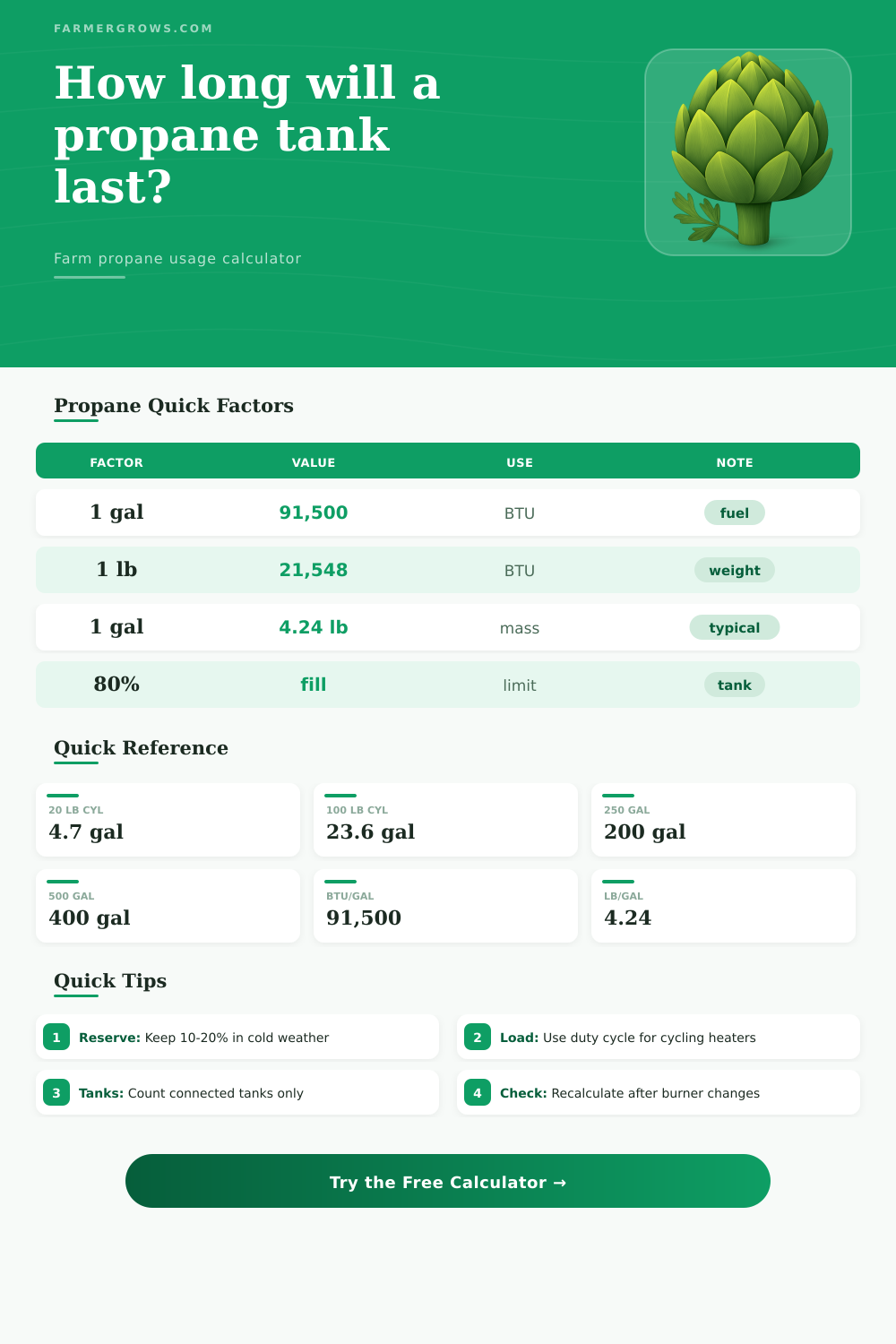
| Propane Factor | Value | Metric Equivalent | Planning Use |
|---|---|---|---|
| Energy per gallon | 91,500 BTU | 26.82 kWh | Fuel-to-heat conversion |
| Energy per pound | 21,548 BTU | 6.32 kWh | Cylinder weight estimates |
| Liquid propane density | 4.24 lb/gal | 0.51 kg/L | Weight and refill checks |
| Standard tank fill limit | 80% of water capacity | Same fill rule | Safe expansion room |
| Usage formula | BTU/hr ÷ 91,500 | kW ÷ 7.86 | Gallons per hour |
| Tank or Cylinder | Common Propane Capacity | Approx Full Weight | 80% Fill Note |
|---|---|---|---|
| 20 lb grill cylinder | 4.7 gal | 37 lb with tare | Already rated by propane weight |
| 40 lb cylinder | 9.4 gal | 72 lb with tare | Portable farm heat backup |
| 100 lb cylinder | 23.6 gal | 170 lb with tare | Small brooders and shops |
| 120 gal tank | 96 gal at 80% | About 407 lb propane | Common outbuilding tank |
| 250 gal tank | 200 gal at 80% | About 848 lb propane | Greenhouse or shop use |
| 500 gal tank | 400 gal at 80% | About 1,696 lb propane | Farmstead and dryer support |
| 1000 gal tank | 800 gal at 80% | About 3,392 lb propane | High demand seasonal loads |
| Farm Appliance | Typical Input | Gallons Per Hour | Best Duty Cycle Entry |
|---|---|---|---|
| Small chick brooder | 20,000 to 40,000 BTU/hr | 0.22 to 0.44 | 50% to 100% |
| Greenhouse unit heater | 60,000 to 150,000 BTU/hr | 0.66 to 1.64 | 30% to 75% |
| Radiant shop heater | 75,000 to 175,000 BTU/hr | 0.82 to 1.91 | 40% to 80% |
| Tank water heater | 30,000 to 60,000 BTU/hr | 0.33 to 0.66 | 10% to 35% |
| Standby generator | 110,000 to 260,000 BTU/hr | 1.20 to 2.84 | 60% to 100% |
| Crop dryer burner | 500,000 to 1,500,000 BTU/hr | 5.46 to 16.39 | 80% to 100% |
| Usable Propane | 50,000 BTU/hr | 100,000 BTU/hr | 250,000 BTU/hr |
|---|---|---|---|
| 4.7 gal cylinder | 8.6 hr | 4.3 hr | 1.7 hr |
| 23.6 gal cylinder | 43.2 hr | 21.6 hr | 8.6 hr |
| 100 gal usable | 183 hr | 91.5 hr | 36.6 hr |
| 200 gal usable | 366 hr | 183 hr | 73.2 hr |
| 400 gal usable | 732 hr | 366 hr | 146 hr |
| 800 gal usable | 1,464 hr | 732 hr | 293 hr |
Runtime table assumes continuous burner input and fuel already available in the tank. Enter duty cycle and daily hours above for a better farm schedule estimate.
Managing a farm has many different component, but one component that must be manage is the propane that is used to power the farm. The length of time that a propane tank will last is dependent upon several factors, such as the size of the burner, the capacity of the propane tank, the schedule of the appliance on the farm each day, and how much propane should be left in the tank in reserve. Using the propane calculator will help to determine the length of time that the propane tank will last.
The variables that must be entered into the calculator to determine the length of time that the propane tank will last include the size of the burner, the capacity of the propane tank, the schedule of the appliances on the farm, and the amount of propane that should be left in reserve. The capacity of the propane tank should not be the water capacity of the tank because propane tanks is filled to only 80% of the tanks capacity. The current amount of propane in the tank and the percentage of the propane tank that is to remain in reserve will determine how many gallon of usable propane can be found in the tank for the farms equipment.
How Long Will Your Farm Propane Tank Last
The rating of the burner and the number of unit of burners will determine the rate at which the farm uses propane. The rating of the burner will determine the amount of heat that the burner emits. The number of units of burners will determine how many burners are running at the same time.
However, the rating of the burner do not determine how many hours of the day that the burner is to be running. The user must enter the duty cycle of the burner into the calculator so that the propane estimate that is calculated for the burner will not be an inflated number of gallons of propane that the farm is to use during the season. The length of the grow season that is to occur and the number of hours that the farms appliances will be running each day will determine the amount of propane that the farm is to use during that grow season.
A short period of time during which the grow season occurs will require less propane gas then a grow season that occurs over a long period of time. The planning window for the grow season will allow the farmer to determine whether or not the propane tank has enough propane to supply that grow season. If the amount of propane that is calculated for the grow season is more than the amount of usable propane that is contained in the propane tank, a warning will appear on the screen.
This warning will allow the farmer to decide in advance to order more propane to the farm prior to the propane tank becoming empty of propane fuel. The vaporization rates for propane change with the temperature at which the propane tanks is storing the propane fuel. When it is cold outside, the propane will be colder in the propane tanks, and the vaporization rates of the propane will be lower.
This means that when it is very cold outside in the winter, the propane tanks will struggle to supply fuel to the burners on the farm that are burning propane that has a low vaporization rate. A 15% to 20% reserve of propane should be maintained in the propane tank so that there is a margin of error for propane vaporization, and so that there is more available surface area for propane to vaporize. While the propane calculator will not measure the vaporization rates of the propane in the tank, the propane reserve can be set to ensure a safety margin for propane with low vaporization rate.
The farmer will have to decide the size of the propane tank based off the frequency of deliveries of propane to the farm and the amount of money that the farm can spend on purchasing propane for the farms equipment. A 250-gallon propane tank may be cheaper to fill with propane than a 1000-gallon tank, but it will require more deliveries of propane to the farm. A 1000-gallon tank will require fewer deliveries of propane to the farm, but will require more money to be committed to buying propane for the farm to use.
Some mistake that many people make when calculating the amount of propane that the farm is to use each day are using the capacity of the tank to fill with propane instead of the 80% volume that can be used by the equipment on the farm. Another mistake is using a duty cycle of 100% for heaters that cycle on and off with the temperature of the area in which they are located. If the heater cycle on and off, a duty cycle of 60% may be used instead.
These mistake will inflate the amount of propane that is calculated to be used by the farm each day. A third mistake is to not use the propane tank until it is empty. Using the propane tank until it is empty is a mistake due to the potential for the propane tank to become empty when the propane deliveries are delayed or when a cold front arrives at the farm.
The reference tables contain information regarding the energy content of the propane per gallon, the number of pounds of propane in each gallon of propane tanks, and the various load of appliances that are located on the farm. These tables will allow the farmer to decide whether or not the size of the propane tanks and the load of burners that are used on the farm are within the standard ranges for propane tanks. Small propane tanks with 20 pounds of propane, for example, contain less than 5 gallons of propane.
Such a small amount of propane will lead to the tank becoming empty quickly if it is supplying fuel to an appliance with a high burner load. The schedules for the farms change frequently, and the propane calculator will provide a baseline for the propane that will be used by the farm each day. Farms may have different schedule for different equipment.
For example, a grain dryer may run for 9 hours one day and 14 hours the next. The numbers on the calculator will have to be updated with the new hours of operation for the farms equipment. By updating the number of hours that the equipment is to be used in the calculator, the propane farm owner will be able to see how the runtime of the propane tank changes in response to the new hours.
There are several different variables that impact the length of time that the propane tank will last. These variables include the size of the propane tank, the load of the burners, the length of time that the appliances are to be used each day, the number of propane tanks that is used in the farm, the amount of propane that is left in reserve in the propane tank, and the number of propane burners that are to be running at once. By understanding these different variables and how they interact with each other, the farmer will be able to decrease the chance that the propane tank becomes empty during the cold winter month.
The propane calculator performs the mathematics for the variables, so that the farmer can focus upon making decisions regarding the management of the propane tanks for the farms equipment.