Propane Tank BTU Calculator
Estimate liquid gallons, stored BTUs, delivered heat, appliance load mix, vaporization derate, and runtime using 91,500 BTU per gallon of propane.
●Propane tank presets
Choose a real-world tank and load mix, then adjust fill percent, reserve, appliance efficiency, and temperature for your site.
●Tank and weather inputs
ASME tank names are usually water capacity. Service fill is commonly limited near 80% liquid propane.
Used when Custom tank capacity is selected.
Enter gauge percent of water capacity. The calculator caps liquid propane at the entered percent.
A reserve helps avoid low-pressure operation and keeps fuel for delivery delays.
Use AFUE or thermal efficiency for delivered heat estimates. Input-load runtime is shown separately.
Cold propane vaporizes more slowly. Temperature derate affects the load the tank can reliably feed.
This is a practical derate for wetted area, wind, snow cover, and regulator icing risk.
Active hours use summed gas input. Clock days account for duty-cycle percentages.
●Appliance load mix
Enter propane appliance input ratings in BTU/hour. Duty cycle estimates how often each load runs during the period you care about.
Use this for pilot loads, small heaters, or a known constant process load.
The calculator shows gallons needed for this many clock hours at the entered duty cycles.
●Current calculation snapshots
BTU calculations use 91,500 BTU per gallon of liquid propane. Vaporization estimates are planning derates, not a replacement for regulator, piping, tank, or code sizing.
●Propane tank BTU reference
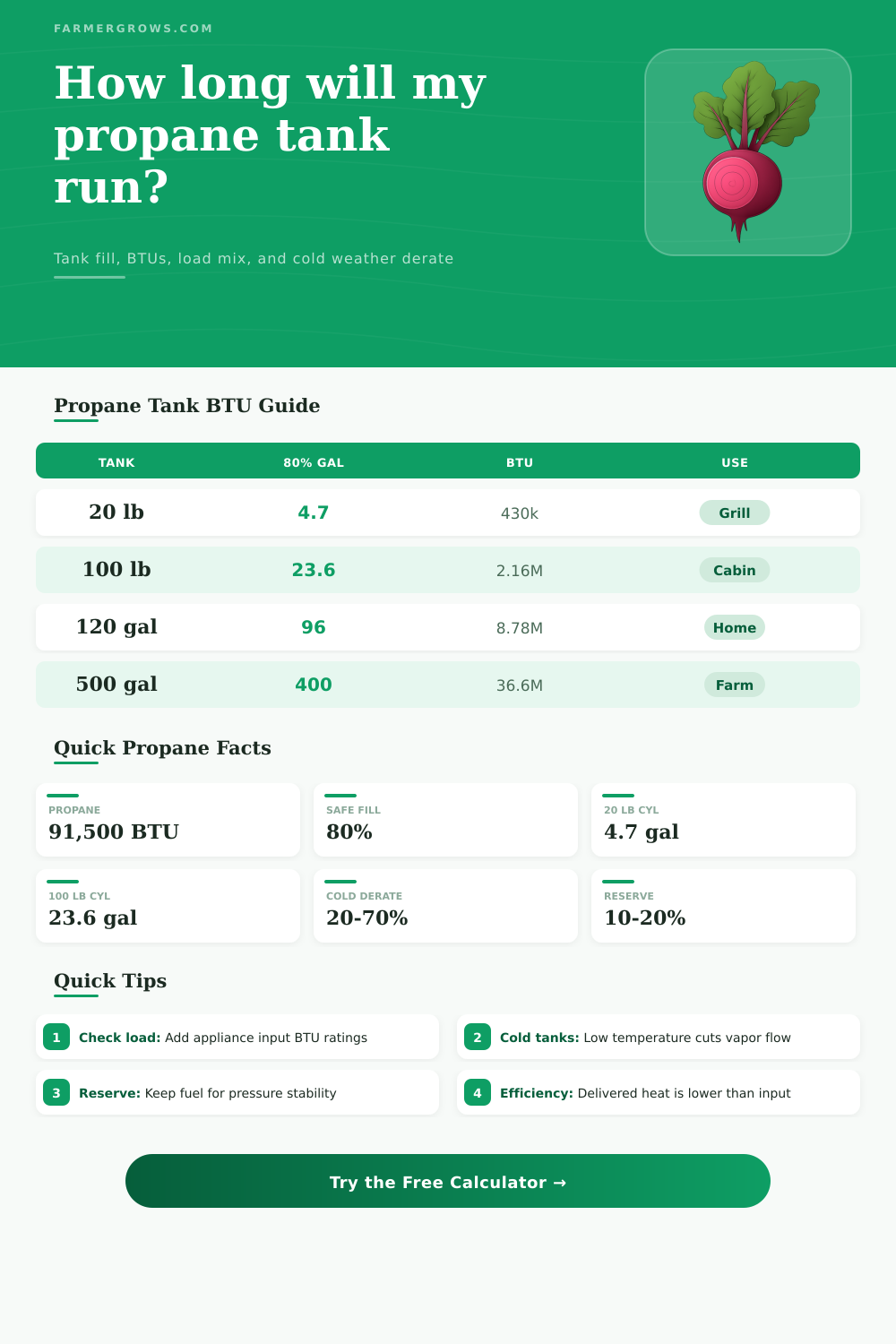
| Tank or cylinder | Approx water capacity | Propane at 80% fill | Stored BTU at 80% | Typical use |
|---|---|---|---|---|
| 20 lb grill cylinder | 5.9 gal | 4.7 gal | 430,000 BTU | Grills, turkey fryer, small patio heater. |
| 30 lb RV cylinder | 7.1 gal | 5.7 gal | 520,000 BTU | RV furnace, water heater, range, camping loads. |
| 100 lb cylinder | 29.5 gal | 23.6 gal | 2.16 million BTU | Cabins, wall heaters, construction heat. |
| 120 gallon tank | 120 gal | 96 gal | 8.78 million BTU | Small home, greenhouse, shop heat. |
| 250 gallon tank | 250 gal | 200 gal | 18.30 million BTU | Home furnace plus water heating. |
| 500 gallon tank | 500 gal | 400 gal | 36.60 million BTU | Farmstead, whole-home heat, standby generator. |
| 1000 gallon tank | 1000 gal | 800 gal | 73.20 million BTU | High demand home, poultry, grain drying support. |
●Temperature and vaporization derate table
| Tank temperature | Derate used | What it means | Planning note |
|---|---|---|---|
| 60 deg F or warmer | 1.00 | Normal vapor pressure and vaporization. | Still check pipe size and regulator capacity for high loads. |
| 40 deg F | 0.92 | Mild cold-weather reduction. | Most residential tanks handle normal furnace cycling. |
| 20 deg F | 0.75 | Noticeable reduction for small cylinders. | Large tanks have more wetted surface and recover better. |
| 0 deg F | 0.55 | Vapor production can become the limiting factor. | A high-BTU shop heater may starve on a small cylinder. |
| -20 deg F | 0.34 | Severe cold derate. | Consider a larger tank, manifolded cylinders, or lower demand. |
●Common propane appliance input table
| Appliance | Typical input BTU/hr | Common duty cycle | Calculator use |
|---|---|---|---|
| High-efficiency home furnace | 60,000 to 100,000 | 20% to 70% | Main heating load; set duty higher in cold snaps. |
| Tank water heater | 34,000 to 40,000 | 5% to 20% | Short burns throughout the day. |
| Kitchen range burner | 5,000 to 18,000 | 1% to 8% | Usually small compared with heating loads. |
| Clothes dryer | 18,000 to 25,000 | 1% to 10% | Depends on laundry frequency. |
| Shop torpedo heater | 60,000 to 250,000 | 20% to 100% | Can exceed cold-cylinder vaporization quickly. |
| Grain dryer burner | 500,000 to 2,000,000 | 50% to 100% | Use large storage and professional fuel-system sizing. |
●Runtime examples at 80% fill
| Tank | Usable gallons | At 40,000 BTU/hr | At 80,000 BTU/hr | At 150,000 BTU/hr |
|---|---|---|---|---|
| 20 lb cylinder | 4.7 gal | 10.8 hr | 5.4 hr | 2.9 hr |
| 100 lb cylinder | 23.6 gal | 54.0 hr | 27.0 hr | 14.4 hr |
| 120 gallon tank | 96 gal | 219.6 hr | 109.8 hr | 58.6 hr |
| 250 gallon tank | 200 gal | 457.5 hr | 228.8 hr | 122.0 hr |
| 500 gallon tank | 400 gal | 915.0 hr | 457.5 hr | 244.0 hr |
●Appliance comparison grid
Space heating
Furnaces and shop heaters usually dominate propane use. A low duty cycle can still burn more fuel than all cooking loads combined.
Water heating
A 40,000 BTU/hr water heater has a high input rating, but short daily run time keeps average fuel demand moderate.
Cooking and dryer
Ranges and dryers are meaningful in small cylinders, yet they are usually secondary on a whole-home tank.
Process loads
Greenhouse heaters, brooders, generators, and grain dryers need extra attention because long duty cycles drain tanks quickly.
●Propane BTU calculation tips
A propane tank BTU calculator allow a person to estimate the length of time that a propane tank will provide fuel to their appliances. Information that is required for the calculator to determine the length of time for the propane tank to supply fuel to appliance includes the size of the tank, the percentage of propane that is currently in the tank, the demand of the appliances that are to be fueled by the tank, and the outside temperature. A person utilizes a propane tank BTU calculator because they need to know if the propane in there tank will be able to reach their appliances when it is cold outside.
While propane tanks contains propane, the amount of propane is not the only determining factor of whether the appliances will be supplied with propane; the ability of the propane to turn into vapor is also a factor. Propane must turn into vapor in order to be utilized by the appliances. The ability for propane to turn into vapor is based off the temperature of the propane in the tank, as well as the size of the propane tank.
How to Use a Propane Tank BTU Calculator
If the outside temperature is low, there will be less propane in the tank that can vaporize and be delivered to the appliances. The propane tank BTU calculator factors in low outside temperature by using the temperature derate and the exposure factor in its calculations. By using these two factor in the calculation of the propane that can vaporize from the propane tank, the propane tank BTU calculator can tell whether or not the tank will be able to provide enough propane vapor to meet the demands of the appliances that are to be supplied with propane.
If the propane tank does not have the ability to vaporize enough propane to meet the demands of those appliances, then the appliances will not be supplied with enough fuel to perform their normal task. In order to use a propane tank BTU calculator, a person must enter a variety of different inputs into the calculator. The size of the water tank in propane tank must be entered, as this is how the propane tanks is most commonly rated.
The user must enter the percentage of propane that is currently in the tank. Propane tanks are never filled to 100% of its capacity. The reason that the propane tanks are never filled to 100% of its capacity is because the propane within the tank is required to have some space within the tank to expand if the outside temperature increase.
Additionally, the percentage of the tank that is to be reserved for those propane tanks must be entered. Propane tanks are not supposed to be run to zero percent of its propane levels, as running a propane tank to this level may cause issue with the regulator that controls the propane that is released from the tank. Additionally, the efficiency of the heating appliances must be entered.
This efficiency percentage relate to the BTUs of propane that is released from the tank and the amount of heat that travels into the living space of a home. High efficiency propane heaters will provide more heat to the living space than low efficiency heaters with the same amount of propane in the tank. Therefore, the efficiency of the appliances must be entered into the calculator for accuracy.
Another field within the propane tank BTU calculator that must be entered is the percentage of each appliance that is to be supplied with propane. The percentage of each appliance that is supplied with propane is important because the various appliances within a home dont run at the same rate at the same time. For example, some appliances, such as water heaters and clothes dryers, will only run for short period of time, while other appliances, such as furnaces, may be required to run for longer periods of time.
If each appliance in the home is entered into the calculator as if it is always running at 100% of its rate, then the calculations of the propane tank BTU calculator may provide incorrect information to the user about how long the propane will last in the tank. Therefore, the user can enter the duty cycle for each appliance, and the propane tank BTU calculator can use these percentages to calculate the average rate at which the appliances will require propane to perform their tasks. In addition to entering the information regarding the appliances, other settings for the propane tank BTU calculator that must be entered include the outside temperature, as well as the exposure of the propane tank to the outside elements.
The temperature at which the propane tank is exposed can impact the vaporization of the propane within the tank. For instance, a propane tank that is exposed to the sun will vaporize the propane within it at a higher rate than a propane tank that is covered in snow. Additionally, the wind that is within the area around the propane tank may also impact its vaporization.
For instance, if the propane tank is exposed to strong wind, the water may be able to remove heat from the shell of the propane tank. These settings within the calculator allow for the propane tank BTU calculator to account for these variables, so that the user does not have to account for them manually when using the calculator. Finally, if the vaporizing capacity of the propane tank is less than the demands of the appliances, the propane tank BTU calculator will provide a warning to the user of that calculation.
This warning will indicate to the users that the propane tank is not able to provide fuel to those appliances. In addition to providing different fields in which the user may enter information into the calculator, there may also be reference tables provided to assist the user in understanding the various calculations provided by the calculator. These reference tables may include information about the sizes of propane tanks, such as those that contain 20 pounds of propane, or those that contain 250 gallons of propane.
Additionally, another reference table may include the temperature derate table for propane tanks. A temperature derate table will indicate the amount of vaporization of propane in the tank if the outside temperature drops to levels below 40 degrees Fahrenheit. This table can help the user understand the impact that the outside temperature input will have on the calculations provided.
Another type of information that is collected by a propane tank BTU calculator is information regarding the mechanical variable of the propane tank. The propane tank BTU calculator cannot calculate the diameter of the pipes that distribute the propane from the tank to the appliances. Additionally, the propane tank BTU calculator does not factor in the elevation of the house in which the propane tank is located.
Additionally, the calculator does not consider the capacity of the regulator that controls the propane that is released from the tank. For instance, if the capacity of the regulator is set for the propane tank during warm months, it may not appropriately regulate the amount of propane that is released from the tank during cold months. Similarly, the length of the pipes from the tank to the appliances may also impact the amount of propane that is supplied to the appliances.
For instance, long pipes may lead to the loss of propane due to friction between the propane and the walls of the pipes. Thus, the homeowners or the service technician that manage the propane tanks must manage any information regarding these mechanical variables of propane tanks. Another potential issue that may impact the accuracy of the calculations from a propane tank BTU calculator is if individuals overestimate the amount of propane in their tank.
For instance, the user may choose to set a reserve percentage to the tank of 15%. However, they may not account for the fact that this 15% is of the total fuel that is contained in the tank. Additionally, the propane tank BTU calculator will automatically subtract the percentage of the reserve from the percentage of the current fill level of the tank.
Thus, the user cannot select a reserve level for their tank, yet also expect the calculator to provide information that suggests that the reserve portion of the tank is available for use. Additionally, the propane tank BTU calculator will show the total weight of the propane that is contained in the tank, in pounds. This measurement can be helpful for those that may order propane tank contents in weights.
Another reason that individuals may wish to utilize the propane tank BTU calculator is due to the fact that the outside temperatures may be low during the winter months. For instance, an electric heater that may be working well in October may not be able to supply the amount of heat required in January when the outside temperatures are low. Thus, a propane tank BTU calculator allows the user to compare the demands of the appliances with the vaporizing capacity of the propane tank.
In the propane tank BTU calculator, there are two types of run times that can be calculated for the propane that is contained within the tank. The first type of runtime within the calculator is the active runtime for the propane tank. The active runtime is calculated with the assumption that each appliance is running at 100% of its potential rate.
The second type of runtime is the clock runtime. The clock runtime is calculated with the use of the duty cycle percentages for each appliance within the home. Both of these times are estimates of the length of time that the propane within the tank will last.
Each of these estimate allows the users to decide when to order additional propane for their tanks. Thus, the propane tank BTU calculator can aid in the understanding of the use of propane by calculating how each of the variables related to propane can impact the length of time that the propane will last in the tank.