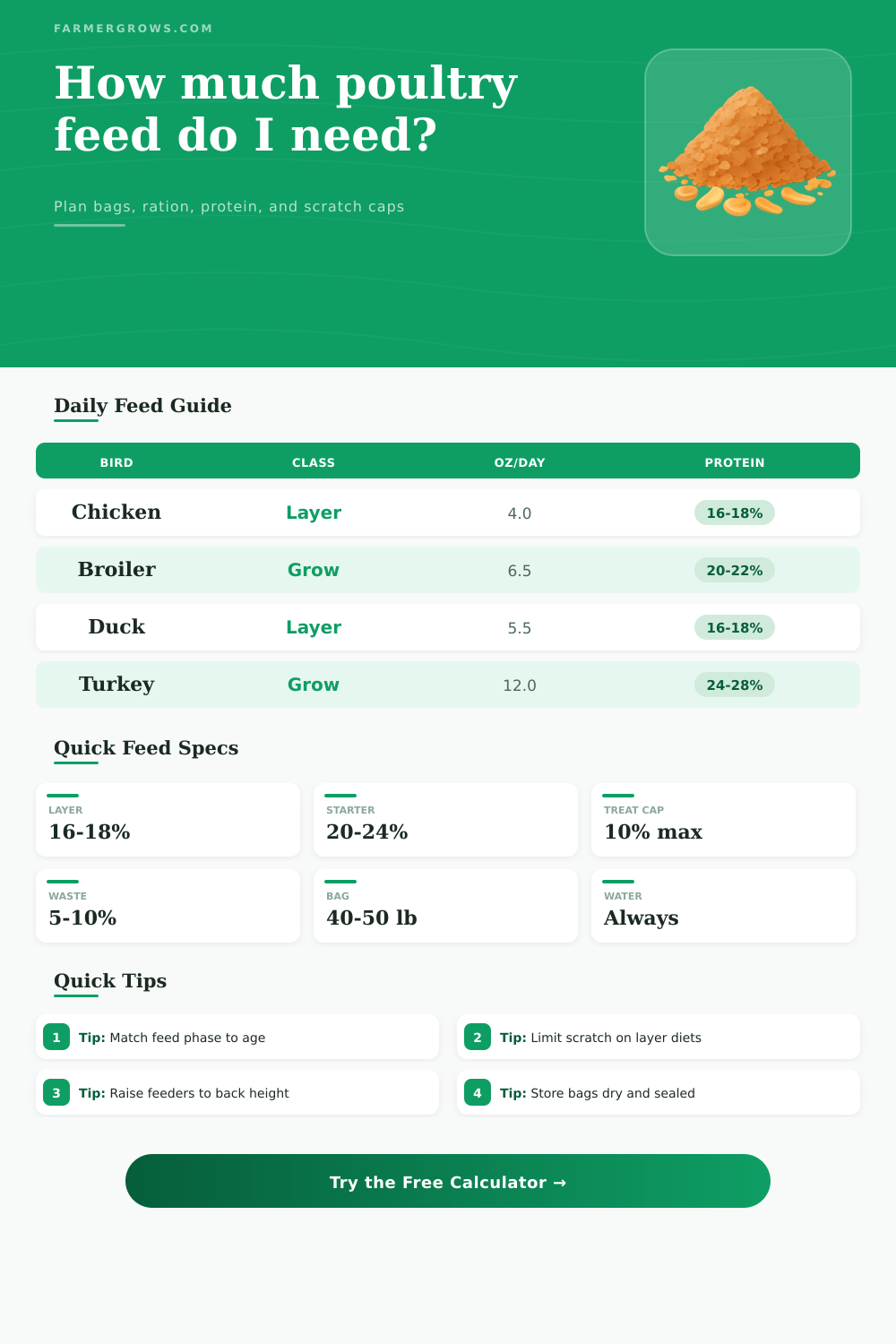
Poultry Feed Calculator
Estimate ration, bag count, protein level, waste buffer, and scratch limits for a mixed flock.
| Phase | Common birds | Protein range | Planning note |
|---|---|---|---|
| Starter | Chicks, poults, keets | 20-28% | Use age-specific starter for rapid early growth. |
| Grower | Pullets, ducks, broilers | 15-22% | Shift down after the starter period as directed. |
| Finisher | Meat birds | 16-20% | Balance growth with clean feeders and fresh water. |
| Layer | Hens, duck layers, quail | 16-20% | Layer feeds usually include extra calcium. |
| Breeder | Breeding groups | 16-20% | Keep body condition steady and avoid excess scratch. |
| Maintenance | Adult non-layers | 12-16% | Adjust for pasture quality and cold weather. |
| Bag size | Chicken layer days | Duck layer days | Turkey grower days |
|---|---|---|---|
| 10 lb | 40 hen-days | 29 duck-days | 13 turkey-days |
| 25 lb | 100 hen-days | 73 duck-days | 33 turkey-days |
| 40 lb | 160 hen-days | 116 duck-days | 53 turkey-days |
| 50 lb | 200 hen-days | 145 duck-days | 67 turkey-days |
| 80 lb | 320 hen-days | 233 duck-days | 107 turkey-days |
| Cap | Use case | For 10 lb feed | Reminder |
|---|---|---|---|
| 0% | Starter chicks | 0 lb treats | Keep the ration fully balanced. |
| 5% | Layer training | 0.5 lb treats | Use for calling birds or coop training. |
| 10% | Adult flocks | 1.0 lb treats | Common upper limit for scratch grains. |
| 15% | Pastured adults | 1.5 lb treats | Monitor egg shell quality and condition. |
| 20% | Short-term use | 2.0 lb treats | Use cautiously when complete feed drops. |
| Waste | Feeder setup | When to use | Adjustment idea |
|---|---|---|---|
| 0-3% | Treadle or deep port | Very tidy mature flocks | Check that timid birds still eat. |
| 5% | Raised hanging feeder | Most small coops | Set lip near back height. |
| 8-10% | Open trough or mixed ages | Common planning buffer | Protect feed from rain and bedding. |
| 12-15% | Young or messy birds | Brooders, ducks, geese | Use spill trays and smaller fills. |
| 20%+ | Poor setup | Only as a warning buffer | Fix the feeder before buying extra feed. |
Providing an correct feed for your flock of laying hens and other poultry requires an understanding of the nutritional needs of the birds you have and the capacity of your current setup. While estimating how much feed your flock consume is a beginning step, many find that the estimates are not accounted for factors like the consumption of feed by the flock each day, waste, and seasonal changes in feed requirements. Each of these factor has a relationship with the quality of the eggs produced by your laying hens, the growth rates of your flock, and the number of bags of feed that you will have to purchase for each month.
The amount of feed that each bird consumes can change according to the age of the bird, the purpose of the bird, and the weather. For instance, laying hens will establish a daily intake of feed once they begins to lay eggs, but broilers will consume more feed due to the need of the broiler to contain more nutrients to support the growth of the bird during different stages. Ducks, turkeys, quail, and geese will have different appetites due to the way that the bodies of those animals must perform certain biological functions.
How to Plan Feed for Your Chickens and Other Poultry
By using a calculator that accounts for each of these different types of birds and their growth stage, you can mathematically calculate the feed requirements. The protein percentage in the feed can impact the way that the flock utilize that feed. If the percentage of protein in the feed is too low, laying hens may produce fewer eggs or eggs with weak shells.
If the protein content is too high, the flock will waste money purchasing feed that there bodies will excrete. The protein level should match the life stage of each bird. For instance, feed for broilers will have more protein than feed for laying hens, as the young birds requires more protein to support their growth.
Matching the protein percentage to life stage will ensure that the feed is efficient used, and that it is not wasteful of that resource. Another factor to consider is the allowance for waste. Many people find that the flock wastes feed due to the behavior of the flock, the weather, and other environmental factors.
Allowing for a small percentage of waste will ensure that you do not find yourself in a situation where you are out of feed for the flock. The same applies to grains and kitchen scrap. While you use grains and kitchen scraps as treats for the flock, any additional feed that is fed to the birds that does not contain protein will dilute the nutritional value of the feed if it is provided in amount beyond 10%.
Thus, providing grains and kitchen scraps in amounts below 10% will ensure that the flock maintains its shell quality and growth rates. In order to determine how many bag of feed to purchase, determining how much feed each flock will consume during a planning period can be calculated with the size of the bags of feed. Using a 30-day planning period will smooth out feed consumption by the flock each day.
Additionally, using the actual weight of the bags of feed will remove guesswork in determining how many bags to purchase for each month. This will result in a number of bags to purchase each month, plus a few extra bags as a safety measure if the feed store is close or if the delivery service is delayed. In analyzing each of these factors, it becomes clear that there are tradeoffs to each consideration.
For instance, if the current feeder for the flock spills bags of feed, increasing the allowance for waste is one solution to the problem. However, another solution would be to adjust the height of the feeder or use a container for the feed that will not result in spillage of feed bags. The other solution would require more effort from the flock owner, but save more feed than the allowance for waste would purchased.
Additionally, knowing how much scratch can be added to the feed before the flock begins to consume it will allow the flock owner to determine if the flock is feeling fed or if they are eating the scratch for entertainment. The feed requirements for each type of bird can range from laying hens to broilers to ducks. Each group of birds will have different feed requirements, yet they will use the same feeders and storage for their feed.
The easiest way to account for each of these different feed requirements is to calculate the amount of feed required for the dominant group of birds, then adjusting the calculation to account for the other groups of birds in the flock. While feed can be calculated for each flock, water is a factor that is not accounted for in any calculation. However, water is essential to the flock.
Each bird will drink twice its body weight in water each day if the weather is normal. However, if the flock is exposed to hot weather or is provided with treats, the flock will increase the amount of water that is consumed. Providing unfrozen water for the flock will ensure that the birds are able to maximize the utilization of the feed they consume.
If water is not provided for the flock, the birds will experience reduced production of the feed, and potential health issue. The feed requirements of the flock can also change according to the weather. In cold weather, the flock will exhibit increased appetites for the feed.
Additionally, the quality of the pasture in which the flock ranges will decrease in cold weather climates. Thus, the flock will require more feed during these periods of the year. In hot weather, the flock will naturaly decrease the amount of feed that they consume.
Thus, it is important to protect the flock from excessive heat, to ensure that they are consuming enough of the feed to meet their requirement. While there is no perfect feed plan, the goal is to create a working estimate for the amount of feed that is required for your flock. A working estimate for feed will ensure that there is enough feed to satisfy the birds, that feed is not wasted, and that the nutrition provided to the flock is balanced enough to allow the flock to perform their biological functions.
Thus, the daily ration, the number of bags to purchase for the feed, and the amount of treats that are provided will have an impact on the function of the flock. When these three factor are aligned with the observed function of the flock, the feed plan will function correctly.