Pond Pump Size Calculator
Estimate pond pump flow from gallons, turnover target, total head, pipe run, fittings, waterfall width, filter restriction, fish load, and efficiency derate.
1 Pump and pond presets
Choose a starting point, then adjust the pond gallons, lift, pipe length, waterfall, filter, and fish load to match the actual installation.
Pump sizing result
Use the recommended GPH at the calculated total dynamic head, then check the pump curve rather than the zero-head box rating.
Sizing breakdown
2 Enter pond and pump conditions
3 Pump type comparison grid
Match the pump style to how the pond is built. The calculator recommends a style from flow and head, but access, winter service, and electrical placement still matter.
4 Live design checkpoints
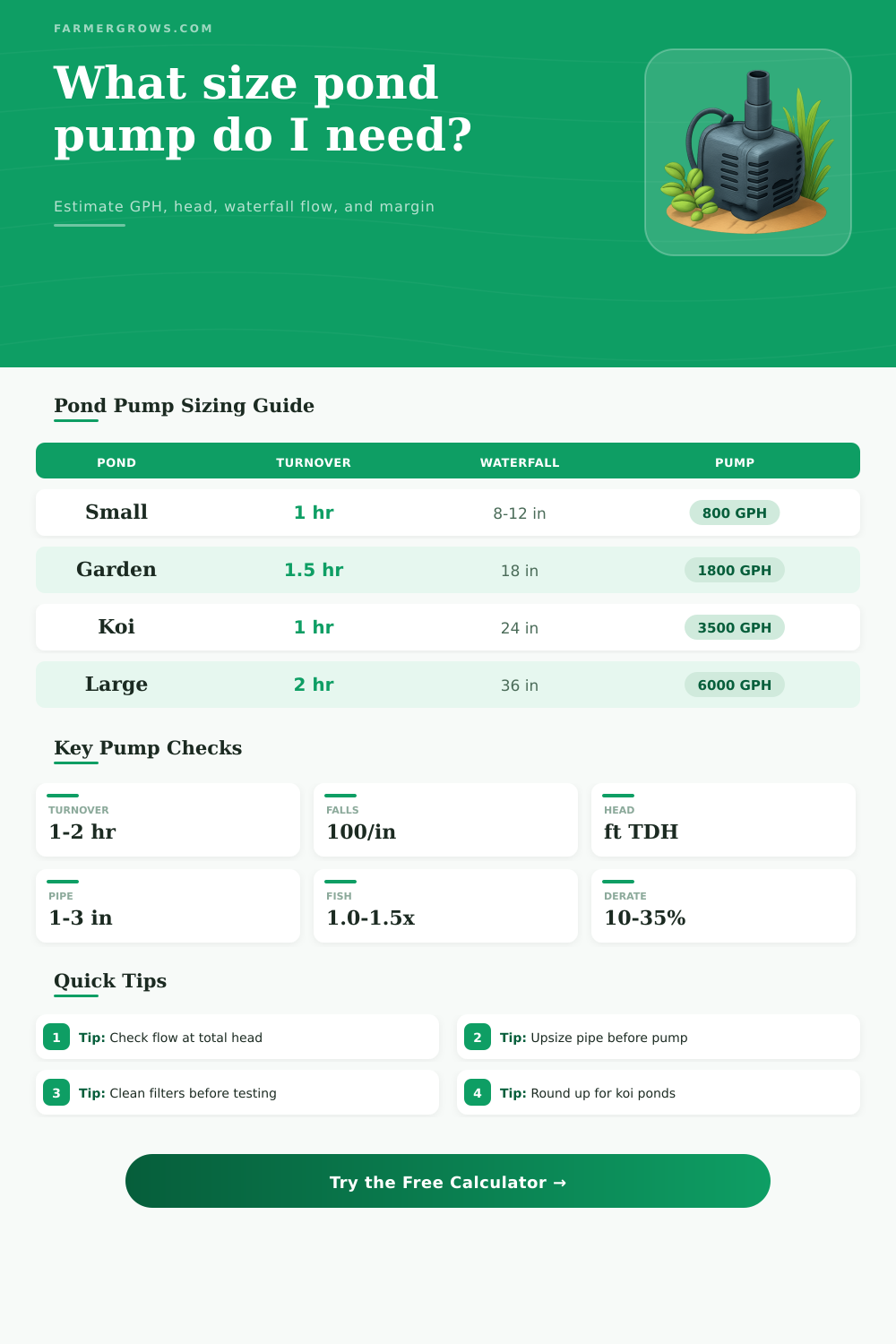
5 Turnover target table
| Pond situation | Common target | Example for 1,000 gal | Notes |
|---|---|---|---|
| Plant or wildlife pond | Every 2 to 3 hours | 335 to 500 GPH | Can run slower if no fish and no waterfall. |
| Goldfish garden pond | Every 1.5 to 2 hours | 500 to 670 GPH | Good starting point for simple biofilters. |
| Koi pond | Every 1 hour | 1000 GPH | High oxygen demand and heavier waste load. |
| Warm climate or heavy feed | Every 0.75 to 1 hour | 1000 to 1335 GPH | Use extra aeration and do not rely on flow alone. |
6 Waterfall flow table
| Waterfall look | Rule of thumb | 18 inch spillway | Best use |
|---|---|---|---|
| Thin trickle | 60 GPH per inch | 1080 GPH | Quiet rill or narrow rock spill. |
| Sheet flow | 100 GPH per inch | 1800 GPH | Most backyard waterfalls. |
| Strong curtain | 150 GPH per inch | 2700 GPH | Clean whitewater look over flat stone. |
| Heavy stream | 200 GPH per inch | 3600 GPH | Short broad drops or visible stream noise. |
7 Plumbing and head loss table
| Pipe size | Quiet flow range | Watch point | Typical pond use |
|---|---|---|---|
| 3/4 inch | 300 to 700 GPH | High friction above small fountain flows. | Small spitters and short tubing. |
| 1 inch | 600 to 1200 GPH | Common kit size but easy to outgrow. | Small filters and compact falls. |
| 1 1/2 inch | 1200 to 3000 GPH | Better for waterfall boxes and longer runs. | Medium ponds and streams. |
| 2 inch | 2500 to 5500 GPH | Lower friction for koi and larger waterfalls. | Large submersible or external pumps. |
8 Filter and fish load table
| Condition | Calculator allowance | Why it matters | Field check |
|---|---|---|---|
| Skimmer and waterfall box | Small flow and head add | Mat pads and spillway boxes collect debris. | Rinse screens before flow testing. |
| Bog or wetland filter | Moderate flow add | Gravel beds like steady circulation without jetting. | Spread flow across the manifold. |
| Pressurized filter or UV | Higher head add | Closed vessels, UV bodies, and valves add restriction. | Check the filter's max flow rating. |
| Koi or heavy feeding | Higher turnover add | Fish waste and oxygen demand rise quickly in summer. | Watch clarity, ammonia, and dissolved oxygen. |
9 Two practical sizing tips
A pump advertised at 3000 GPH may deliver far less at 6 ft of total dynamic head. Compare your result to the pump curve at the calculated TDH.
Moving from 1 inch hose to 1 1/2 or 2 inch line often improves waterfall flow more efficiently than choosing a much larger pump.
Choosing an pond pump requires you to think about the journey that the waters will take through your pond. The pond pump must be able to move the water from the surface of the pond to the outlet and back to the surface of the pond again. The water flow must be able to overcome the force of gravity, the friction created within the hose that moves the water, the resistance created by a filter or waterfall box within the pond, but also the resistance created by all of the element within the pond that may impede the movement of the water.
If the chosen pump are too small for the requirements of the pond, the water will trickle over the rocks within the pond. Conversely, if the pump is too large for the requirements of the pond, the pump will become too hot to operate efficient and will waste electricity. The volume of the pond will help determine the baseline specification of the pond pump.
How to choose the right pond pump
The volume of the pond will determine how much water the pump must move within the pond. Small wildlife pools may contain less water than ponds that contains fish, as the fish produce more waste. The number of gallon of the pond and the desired number of hours for the pond water to turn over can be entered into a calculator to determine the total number of gallon of water that must move through the pond each hour.
The head of the pond pump will determine the resistance that the pump will need to overcome within the pond. The static lift of the pond will be the distance that the water must travel vertically from the pond surface to the pump. However, head will also account for the friction that is created by each foot of pipe and each addition to the pond that allow the water to travel through the pond.
Thus, a longer run of undersize pipe will reduce the head of the pond more deep than the depth of the pond. The total dynamic head include each of these factors to determine the total head that the pond pump must overcome. The width of the waterfall will impact the size of the pond pump.
The width of the waterfall will determine the amount of volume of water that must pass through the waterfall into the pond. The width of the waterfall can be entered into a calculator to determine the size of the waterfall look. The waterfall requirements will be calculated separately from the turnover rate requirements of the pond to allow for the determination of the correct size for the pond pump.
The amount of fish within the pond will impact the size of the pond pump. Additionally, the type of filter that is present in the pond will also impact the required amount of water circulation within the pond. Calculators that determine the size of the pond pump will apply a multiplier to the size of the pump according to the number of fish in the pond and the type of filter that is used.
Thus, two ponds that contains the same amount of water may have different requirement for the size of the pond pump due to these different variables. The diameter of the pipe will impact the efficiency of the pond pump. Using a larger diameter pipe will reduce the friction within the pond pump.
Thus, increasing the diameter of the pipe one size will often increase the efficiency of the pond pump more than increasing the size of the pond pump. However, the velocity of the water through the pond should also be considered. If the velocity is too high, the water will create noise within the pond system and contribute to resistance within the system.
Thus, if the velocity is too high, the tubing should be increased in size rather than the wattage of the pond pump. The specific pond pump that is selected determines the amount of energy that the pond pump will use. The energy use will depend upon both the head and the diameter of the pipe that is used in the pond system.
Using less head and using larger pipe sizes will reduce the energy use of the pond pump. Because pond pumps often run around the clock, the pond pump manufacturer can determine the amount of energy that will be used each month to ensure that the wattage is within a reasonable range for the pond system. Pond systems will often change after they is installed.
Leaves may grow on the screens of pond pump filters, and algae often coats spillways. Each of these factors will increase the resistance to the movement of water within the pond. Thus, pond calculators includes a field to derate the efficiency of the pond pump to account for these changes.
When determining the size of the pond pump that is required for the pond, it is necessary to round up to ensure that the pump can handle the additional resistance created by these pond variables. Rounding up is the better choice for ponds that contain koi fish. The method of servicing the pond pump is the last factor to consider in the selection of the pond pump.
Submersible pond pumps are easy to clean but difficult to reach if the pond is deep. External pond pumps require a dry and well-ventilated location for the pump to be place, but the suction lines for pond water will be longer. Each type of pond pump can be better than the other, but the best pond pump is the one that meet the requirements of the pond system and layout.