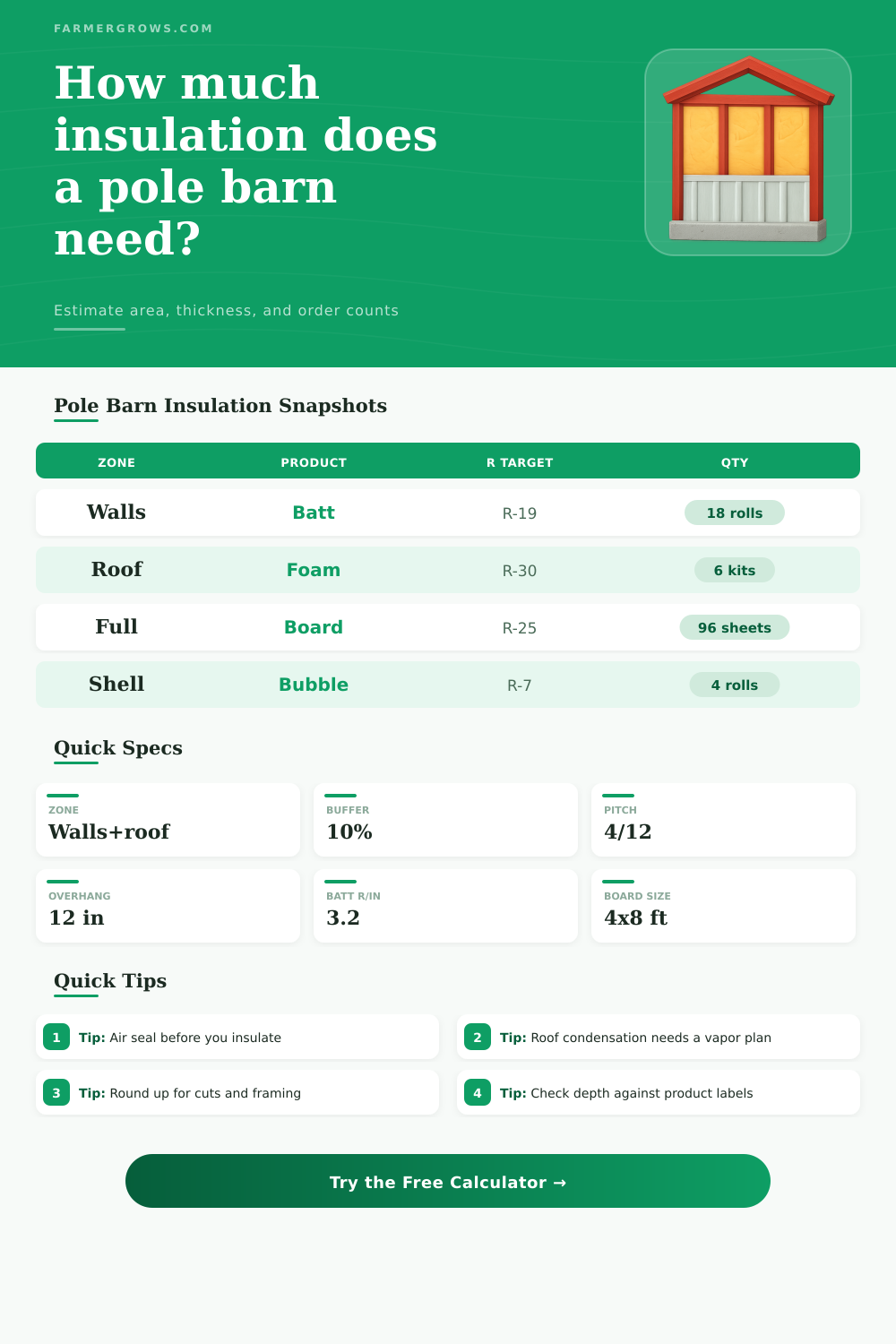
Pole Barn Insulation Calculator
Estimate wall and roof insulation area, required thickness, and package counts for batts, boards, spray foam, and retrofit liners.
Use a real jobsite starting point. Each preset loads a common barn size, insulation zone, product type, target R-value, and waste allowance.
Calculation Results
Area, thickness, and order counts update from the barn size, roof pitch, openings, waste allowance, and product choice.
| Product | Pack type | Base cover | Thickness |
|---|---|---|---|
| Fiberglass batts | Roll | 40 sq ft | 3.5 in |
| Mineral wool | Bag | 32 sq ft | 3.5 in |
| Rigid foam board | Sheet | 32 sq ft | 1 in |
| Closed-cell foam | Kit | 650 bf | 1 in eq |
| Product | R/in | Best use | Note |
|---|---|---|---|
| Fiberglass batts | 3.2 | Walls | Low cost |
| Mineral wool | 4.3 | Walls | Denser fit |
| Rigid foam board | 5.0 | Roof | Continuous layer |
| Closed-cell foam | 6.5 | Roof | Best air seal |
| Zone | Wall target | Roof target | Typical use |
|---|---|---|---|
| Storage | R-13 | R-19 | Unheated bay |
| Shop | R-19 | R-30 | Work area |
| Warm room | R-21 | R-38 | Heated room |
| Cold shell | R-7 | R-10 | Condensation control |
| Project | Size | Zone | Product |
|---|---|---|---|
| Utility bay | 24 x 24 | Walls only | Batt |
| Heated shop | 30 x 40 | Walls and roof | Foam |
| Equipment shed | 40 x 60 | Full shell | Board |
| Metric demo | 12 x 18 m | Full shell | Foam |
When insulating a pole barn, it is important to calculate the amount of insulation that is necessary for the barn. Insulation is necessary to regulate the temperature within the pole barn, as well as to prevent heat from the barn from escaping the pole barn. Should you not calculate the amount of insulation correct, you may either purchase too much or to little of the insulation to perform the project.
Pole barns has a particular construction that must be considered when insulating them. The posts and girts of the pole barn can take insulation batts, but the pitch of the barn’s roof increase the area of the roof compared to the floor area of the barn. Thus, when calculating the square footage of the roof, you must consider the pitch of the barn’s roof.
How to Calculate and Install Insulation for a Pole Barn
The area of the walls is calculated in a similar way to the area of the roof. You calculate the gross area of the barn walls, but you must subtract the areas of openings in the walls (doors, windows, bays for equipment) from that area. Doors and windows dont have the same level of insulation requirements as the walls of the barn.
Thus, the area of those openings are subtracted from the gross area of the walls. Additionally, you must purchase 10% more insulation than the calculations in case of cutting and waste of the insulation during installation of the barn. There are several types of insulation products that you could utilize in constructing the pole barn.
Two types of insulation include fiberglass and mineral wool. Fiberglass insulation provide approximately 3.2 R-value per inch of insulation. Mineral wool provides approximately 4.3 R-value per inch of insulation.
Another type of insulation includes rigid foam boards, which provide 5 R-value per inch of insulation. Finally, closed-cell spray foam insulation provides 6.5 R-value per inch of insulation. Each type of insulation has its own cost, so it is important to consider each budget for these options to purchase the proper amount of insulation.
In order to calculate the thickness of the insulation that is required in the walls and floor, the type of insulation will provide the R-value per inch that the target R-value can be divided by. For instance, if the target R-value is 19 and the type of insulation has 3.2 R-value per inch, then you can calculate the thickness of the insulation. Additionally, in areas that have colder climate, the R-values can be higher to account for the amount of heat that the barn must retain.
Thus, an individual that intends to construct a heated barn should use higher R-values of both the walls and the roof. In addition to the calculations, it is also important to consider the air sealing of the pole barn. Air sealing prevents air from passing through gaps in the barn construction.
Should air not be sealed, the wind can enter the barn and reduce the effectiveness of the insulation. For instance, if an individual place insulation batts into the barn, but does not air seal the barn, the insulation will not perform as efficient. Finally, another important consideration is air vapor management in the roof.
If warm air from within the barn contact the metal roof, condensation will form on that metal. To prevent this from occurring, you can install insulation or vapor barrier on the roof of the pole barn. To prepare the barn for insulation, you should store the insulation batts within the barn.
The insulation can be damaged if it remains outside of the barn. Additionally, if you are to use spray foam insulation, the area must be heated to between 50 and 80 degree. If not, the spray foam will not expand appropriate to seal the gaps in the barn structure.
Following these steps and performing these calculations will ensure that there is an adequate amount of insulation for the pole barn. You should of checked the space first. It is alot of work but worth it for teh barn.