Pole Barn Material List Calculator
Estimate posts, trusses, steel sheets, trim, and footing concrete from a pole barn layout. Switch units, test presets, and see the full breakdown.
Pick a real-world barn shape to seed the calculator. Each preset sets length, width, wall height, pitch, spacing, holes, slab, and material so you can compare layouts in seconds.
Advanced layout controls
These refine the roof, posts, concrete, and cladding counts. Defaults stay practical for common pole barn builds.
Material Results
These values update from the selected barn size, roof pitch, spacing, and material system.
| Panel system | Wall weight | Roof weight | Notes |
|---|---|---|---|
| 29 ga steel | 0.80 lb/sq ft | 0.80 lb/sq ft | Lightest common shell |
| 26 ga steel | 1.10 lb/sq ft | 1.10 lb/sq ft | Heavier, stiffer panel |
| Board and batten | 2.30 lb/sq ft | 2.30 lb/sq ft | Thicker wood cladding |
| Insulated steel | 1.45 lb/sq ft | 1.45 lb/sq ft | Panel and foam core |
| Post spacing | 24 x 24 | 30 x 40 | 40 x 60 |
|---|---|---|---|
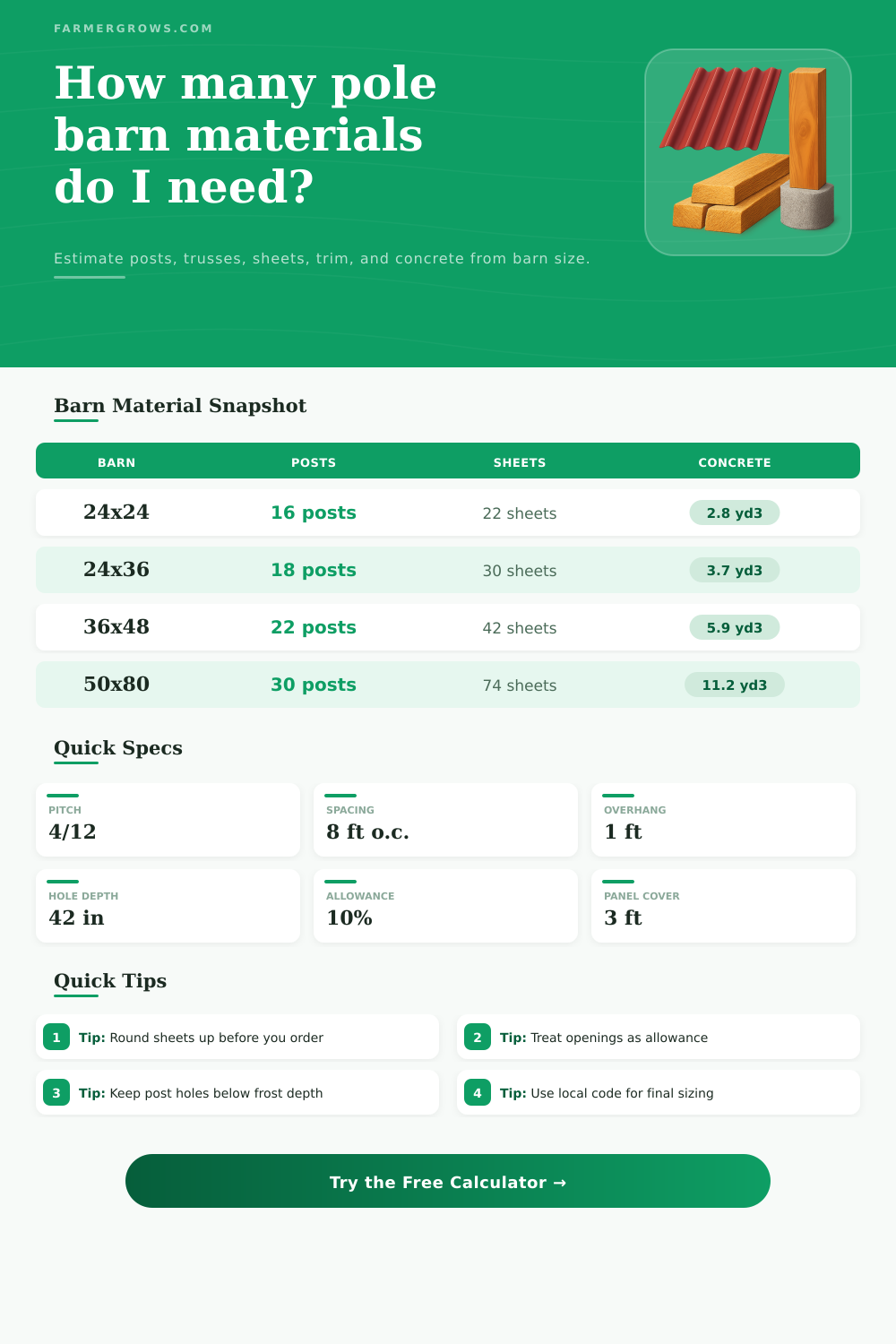
| 6 ft O.C. | 20 posts | 24 posts | 28 posts |
| 8 ft O.C. | 12 posts | 18 posts | 24 posts |
| 10 ft O.C. | 12 posts | 14 posts | 20 posts |
| 12 ft O.C. | 8 posts | 12 posts | 16 posts |
| Roof pitch | Rise / 12 | Slope factor | Use case |
|---|---|---|---|
| 3/12 | 3 in | 1.03 | Low slope shed |
| 4/12 | 4 in | 1.06 | Most barns |
| 5/12 | 5 in | 1.08 | Higher drainage |
| 6/12 | 6 in | 1.12 | Steeper shell |
| Hole size | Depth | Concrete / post | Use case |
|---|---|---|---|
| 12 in | 42 in | 0.20 yd3 | Light barn post |
| 12 in | 48 in | 0.23 yd3 | Deeper embed |
| 14 in | 48 in | 0.32 yd3 | Heavier shell |
| 16 in | 54 in | 0.47 yd3 | Large spans |
A pole barn is a buildings that uses treated posts to construct the frame and roof. To build a pole barn, you must calculate the material you need. Calculating the materials will allow you to avoid buying more much lumber or not having enough trusses for the construction site.
To construct a pole barn, you will need posts along the perimeter of the shed that is placed at specific intervals. To calculate the number of posts you will need for the barn, calculate the perimeter of the shed and divide that measurement by the distance between each post. For example, if the pole barn is 40 feet in length and 60 feet in width, you will have to account for each bay of the barn for its posts.
Materials Needed to Build a Pole Barn
You will place these posts at regular intervals along the perimeter of the pole barn, and many individual often forget this essential construction component. Another factor to consider when building a pole barn is the height of the sidewalls. The higher you would like the sidewalls of the pole barn to be, the more higher the height will be in the calculation.
This is because the girts, which holds the siding panels to the pole barn, will be required in greater quantities if the sidewalls are to be taller. The girts are placed at intervals of four foot along the sidewalls of the pole barn to prevent the steel panels from bending in the wind. Additionally, the pitch of the roof will play a role in the amount of steel sheet that will be required to cover the roof.
The pitch of the roof is the slope of the roof. Steeper pitches will result in the roof having more surface area than a flat roof. Thus, a steeper pitch roof will require more steel sheets than a roof with a shallow pitch.
Concrete will be required to build the pole barn. You will place the treated posts into holes in the ground that are fill with concrete. The amount of concrete that will be required for each post hole need to be calculated, as will the amount of concrete necessary to form the floor slab of the pole barn.
The depth of the post holes must be calculated to ensure that the depth of the hole will be sufficient to prevent the frost in the ground from moving the treated posts. If the frost moves the posts in the ground, the pole barn will be constructed in such a way that it cant remain stable. Steel sheets will be used to cover the walls and the roof of the pole barn.
You can calculate the number of metal sheet that will be used by taking the perimeter of the barn and dividing the measurement by the width of the steel panel. This calculation does not take into account the height of the sidewalls or the slope of the roof. For example, 29-gauge metal is light in weight.
Insulated metal panels has more weight due to the higher R-value of the panels. When calculating the materials for the pole barn, it is best to include a buffer in the calculations. A buffer means buying additional materials, such as lumber or steel panels, to account for mistakes in the measuring process or warped steel panels.
By including a buffer in the calculations, you will ensure that you have enough materials to complete the barn. Additionally, there will be openings in the walls of the pole barn for windows and doors. These openings will reduce the amount of siding panels that will be required for the walls.
Finally, local building code may affect the construction of the pole barn. The slope of the ground where the pole barn will be constructed may impact the amount of earth that must be move in constructing the shed. Building codes may require the depth of the post holes to be deeper than the frost depth.
Additionally, local regulation may require specific rebar to be placed into the posts. If the pole barn will span more than forty feet, it is best to consult with a professional engineer about the construction process. By carefully planning out the materials for the construction of the pole barn, you can ensure that the shed will be correctly built and remain stable once constructed.