Pasture Seed Calculator
Estimate pure live seed, bulk seed pounds, grass and legume split, bag count, and adjusted drilled or broadcast rates for new pasture stands, overseeding, and renovations.
Use the germination and purity printed on the seed tag. Local extension recommendations, soil pH, seeding depth, inoculation, and grazing timing can change the final mix.
Pasture Seed Estimate
Bulk seed is adjusted from target pure live seed, method, stand type, seed tag germination, seed tag purity, and ordering buffer.
| Pasture mix | Typical target rate | Grass share | Legume share | Best fit |
|---|---|---|---|---|
| Horse cool-season pasture | 16 to 22 lb PLS/ac | 75% to 90% | 0% to 25% | Durable grazing where clover is limited for horse management. |
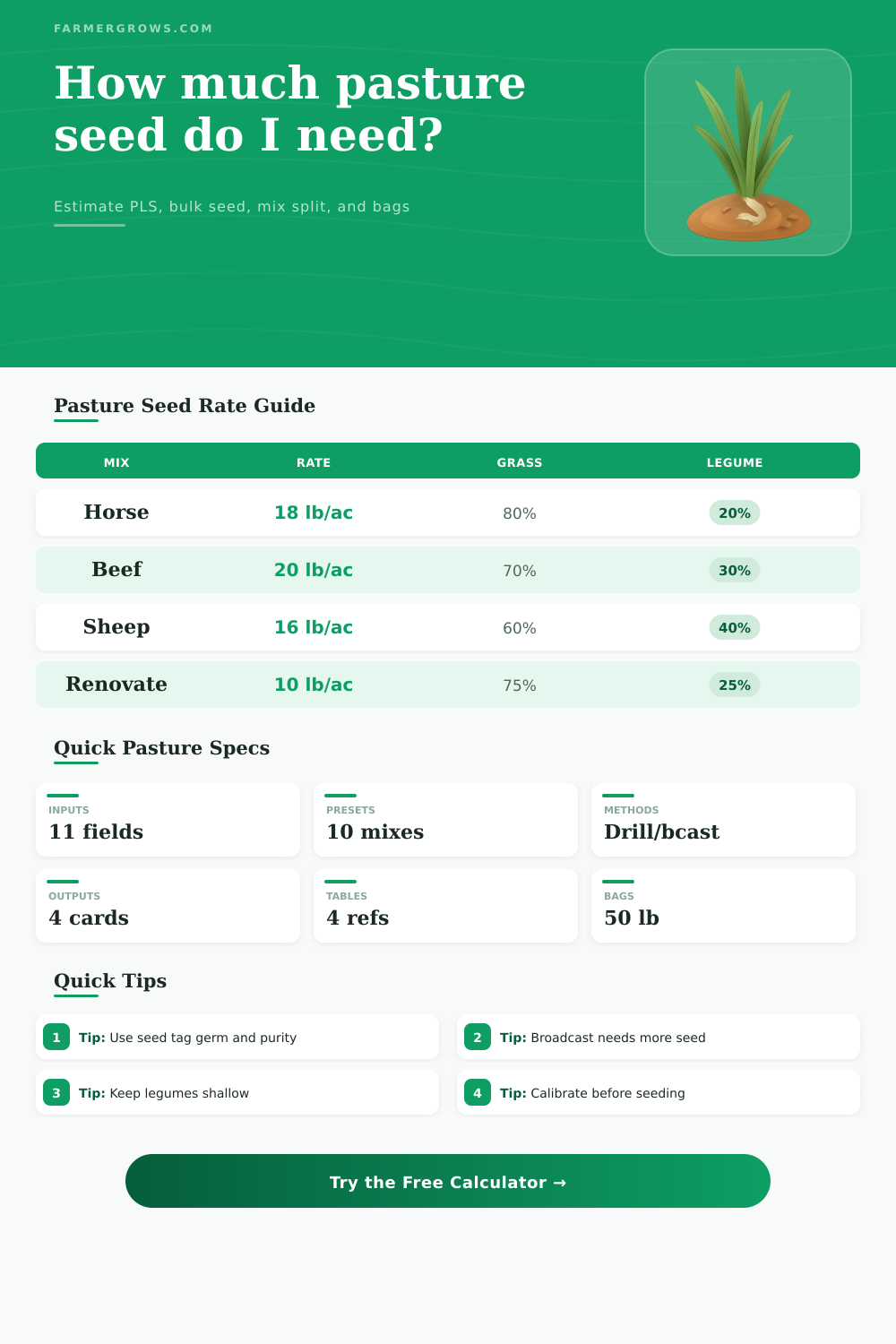
| Beef cow grazing mix | 18 to 24 lb PLS/ac | 60% to 80% | 20% to 40% | Rotational grazing, hay aftermath, and mixed fertility fields. |
| Dairy ryegrass clover mix | 22 to 30 lb PLS/ac | 55% to 75% | 25% to 45% | High quality forage where frequent grazing keeps stands leafy. |
| Alfalfa orchardgrass hay | 12 to 18 lb PLS/ac | 25% to 45% | 55% to 75% | Hay fields and managed grazing with good drainage and pH. |
| Native warm-season grass | 6 to 10 lb PLS/ac | 90% to 100% | 0% to 10% | Summer forage, wildlife strips, and lower input fields. |
| Seeding method | Rate factor | Depth guidance | Field condition | Stand note |
|---|---|---|---|---|
| Drilled or no-till drill | 1.00 | 1/4 to 1/2 in for many grasses | Firm seedbed with residue controlled | Best seed placement and most even emergence. |
| Broadcast and pack | 1.20 | Surface to 1/4 in for small seed | Cultipack before and after if possible | Needs extra seed because placement is less uniform. |
| Frost seed legumes | 1.10 | Surface seeded into freeze-thaw soil | Open sod and weak grass competition | Works best with clovers and hoof or roller contact. |
| Thin spot repair | 0.75 | Match species depth | Existing stand remains in place | Lower rate if open soil is only in selected patches. |
| Germination | Purity | PLS percent | Bulk lb for 100 lb PLS | Planning note |
|---|---|---|---|---|
| 95% | 98% | 93.1% | 107 lb | High quality tag, only a small bulk adjustment. |
| 88% | 96% | 84.5% | 118 lb | Common pasture lot adjustment for mixed species. |
| 80% | 90% | 72.0% | 139 lb | Order more bulk seed to deliver the same live seed. |
| 70% | 85% | 59.5% | 168 lb | Consider a germ test or fresh seed before planting. |
| Field size | Target rate | PLS needed | Bulk at 85% PLS | 50 lb bags |
|---|---|---|---|---|
| 5 acres | 18 lb/ac | 90 lb PLS | 106 lb bulk | 3 bags |
| 10 acres | 18 lb/ac | 180 lb PLS | 212 lb bulk | 5 bags |
| 25 acres | 14 lb/ac | 350 lb PLS | 412 lb bulk | 9 bags |
| 40 acres | 10 lb/ac | 400 lb PLS | 471 lb bulk | 10 bags |
Seed tag tip: Run the calculator with the germination and purity from the actual lot tag, not a catalog average. Low PLS changes bag count quickly.
Field tip: Keep small legume seed shallow, firm the seedbed, and delay grazing until seedlings are anchored well enough to resist pulling.
To determine the amount of seed that you need to establish or improve a pasture, you must determine the specific amount of seed that will be required to reach your target stand. The amount of seed that is required will include factors besides the number of acre that you intend to establish or improve. Other factors includes the germination rate of the seeds and the purity of those seeds.
Seed tags will include both germination and purity percentage, which will allow you to calculate the pure live seed from that bag of seed. Pure live seed is the amount of living seed from that bag of seed, and that figure is the one that you are interested in determining. If bags of seed have an 88% germination rate and a 96% purity rate, the pure live rate is approximately 84%.
How to Figure How Much Seed You Need for a Pasture
Because the pure live rate is typically less than 100% of the total bag weight, it is often necessary to purchase additional bags of seed to reach your target stand. Additionally, other factors that will influence the total amount of seed that is required for your pasture include the seeding method that you will use, as well as the conditions of the ground to be seeded. If you will till the ground to be seeded prior to seeding, you will use the full rate of seed.
If, however, you intend to perform renovation or overseeding into existing sod, the target rate will be lower, as the existing plant will both be occupying the same area as the plants to be seeded, and will be competing for the same resources as those plants. The seeding method can also influence the total amount of seed that is required to establish the pasture. Methods like drilling will allow you to place the seeds at a consistent depth into the ground, and will help to ensure that the soil is firm around the seeds.
As such, drilling methods will allow you to more closely adhere to the recommended amount of seed to be placed into the ground. Methods like broadcasting will spread the seeds across the ground, but will not allow for the same level of control over the depth and firmness of the soil. As such, more seed will be required to achieve the same number of plants per square foot as drilling.
Additionally, frost seeding methods for legume species will require an increase in the amount of seed to be placed into the ground, since frost seeding rely upon freeze-thaw cycles of the soil rather than mechanical placement of the seeds. The ratio of species that will be seeded can also influence the stand that is created during establishment of the pasture. Grasses will provide the bulk of the yield from the pasture, as well as provide the traffic tolerance for the pasturage.
Legumes will contribute protein to the pasture, will fix the nitrogen in the soil, but can require shallower placement into the ground and require proper inoculation. Each calculator includes fields for entry of the percentage of grass and legume species that will be seeded, which can be used to allow establishment of a pasture that meets your goals for the grass and legume split. Additionally, other species can be included in the pasture if desired.
Beyond the specifications of the pasture that is to be created, there are other factors that can influence the success of the pasture. One factor is the pH of the soil; if the pH level is too low (below pH 6.0), the legumes will struggle to nodulate. Another factor that can influence the success of the pasture is the amount of residue that is present in the ground; if the amount of residue is too great, it will prevent the seedlings from accessing the light.
Additionally, if you graze the pasture too soon after emergence of the seedlings, the pasture can prevent the success of that pasture stand; waiting until the roots are established and the tillers have emerged will ensure the best chance of survival of the young pasture stand during it’s first year of establishment. It is also important to check the seed tag to ensure that the actual batch of seed to be used has similar figures to those listed on the tag; the tag tells you more about the specific batch of seed than the averages listed for that type of seed. The reference tables included on this page can help indicate the rates at which seeds can be planted into the ground, as well as the changes to the amount of seed that will be required based off the seeding method that will be used.
Once the calculator has provided the total weight of each type of seed that will be needed, the total number of bags of each type of seed that will be required, and the split of grass to legume species percentages, those figures will have to be matched to the settings of your drill or broadcast seeders. It is recommended to order a modest buffer in the amount of seed that you will purchase, to account for the chance that some of the seed will be lost to wind or skipped when seeding the ground. The goal is to create a stand of pasture plants that are even in there coverage, and that will be able to support the grazing pressure that will be placed upon the pasture stand.