🌺 Orchid Sunlight Calculator
Find out exactly how much light your orchid needs based on type, window direction, and growing conditions
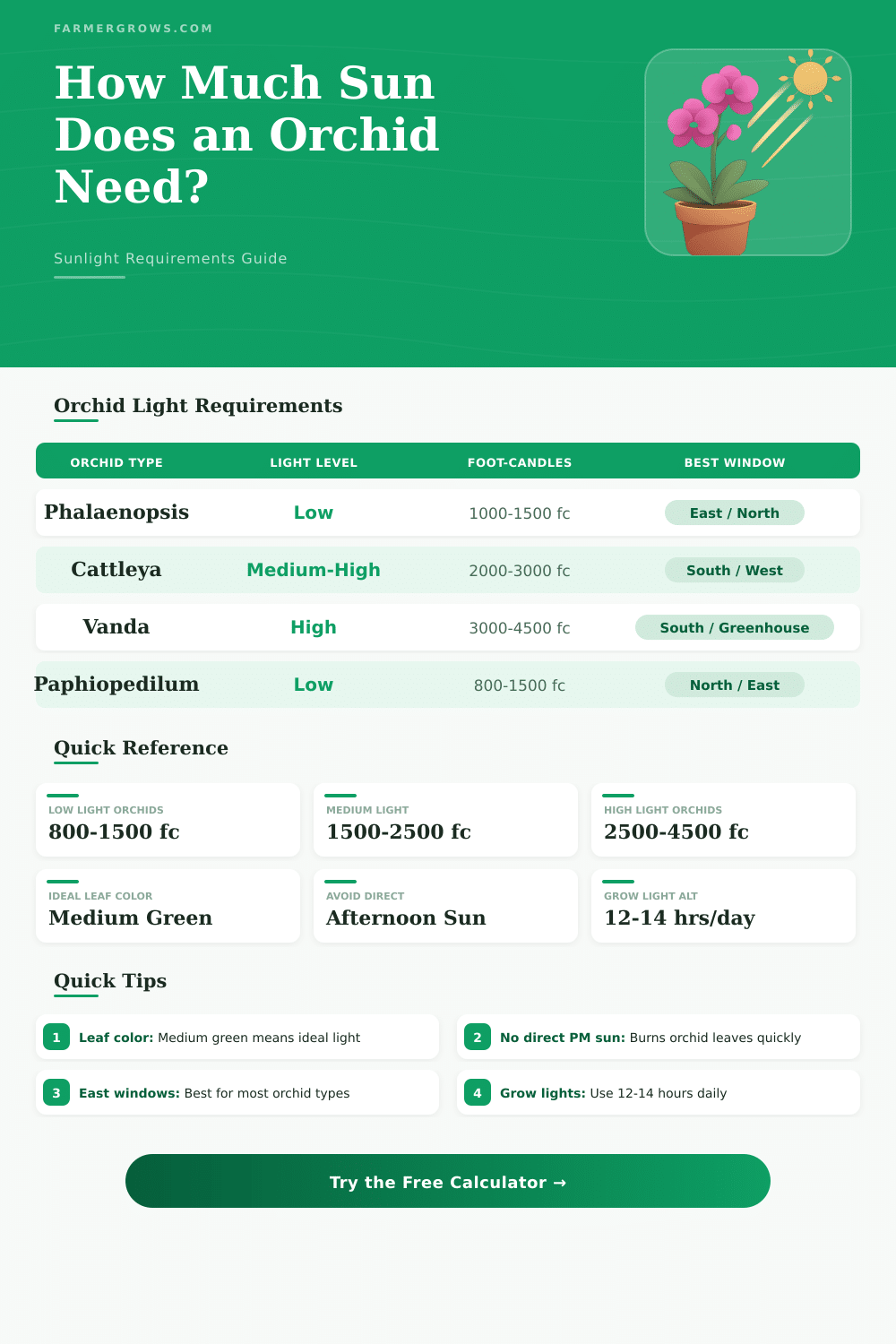
| Orchid Type | Light Level | Foot-Candles | Best Window |
|---|---|---|---|
| Phalaenopsis (Moth) | Low | 1,000–1,500 fc | East / North |
| Cattleya | Medium-High | 2,000–3,000 fc | South / West (sheer curtain) |
| Dendrobium | Medium-High | 2,000–3,000 fc | East / South (bright indirect) |
| Oncidium | Medium | 1,500–2,500 fc | East / South |
| Vanda | High | 3,000–4,500 fc | South / Greenhouse |
| Paphiopedilum | Low | 800–1,500 fc | North / East |
| Cymbidium | High | 2,500–3,500 fc | South / Outdoor summer |
| Miltonia | Medium | 1,500–2,000 fc | East |
| Window Direction | Light Intensity | Estimated Foot-Candles | Best For |
|---|---|---|---|
| North | Low, consistent | 200–800 fc | Phalaenopsis, Paphiopedilum |
| East | Moderate morning sun | 500–2,000 fc | Most orchids, gentle morning light |
| South | Brightest, all day | 1,500–5,000+ fc | Vanda, Cattleya, Cymbidium (with sheer curtain) |
| West | Strong afternoon sun | 1,000–4,000 fc | Cattleya, Dendrobium (use sheer curtain in summer) |
| Orchid Type | PPFD Target (µmol/m²/s) | Daily Hours | Recommended Spectrum |
|---|---|---|---|
| Low Light (Phal, Paph) | 80–150 | 12–14 hrs | Full spectrum, warm white |
| Medium (Oncidium, Miltonia) | 150–250 | 12–14 hrs | Full spectrum, balanced |
| Medium-High (Cattleya, Dend) | 200–350 | 12–14 hrs | Full spectrum, bright white |
| High Light (Vanda, Cymb) | 300–500 | 12–16 hrs | Full spectrum, high output |
| Leaf Color | Light Status | Action Needed | Details |
|---|---|---|---|
| Dark Green | Too Little Light | Move closer to window | Orchid is not getting enough light to bloom well |
| Medium Green | Ideal | No change needed | Healthy color indicates proper light levels |
| Light / Yellow-Green | Too Much Light | Move away or add sheer curtain | Leaves may sunburn if not corrected |
| Red or Purple Tint | Sun Stress | Reduce direct exposure | Natural defense but signals upper limit reached |
Orchids need sun to grow and bloom. Here something clear. However the main problem deals with the right amount of that light.
For them the best lighting is strong, but not direct or focused. Too strong sun can hurt the leaf. In wild nature they usually grow on trees or branches of big trees.
How Much Light Do Orchids Need
One calls them air plants, and here they receive light that passes through the green cover of the woods. Because of that their needs for sun are most commonly medium to clear indirect light.
Various species of orchids need different levels of light. Usually they want the blue part to grow and red to form flowers. One groups them in three groups according to the need of light levels, measured by means of foot-candles.
Some species with high light need can handle direct light and can benefit under clear open conditions or under strong grow lights. For instance, Cattleya-orchids want more strong lighting and last some hours of direct sun. Even so it stays wise to manage it to escape wounds on the leaves.
Lay them beside south window with thin curtain to deliver strong light, that even so stays gentle.
Dendrobium-orchids stay healthy with six to eight hours of clear indirect sun. In winter seasons of north regions, extra grow lights help make up for the absence of natural light.
Phalaenopsis-orchids work otherwise. They benefit with weak lighting. Windows positioned northeast, with little or no direct sun answer well for them.
If the leaves of Phalaenopsis have dark shade, that shows absence of light. Clear olive-green leaves point to right amount. Reddish color on leaves and stem signals, that the plant itself makes natural protection against too much solar exposure.
A good way to check light levels is the simple shadow method. Hold the hand above the plant. Clear and sharp shade shows stronger and direct light.
Soft shade points too weaker light. Even around one window the levels can change a lot. Beside the glass direct sun reaches 4,000 to 8,000 foot-candles, but in the side area it sinks to about 500.
The most useful guard against too much sun is use filtered light, as by means of thin curtain. North or east windows also are useful. East and west windows, that receive two to five hours of direct light, answer for most orchids and form the best chance when the needs are unknown.
Orchids like steady light conditions. When a plant receives too much strong light too much time, its leaves become yellow, later pale, and brown marks show up. Without enough light they can grow tiny or notbloom at all.
Sudden temperature drop of around ten degrees can also push flowering.