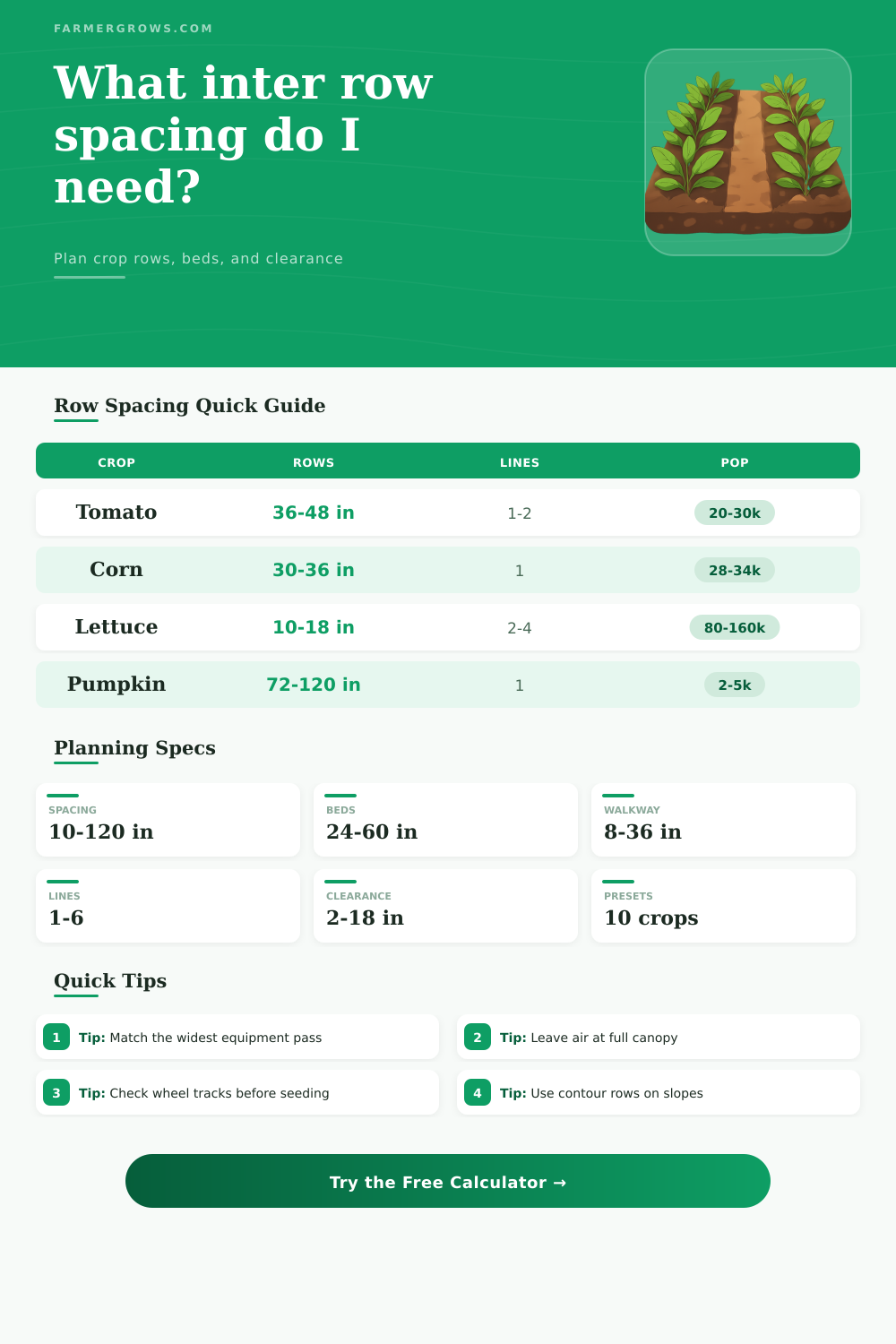
Inter Row Spacing Calculator
Size crop row spacing from canopy spread, tire track, implement width, raised bed layout, walkway clearance, irrigation line count, row orientation, and target plant population.
The calculator chooses the widest required row interval from crop canopy, equipment pass, bed plus walkway, and drip-line layout, then checks how that spacing affects rows per field and plants per acre.
Spacing Recommendation
The widest requirement becomes the working inter-row spacing. Population is recalculated from row spacing, row length, and the in-row spacing needed to approach your target.
| Formula | Expression | What it controls | Example |
|---|---|---|---|
| Canopy requirement | canopy spread + air clearance | Leaf airflow and harvest access at full size | 30 in + 8 in = 38 in |
| Equipment requirement | max(tire track, implement width) + clearance | Wheel track, cultivator, sprayer, or harvester pass | 54 in + 6 in = 60 in |
| Bed requirement | bed width + walkway | Raised bed center spacing and foot traffic | 30 in + 18 in = 48 in |
| Irrigation requirement | max(bed width, drip line span) + walkway | Multiple drip lines inside one bed or row strip | 2 lines at 12 in plus walkway |
| Recommended spacing | max(requirements) x orientation factor | The row center-to-center interval to use | 60 in x 1.04 = 62.4 in |
| Crop group | Common inter-row spacing | Typical canopy spread | Population note |
|---|---|---|---|
| Tomato, trellised cucumber | 42 to 72 in | 24 to 42 in | Population often limited by trellis and harvest lane |
| Corn, beans, planter crops | 20 to 36 in | 12 to 24 in | Planter and cultivator setup often set row centers |
| Lettuce, herbs, root crops | 10 to 24 in within beds | 6 to 14 in | Use bed utilization rather than single-row thinking |
| Potatoes and hilled crops | 30 to 42 in | 24 to 36 in | Leave enough soil and machine room for hilling |
| Pumpkins, squash, melons | 72 to 120 in | 60 to 120 in | Canopy spread usually dominates population |
| Equipment setup | Typical working width | Spacing impact | Field check |
|---|---|---|---|
| Hand harvest only | 18 to 30 in walkway | Walkway and canopy clearance usually dominate | Can workers pass without brushing plants? |
| Push seeder or wheel hoe | 12 to 24 in | Works well inside beds or narrow row centers | Check handle swing and turning area |
| Walk-behind tractor | 24 to 36 in | Often needs 30 to 42 in centers | Measure outside wheel width with attachments |
| Compact tractor | 48 to 72 in | Tire track may force wider centers than crop wants | Match row centers to tire track and implement |
| Mower, sprayer, harvest cart | 54 to 96 in | Alley width dominates permanent crop spacing | Leave room for loaded turns and wet soil |
| Row orientation | Calculator factor | When to use it | Spacing effect |
|---|---|---|---|
| Rows along long side | 1.00 | Most efficient row length and fewer turns | No extra spacing buffer |
| Rows across short side | 1.00 | Useful when access lanes or irrigation headers require it | No extra spacing buffer |
| North-south sun rows | 1.02 | Fruiting crops where even light matters | Slight buffer for leaf drying |
| East-west shade rows | 1.04 | Leafy crops in hot periods or shade management | Small buffer for shaded canopy |
| Contour or cross-slope rows | 1.06 to 1.08 | Slopes where erosion control matters | Extra space for turns and uneven ground |
Before planting: Mark two trial rows and drive the widest tractor, mower, cart, or sprayer through them. If the operator has to steer perfectly to avoid plants, add clearance.
Before tightening spacing: Compare bed utilization with canopy occupancy. A bed can look efficient early but still close too tightly when mature leaves, drip lines, and harvest traffic overlap.
Row spacing is a decision that determine both how the crop grows and how the person manage the field. Row spacing is important because the row spacing for the crop will determine how much light and air each plant in the field can receive. If row spacing is too narrow for the crop, then the plants will compete for the same amount of light, air, and growing space.
Furthermore, the field will not have enough space for machinery to move through the field without damaging the plant. If the row spacing is too wide, then the ground will remain empty and unproductively for the crop, and the plant population will drop as a result. Many grower will choose the row spacing for there fields based off what they accomplished during previous growing seasons.
How to Choose Row Spacing for Your Field
This choice will change if the crop or machinery within the field change. Several factor will determine the distance between rows. One of the factors is the spread of the canopy.
The leaves of the plants need to have space to breathe and for the fruit to be able to grow and be harvest from the plants. Additionally, the leaves and the fruit of the plants should not be ripped while harvesting the crop from the plants. Another of the factors that will influence the distance between rows is the equipment that will be used in the field.
The tires of the tractor and the cultivator will destroy any plant that the operator touch while using the machinery. Other factors include the width of the row beds and the number of walkways that will pass through the field. The irrigation line for the field can determine the width of each bed.
For example, if a person plants multiple drip tapes within one row bed, the irrigation lines will make the width of the bed wider than the plants require. A calculator can help a person decide on the row spacing for the field based on these growing requirements. A person may make the mistake of only considering the crop when determining the row spacing.
While the crop will require a minimum amount of room for each row, the machinery that will be used within the field may require more room than the crop require. For instance, if the sprayer for the fields has a sixty-inch track for its sprayer nozzles, the row spacing for the plants should be no less than sixty inches. Any attempt to use this sprayer within a field with forty-eight-inch rows will damage the plants.
Another mistake that a person can make is ignoring the size of the tractor that will be used within the field when setting the row spacing. For instance, a person using row spacing for a large tractor within a small hand scale operation will create row beds that are too wide for the individual operator to manage the field effectively. The plant population will be too low within these field due to the row spacing.
The orientation of the rows within the field is another factor that will impact how well the field performs. If the rows within the field are oriented to run north and south, each crop will receive even light throughout the day. Additionally, for crops that require the plants to color evenly during the growing season, north-south rows are the best orientation for the rows within the field.
Fields with east and west rows will create shade for the crops during the afternoon. This feature is beneficial for crops like lettuce that need to be protected from too much sunlight during hot months. Rows that are implemented as contours along the slope of the land will control erosion of the soil.
However, the contouring of the field will make it more difficult to efficient manage the field. Bed utilization within a field can be a feature that many people ignore when the plants are small. For instance, many plant beds may look good for young plants but will grow to become a tunnel of vegetation that prevents anyone from accessing the harvested crops.
Another overlooked feature is that if there is a walkway for the worker or the machinery within the field to use, but if the plants are too tall when mature, then the walkway becomes waste space within the field. Many people will ignore this when the plants are small but must be considered when the crops grow to they’re full potential. Another factor is the irrigation layout within the field.
A person can use one drip line within each row. Alternatively, the farmer can use two or four drip lines within one planting bed. Using multiple drip lines allow the crops to receive adequate water without increasing the height of the planting beds.
Thus, the number of drip lines within the field will impact the width of the strips of land that will be irrigated. The irrigation requirement for the field will impact the row spacing for the field. Population target for the plants to be grown within the field will be the last factor to consider.
The person may desire a specific number of plants within a given acre of the field. The row spacing of the field may not allow for the population target for the desired yield. The population calculator for the field will display the difference between the target and actual population.
The person can use this calculation to determine how they will manage the field relative to there desired population target. Fields often contain features that interfere with the mathematical calculations that determine the row spacing of the field. Features like headlands, turn rows, and wet spots in the field will limit the number of acre that can actualy be utilized for growing the plant.
Fields on a slope may require additional space between the rows to allow for the movement of a loaded cart. A wet spot in the spring may turn a narrow walkway into mud. This mud will make it difficult for the worker to travel the field without stepping on the plant.
A person should perform a certain practical habit to ensure that the row spacing is correct. A person should mark two row at the distance that was calculated for row spacing. After marking the two rows, all of the machinery that will be used within the field should be driven through these two rows.
If an operator has to slow the machinery or steer the machinery very precisely to avoid damaging the plants, the row spacing is too narrow for the machinery to be used within the field. This habit is a low-cost management practice to avoid making mistakes with row spacing during the middle of the growing season. You should of checked this early.