⚙️ Hydraulic Cylinder Size Calculator
Calculate bore diameter, rod size, force output, extension speed & flow rate for any hydraulic cylinder application
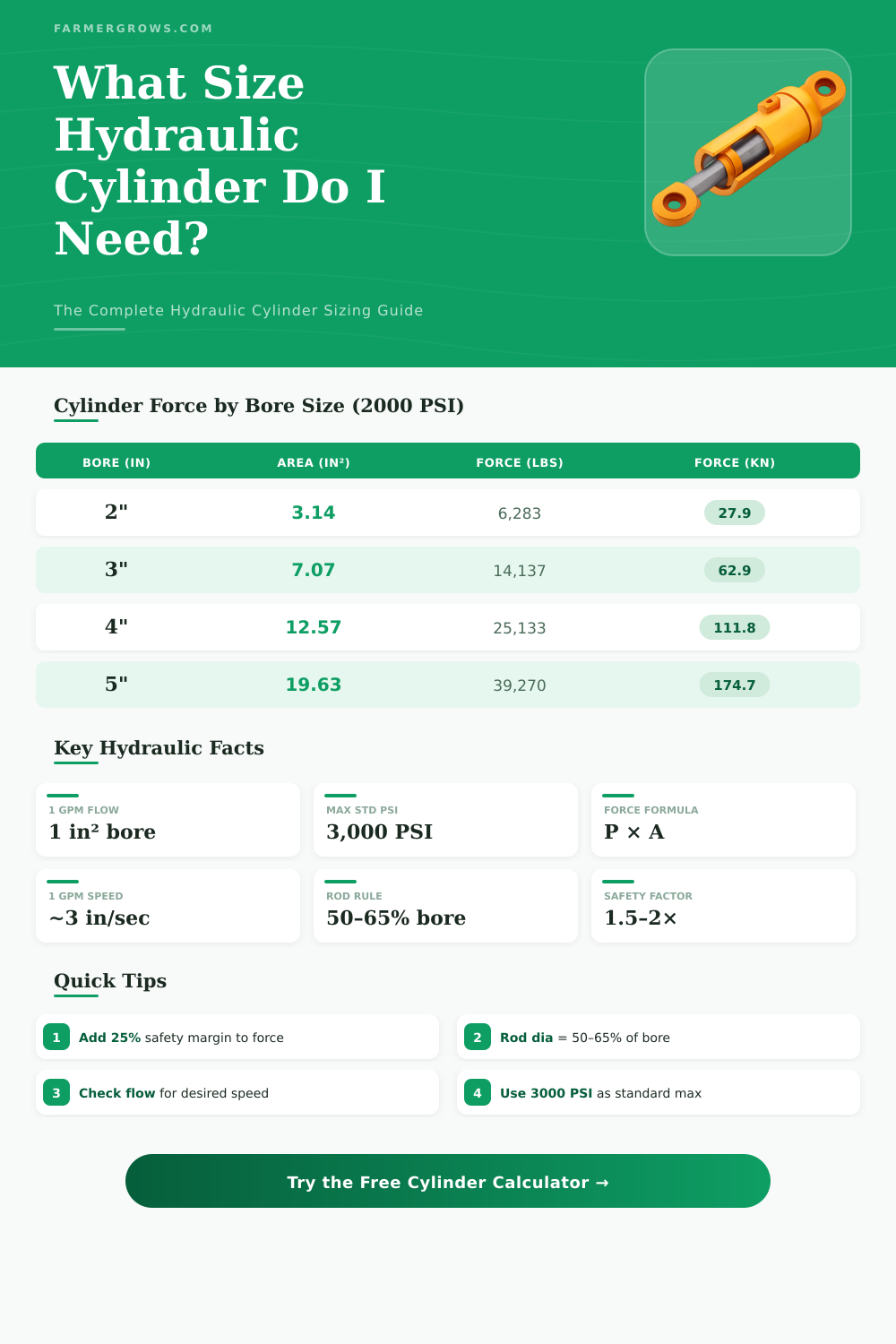
| Bore (in) | Area (in²) | Force @ 1500 PSI | Force @ 2000 PSI | Force @ 3000 PSI | Force @ 5000 PSI |
|---|---|---|---|---|---|
| 1.5" | 1.77 | 2,651 lbs | 3,534 lbs | 5,301 lbs | 8,836 lbs |
| 2" | 3.14 | 4,712 lbs | 6,283 lbs | 9,425 lbs | 15,708 lbs |
| 2.5" | 4.91 | 7,363 lbs | 9,817 lbs | 14,726 lbs | 24,544 lbs |
| 3" | 7.07 | 10,603 lbs | 14,137 lbs | 21,206 lbs | 35,343 lbs |
| 3.5" | 9.62 | 14,432 lbs | 19,242 lbs | 28,863 lbs | 48,105 lbs |
| 4" | 12.57 | 18,850 lbs | 25,133 lbs | 37,699 lbs | 62,832 lbs |
| 5" | 19.63 | 29,452 lbs | 39,270 lbs | 58,905 lbs | 98,175 lbs |
| 6" | 28.27 | 42,412 lbs | 56,549 lbs | 84,823 lbs | 141,372 lbs |
| 7" | 38.48 | 57,726 lbs | 76,969 lbs | 115,453 lbs | 192,422 lbs |
| 8" | 50.27 | 75,398 lbs | 100,531 lbs | 150,796 lbs | 251,327 lbs |
| Bore (in) | 2 GPM Speed | 5 GPM Speed | 10 GPM Speed | 15 GPM Speed | 20 GPM Speed |
|---|---|---|---|---|---|
| 2" | 2.55 in/sec | 6.37 in/sec | 12.73 in/sec | 19.10 in/sec | 25.46 in/sec |
| 3" | 1.13 in/sec | 2.83 in/sec | 5.66 in/sec | 8.49 in/sec | 11.32 in/sec |
| 4" | 0.64 in/sec | 1.59 in/sec | 3.18 in/sec | 4.77 in/sec | 6.37 in/sec |
| 5" | 0.41 in/sec | 1.02 in/sec | 2.04 in/sec | 3.06 in/sec | 4.07 in/sec |
| 6" | 0.28 in/sec | 0.71 in/sec | 1.41 in/sec | 2.12 in/sec | 2.83 in/sec |
| Application | Typical Bore | Typical Pressure | Force Range |
|---|---|---|---|
| Gate / Door Actuator | 1" – 2" | 500 – 1500 PSI | 400 – 4,700 lbs |
| Log Splitter | 3" – 5" | 2000 – 3000 PSI | 14,000 – 59,000 lbs |
| Snow Plow / Blade | 2" – 3" | 1000 – 2000 PSI | 3,100 – 14,000 lbs |
| Tractor 3-Pt Hitch | 2.5" – 4" | 1800 – 2500 PSI | 8,800 – 31,400 lbs |
| Dump Truck Hoist | 4" – 6" | 2000 – 3000 PSI | 25,000 – 85,000 lbs |
| Excavator Arm | 5" – 8" | 2500 – 5000 PSI | 49,000 – 251,000 lbs |
| Industrial Press | 6" – 12" | 2000 – 5000 PSI | 56,000 – 565,000 lbs |
| Forklift Mast | 3" – 5" | 2000 – 3500 PSI | 14,000 – 69,000 lbs |
| PSI | Bar | MPa | kPa |
|---|---|---|---|
| 500 PSI | 34.5 bar | 3.45 MPa | 3,447 kPa |
| 1,000 PSI | 68.9 bar | 6.89 MPa | 6,895 kPa |
| 1,500 PSI | 103.4 bar | 10.34 MPa | 10,342 kPa |
| 2,000 PSI | 137.9 bar | 13.79 MPa | 13,790 kPa |
| 2,500 PSI | 172.4 bar | 17.24 MPa | 17,237 kPa |
| 3,000 PSI | 206.8 bar | 20.68 MPa | 20,684 kPa |
| 5,000 PSI | 344.7 bar | 34.47 MPa | 34,474 kPa |
The size of hydraulic cylinder is very important working with farm machines. They deliver linear force to lift, tilt or move parts of tools like loaders, mowers and rotary cutters. It matters to choose the right type or design of hydraulic cylinder, which leads to thinking about specifications.
Here are factors like bore size, rod diameter, stroke length, operating pressure and materials
Choosing the Right Hydraulic Cylinder for Farm Machines
Right hydraulic cylinder for tools requires you to mind bore size, stroke length, mounting style and PSI. When you buy new hydraulic cylinder, many things require thought, for example the mount type. Mounting affects the alignment of the roll, its mode and skill to bear loads.
Common types are flange, clevis and trunnion mounts. The speed and force needs decide the size.
Precise measurement is importnat. You measure stroke length taking the extended length of hydraulic cylinder minus the retracted length. Bore diameter you estimate from the outside diameter of cylinder less the tube wall.
At assembled or installed cylinder it is possible to estimate bore diameter from outside diameter less the thickness of both tube walls. Standard bore sizes range from 25 mm until 125 mm for bores. Industrial standard tube sizes are available in charts, so it is possible to easily compare and identify.
The rod of hydraulic cylinder is round chrome steel pole for back and forth move. It does not decide the cylinder size. The piston diameter or bore size give the name as 2-inch, 3-inch or 4-inch.
If rod estimates half of the cylinder bore size, that is reasonably exactly.
Big bores give big piston area, which increases the force that cylinder generates. Occasionally the size depends more on rod force and column load capacity. It is not enough to only count force.
Cylinder rod can travel from a fraction of inch until several feet. There is risk of big cylinder failure, if small cylinder bears maximum load in full rod extent. Big bore and rod for safe carrying of whole load is key.
AG hydraulic cylinders range from 1.5-inch bore until 4.0-inch bore. For instance, 2-inch bore with 4-inch stroke in 2500 PSI operates as standard agricultural double acting cylinder. Standard thread sizes usually are 1/4, 3/8, 1/2 or 3/4 inches.
If heads or base requires ports other than standard, point cylinder bore size and thread size. Speed depends on cylinder size, port size, air pressure, bore, hose length and the load itworks against.