🌸 Hydrangea Spacing Calculator
Calculate exactly how much space your hydrangeas need based on variety, planting arrangement, and garden size
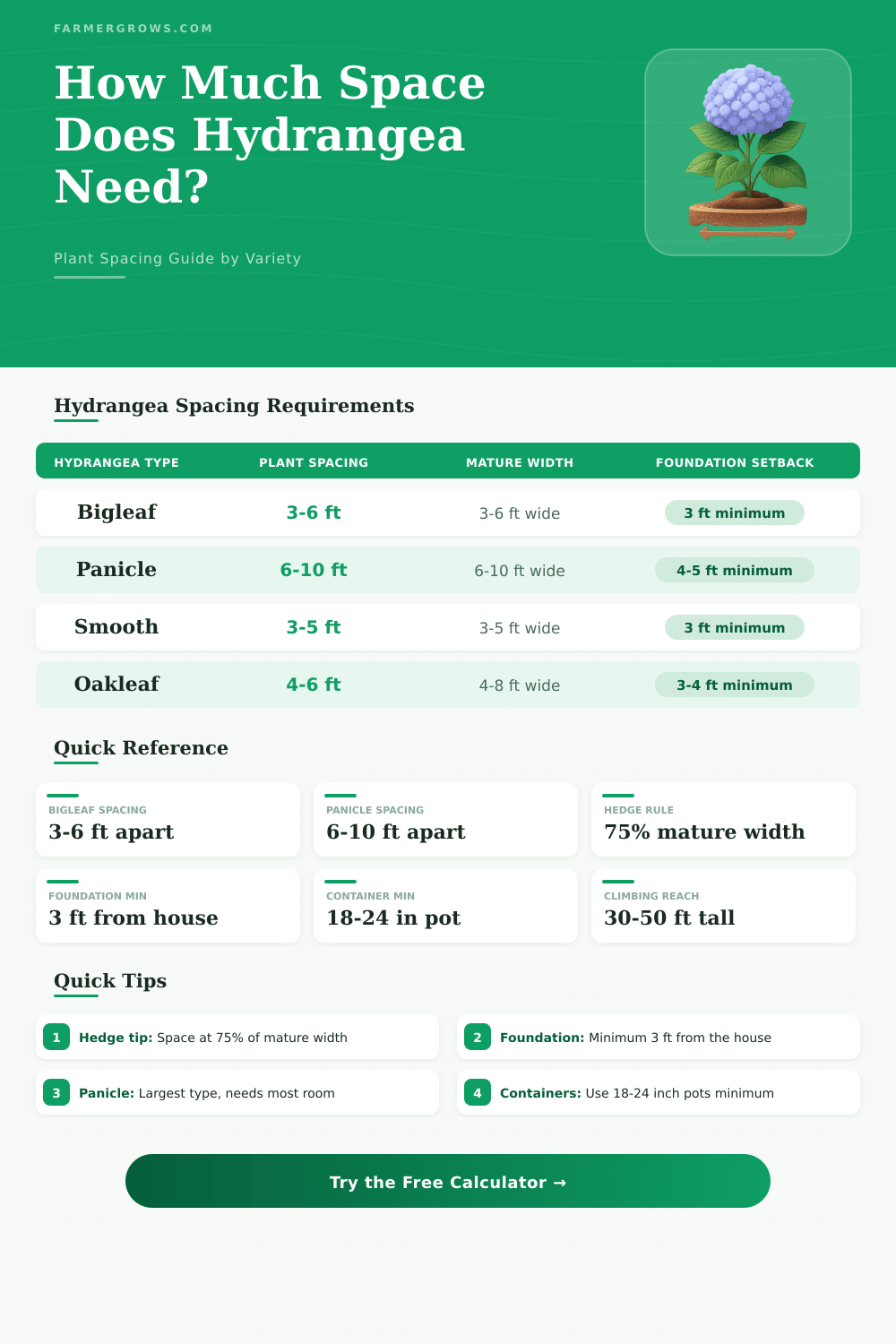
| Hydrangea Type | Plant Spacing | Mature Width | Mature Height | Foundation Setback |
|---|---|---|---|---|
| Bigleaf | 3–6 ft (90–180 cm) | 3–6 ft (90–180 cm) | 3–6 ft | 3 ft min |
| Panicle | 6–10 ft (180–300 cm) | 6–10 ft (180–300 cm) | 8–15 ft | 4–5 ft min |
| Smooth / Annabelle | 3–5 ft (90–150 cm) | 3–5 ft (90–150 cm) | 3–5 ft | 3 ft min |
| Oakleaf | 4–6 ft (120–180 cm) | 4–8 ft (120–240 cm) | 4–8 ft | 3–4 ft min |
| Climbing | 5–8 ft (150–240 cm) | 5–6 ft spread | 30–50 ft | 1–2 ft from wall |
| Mountain | 3–4 ft (90–120 cm) | 3–5 ft (90–150 cm) | 2–4 ft | 3 ft min |
| Hydrangea Type | Growth Rate | Years to Mature | Spread at Maturity | Best For |
|---|---|---|---|---|
| Bigleaf | Moderate | 3–5 years | 3–6 ft diameter | Borders, containers, specimen |
| Panicle | Fast | 3–5 years | 6–10 ft diameter | Specimen, privacy screen |
| Smooth | Fast | 2–4 years | 3–5 ft diameter | Mass planting, borders |
| Oakleaf | Moderate | 4–6 years | 4–8 ft diameter | Woodland, foundation, specimen |
| Climbing | Slow initially | 5–7 years | 30–50 ft coverage | Walls, fences, arbors |
| Mountain | Moderate | 3–4 years | 3–5 ft diameter | Small gardens, containers |
| Hydrangea Type | Hedge Spacing | Plants Per 10 ft | Fill-In Time |
|---|---|---|---|
| Bigleaf | 2.5–4.5 ft (75% of width) | 2–4 plants | 2–3 years |
| Panicle | 4.5–7.5 ft (75% of width) | 1–2 plants | 2–4 years |
| Smooth | 2.5–3.75 ft (75% of width) | 3–4 plants | 1–2 years |
| Oakleaf | 3–4.5 ft (75% of width) | 2–3 plants | 3–4 years |
| Mountain | 2.5–3 ft (75% of width) | 3–4 plants | 2–3 years |
| Garden Size | Specimen Plants | Hedge Row Plants | Mass Planting |
|---|---|---|---|
| 5 × 5 ft (1.5 × 1.5 m) | 1 (small type) | N/A | 1 |
| 10 × 10 ft (3 × 3 m) | 1–2 | 2–3 | 3–4 |
| 20 × 10 ft (6 × 3 m) | 2–3 | 4–6 | 6–10 |
| 30 × 6 ft (9 × 1.8 m) | 3–4 | 5–8 (hedge line) | 8–12 |
| 20 × 20 ft (6 × 6 m) | 3–5 | 5–8 | 10–20 |
| 50 × 20 ft (15 × 6 m) | 5–8 | 10–15 | 25–50 |
Hydrangea rank between the most favourite bushes for gardens. They give rich flowers that span a long time from summer until autumn. That makes them good for shady banks of forests, grown at foundations, banks with bushes group crops or even in vases.
When gardens shrink in size and Space becomes tight, homeowners more commonly choose little types of Hydrangea, that well adapt to tiny areas.
How Far Apart Should You Plant Hydrangeas
Well Space Hydrangea is truly important. Widely one leaves 3 until 10 feet between them, according to the species. Practical advice is add one-foot distance around the width, that the adult plant will reach.
Only climbing Hydrangea stray from that rule. When one plants them for fences, commonly suggest 24 inches between the centres, although many hybrids can spread more than expected and surpass their planned sizes.
Smooth Hydrangea usually expand in 3 until 5 feet in width. If one spaces them at around 5 feet, that helps their healthy growth. Oakleaf Hydrangea favour 7 until 9 feet of Space.
Climbing species require 6 until 7 feet, together with a lot of vertical height. They will extend 3 until 5 feet out from a wall, when they fully grow. One can also choose spacing of 3 until 6 feet between the plants, depending on the type.
Putting two bushes too closely is not wise. If planted at the right distance, two Hydrangea will eventually look as won alone group. Even so, that requires some years to fill the area.
When they are planted too close, they start to compete between themselves.
Hydrangea plants have several species. The majority grow as bushes, but the climbing Hydrangea looks like grape. Maybe mophead and lacecap are the most common in zones of 6 until 9.
For fences try panicle, smooth or oakleaf Hydrangea. The oakleaf adds also nice autumn colour to the leaves. Hydrangea are quite dense to create a barrier, both physically and visually.
The size of Hydrangea varies a lot. New types commonly stay at only 2 until 3 feet high and broad, ideal for tiny areas. Some compact forms reach only 1 until 2.5 feet in both directions.
On the other hand, some Hydrangea can rise until 20 feet or even more. Mountain Hydrangea are usually smaller, so they perfectly suit for little gardens and vases.
Hydrangea benefit in rich, well draining ground with enough moisture. They grow best in a bit sour soil. In the south, afternoon shade is needed.
One must avoid warm, dry and bare places. Cover from mulch helps to keep the moisture and control the temperatures of the soil. Hydrangea require Space to keep their growth and flowering yearly after yearly.
Because of that, for potted Hydrangea, choose a pot some inches broader than the original, andleave around three inches between the soil surface and the edge of the pot, which is advised.