Heat Units Calculator
Estimate growing degree days from crop base temperature, upper cutoff, daily high and low, and a selected day span. Add accumulated GDD and a maturity target to project how fast the field is moving.
Choose a named crop profile to load practical base temperature, upper cutoff, maturity target, and typical field weather. You can edit every value after selecting a preset.
Heat Units Output
Results use the selected crop base, cutoff method, daily temperatures, day span, accumulated GDD, and forecast pace.
| Crop | Common Base | Upper Cutoff | Typical Target | Best Use |
|---|---|---|---|---|
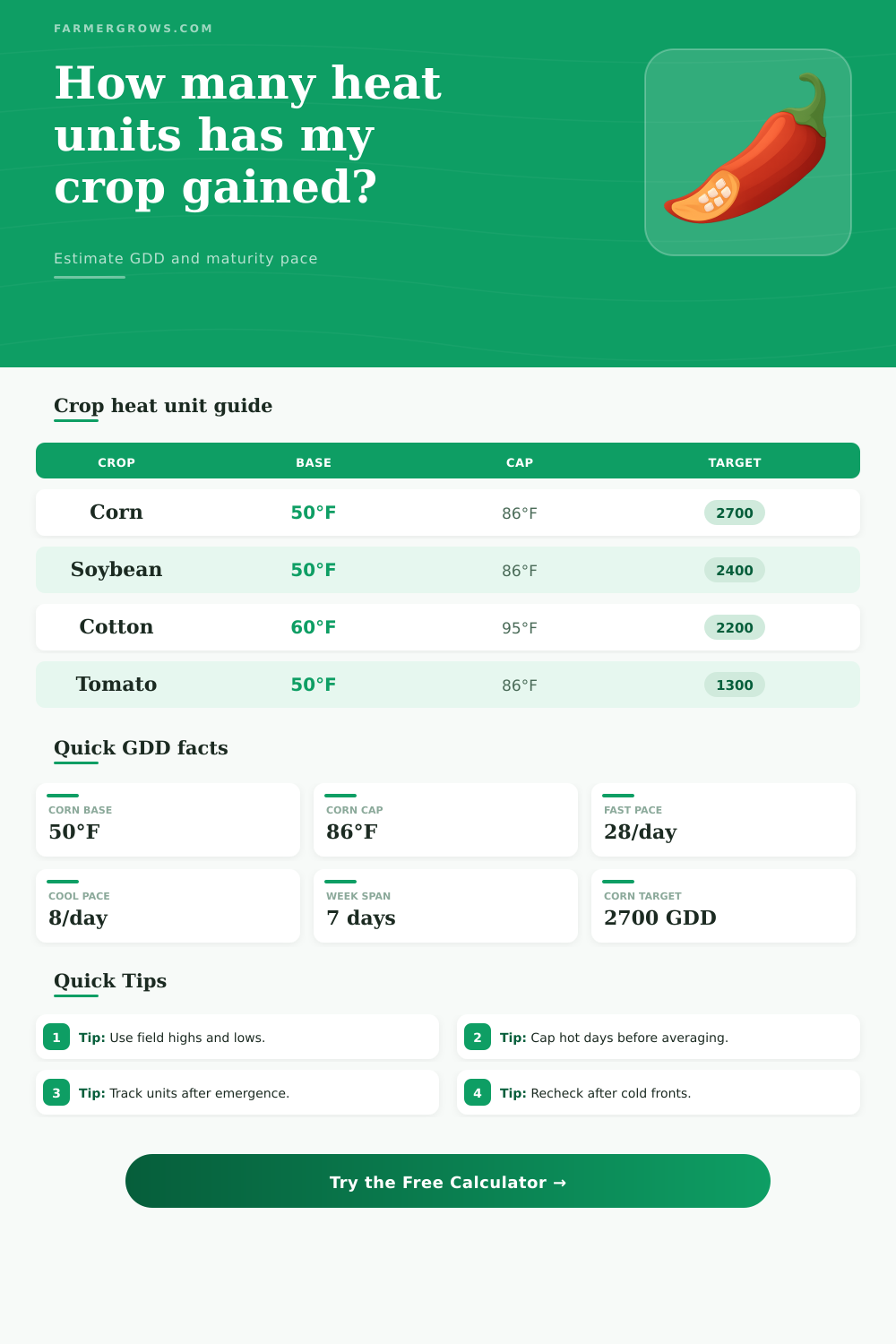
| Field corn | 50°F / 10°C | 86°F / 30°C | 2,400-3,000 GDD | Emergence to black layer by hybrid maturity |
| Sweet corn | 50°F / 10°C | 86°F / 30°C | 1,200-1,700 GDD | Planting to harvest window |
| Soybean | 50°F / 10°C | 86°F / 30°C | 2,200-2,800 GDD | Emergence to maturity by maturity group |
| Cotton | 60°F / 15.6°C | 95°F / 35°C | 1,900-2,300 GDD | Squaring, bloom, boll, and cutout tracking |
| Grain sorghum | 50°F / 10°C | 95°F / 35°C | 2,000-2,600 GDD | Emergence to physiological maturity |
| Tomato | 50°F / 10°C | 86°F / 30°C | 1,000-1,500 GDD | Transplant to first ripe fruit timing |
| Potato | 45°F / 7.2°C | 86°F / 30°C | 1,200-1,800 GDD | Emergence to tuber bulking and vine kill planning |
| Winter wheat | 32°F / 0°C | 86°F / 30°C | 1,800-2,400 GDD | Spring green-up to heading and grain fill |
| Crop | Early Stage | Mid Stage | Late Stage | Field Note |
|---|---|---|---|---|
| Field corn | VE 90-150 | V6 450-650 | R6 2,400+ | Hybrid maturity changes the final target. |
| Soybean | Emergence 90-150 | Flowering 750-1,100 | R8 2,200+ | Photoperiod still matters for flowering. |
| Cotton | Squaring 450-550 | Bloom 850-950 | Open boll 1,800+ | Use nodes and fruit retention with heat units. |
| Tomato | Rooting 120-220 | Flowering 450-650 | First ripe 1,000+ | Very hot nights can slow fruit set. |
| Potato | Emergence 250-350 | Tuber set 600-800 | Bulking 1,200+ | Water stress shifts useful heat into stress. |
| Alfalfa | Regrowth 100-150 | Bud 450-550 | Early bloom 700+ | Cutting quality falls as maturity advances. |
| Daily Low | Daily High | 50/86 Crop | 60/95 Crop | Interpretation |
|---|---|---|---|---|
| 44°F | 62°F | 3 GDD | 0 GDD | Slow spring growth; warm-season crops barely move. |
| 52°F | 74°F | 13 GDD | 3 GDD | Moderate for corn and soybean, light for cotton. |
| 62°F | 84°F | 23 GDD | 13 GDD | Strong growth without hitting an upper cutoff. |
| 70°F | 94°F | 28 GDD | 22 GDD | Corn is capped; cotton still gains useful heat. |
| 76°F | 101°F | 31 GDD | 25.5 GDD | Heat accumulation continues but stress risk rises. |
| Method | Formula Idea | Best For | Watch Out For |
|---|---|---|---|
| Average with upper cutoff | Cap low and high, average, subtract base | Most crop GDD tracking with published cutoffs | Can understate heat where night lows stay high |
| Cap high only | Limit high, keep actual low, average, subtract base | Simple field notebooks and mixed data sources | Cold lows below base may reduce the average strongly |
| No upper cutoff | Average actual low and high, subtract base | Cool-season checks and rough comparisons | Overstates growth on very hot days |
| Forecast pace | Remaining GDD divided by expected GDD/day | Harvest planning, scouting rounds, irrigation timing | Update after weather pattern changes |
Growing degree days, or GDD, are a method that grower use to measure teh growth of a crop based on heat accumulation. While the calendar is a helpful tool for measuring time, the calendar isnt an accurate method for determining the time it will take for a plant to reach the maturity stage. The calendar does not take into account the different weather conditions that may inhibit the growth of the plant.
Plants will not grow based on the number of days that pass, but instead, based on the amount of heat that the plant accumulates. Growing degree days will help a grower to determine after how many days the crop will be ready for harvest. Every plant contains a base temperature.
How Growing Degree Days Measure Plant Growth
The base temperature for the plant is the amount of heat that is required for the plant to begin to grow. If the air temperature are too low for the plant’s base temperature, then the plant will not accumulate any growing degree days. After the air temperature reaches the base temperature for the plant, the plant will begin to accumulate the growing degree days.
The growing degree days are accumulated with each degree that the air temperature exceed the base temperature. When a plant accumulates enough growing degree days, it will reach a number of important milestones within its growing season. Growing degree days consider the number of days in relation to the heat accumulation for the plant rather than the actual number of hours that pass in a day.
In order to calculate the growing degree days for a plant, the grower uses the upper cutoff temperature for the plant. This is used to ensure that the grower does not calculate too many growing degree days for the plant. If too many growing degree days is calculated for a plant, the date in which the plant will be ready for harvest will be incorrect.
Each plant has a ceiling to the amount of heat that it can accumulate. For instance, if the air temperature reaches 105 degree for a corn plant, it may be stressed by the heat instead of experience a growing season. By using an upper cutoff temperature, the grower ensures that the growth of the plant is correctly calculated and projected.
Due to the environment in which the plant is grown, the temperature that the plant experiences may not be the same as the temperature that is recorded in a weather station. Instead, adjustments must be made for the field in which the plant is grown. For instance, black plastic mulch will become heated during the sunny days, which can heat the soil in which the plant is grown.
The heated soil will allow for the plant to reach its growing degree days at a faster rate. Additionally, if the field in which the plant is grown has heavy covering of leaves, the temperature in the field may be less than the temperature recorded at the weather station. These factors in the field may alter the growing degree days that would normally be calculated for that plant, thus requiring the grower to make adjustments for the field in which the plant is grown.
Growing degree days does not guarantee that the plant will reach the maturity stage for its crops. While growing degree days is a helpful method for calculating the potential growth of a plant, other stressors in the environment may interfere with that potential growth. If the plant is exposed to stressors like drought or a lack of nitrogen to its leaves, the plant may not be able to accumulate enough heat to reach maturity.
For instance, if the plant is wilting from a lack of water, the plant will not be able to grow, even if the air temperature is high enough for the plant to accumulate enough growing degree days. While growing degree days may provide the grower with a baseline for the growth stage of the plant, the physical condition of the plant will help to determine the actual growing progress that the plant will make during its season. Growing degree days can be of great use for the grower to project the date on which the plant will be ready for harvest.
If the grower knows the amount of growing degree days that the plant has currently accumulated, and the weather that is forecasted for the plant, the grower can project the date on which the plant will reach the maturity stage for its crops. For instance, if the grower determines that the plant is currently at eighty percent of the required growing degree days for its season, the grower can plan the harvest of the crops for the farm. Growing degree days will transform the period of uncertainty for the grower into a logistical plan for the farm to plan its activities.
Because each plant species responds differently to heat, each species will contain different requirements for the amount of growing degree days that is required for the plant to reach its various milestones during its season. For instance, the cotton plant will require a higher base temperature than the potato plant. By referring to tables that list different plants and their requirement for growing degree days, growers can easily understand the progress of each plant species within its environment.
While each grower will experience the same weather around the world, each species of plant will react differently to the heat that it receives during the growing season. By calculating the amount of growing degree days that a plant is to accumulate during its season, the grower can establish a scientific baseline for that plant and understand the biological stage of its growth.