Greenhouse Heating Calculator
Estimate winter greenhouse heat load from dimensions, exposed surface area, glazing U-value, inside and outside temperature, air changes, curtain savings, heater efficiency, fuel use, and backup capacity.
Use this as a sizing estimate for farm planning. Confirm final equipment with local codes, combustion air needs, venting, crop temperature targets, and site wind exposure before installation.
Greenhouse Heating Results
Results combine glazing conduction, infiltration heat loss, curtain reduction, heater efficiency, and selected fuel heat content.
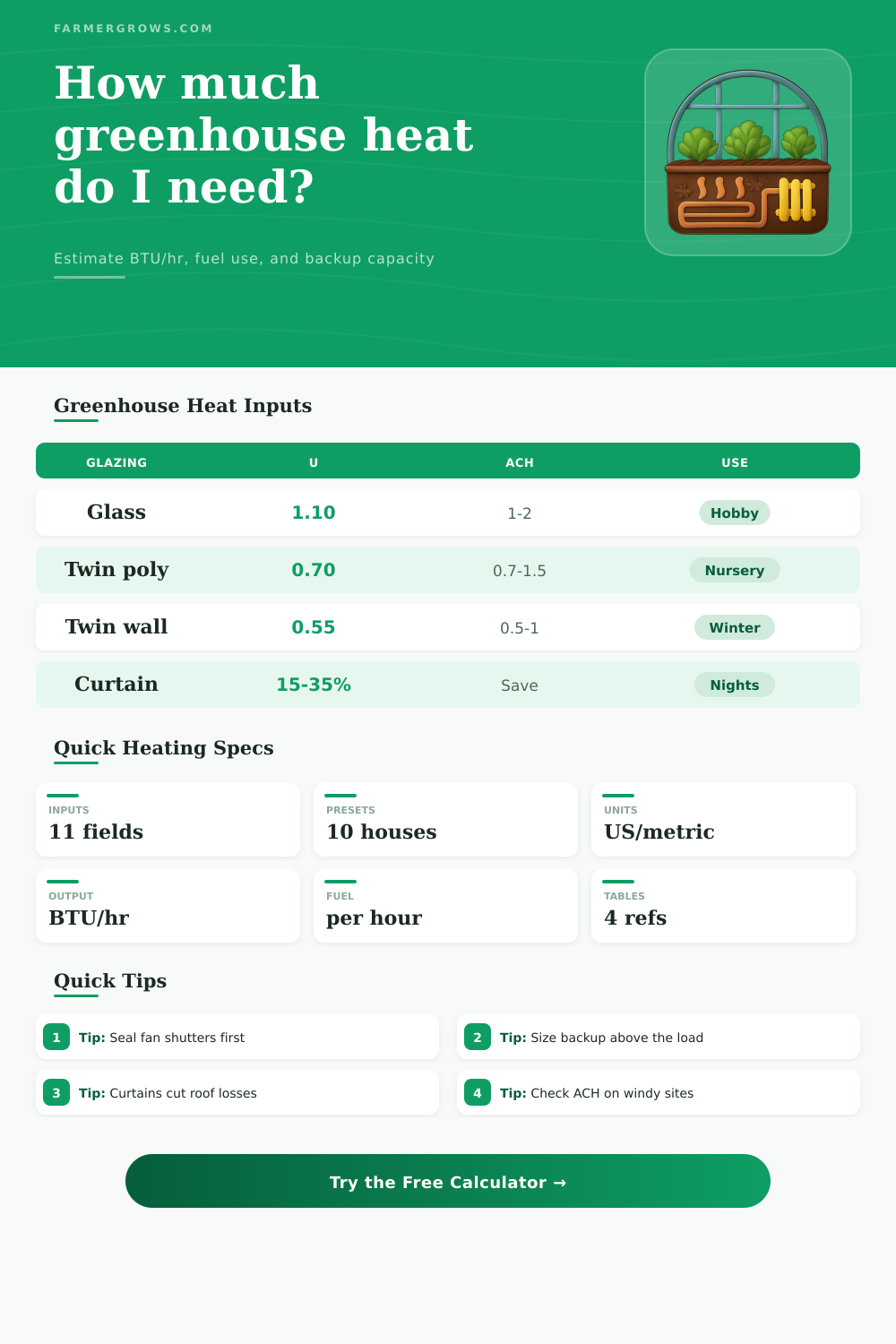
| Glazing type | Typical U-value | Heat loss tendency | Best planning note |
|---|---|---|---|
| Single polyethylene film | 1.10 to 1.25 | Highest | Use for seasonal crops or pair with larger backup heat. |
| Single glass | 1.00 to 1.15 | High | Air leakage around old sash can matter as much as glass loss. |
| Double inflated poly | 0.70 to 0.85 | Moderate | Keep blower pressure steady so the air layer remains useful. |
| Twin-wall polycarbonate | 0.55 to 0.65 | Lower | Good for permanent winter houses and sidewall retrofits. |
| Multi-wall panel with curtain | 0.35 to 0.55 effective | Lowest | Account for curtain gaps, tracks, and end-wall leakage. |
| Air tightness condition | ACH planning range | Typical source | When to use it |
|---|---|---|---|
| Tight new greenhouse | 0.4 to 0.8 | Sealed doors, tight poly, closed vents | Calm sites with maintained weather seals. |
| Average production house | 0.8 to 1.5 | Fans, louvers, doors, minor film gaps | Common default range for winter estimating. |
| Older or windy house | 1.5 to 2.5 | Loose shutters, worn seals, exposed ridge | Use when heat drops quickly on windy nights. |
| Frequent door traffic | 2.0 to 3.5 | Loading, harvest, rolling doors | Use for busy ranges or retail greenhouses. |
| Emergency ventilation crack | 3.5 plus | Open vent or failed closure | Use only for contingency checks, not normal sizing. |
| Heating system | Typical efficiency | Fuel unit used here | Greenhouse note |
|---|---|---|---|
| Propane unit heater | 78% to 85% | 91,500 BTU per gallon | Common for small and mid-size houses. |
| Natural gas unit heater | 80% to 93% | 100,000 BTU per therm | Often easiest to stage across multiple bays. |
| Condensing boiler | 88% to 96% | Fuel dependent | Useful for hydronic bench, root-zone, or floor heat. |
| Electric resistance | 100% | 3,412 BTU per kWh | Simple output math, but service capacity must be checked. |
| Wood pellet heater | 70% to 82% | 8,000 BTU per pound | Feed reliability and ash handling affect backup planning. |
| Backup margin | Added capacity | Use case | Planning note |
|---|---|---|---|
| Light reserve | 10% | Mild climate, tight house | Works when crop damage risk is low. |
| Standard reserve | 20% | Most greenhouse sizing | Good default for colder nights and cycling losses. |
| Wind reserve | 30% | Exposed or leaky houses | Use when infiltration is uncertain. |
| Recovery reserve | 40% | Retail, harvest, door traffic | Helps recover temperature after openings. |
| Critical crop reserve | 50% plus | High-value starts or tropical crops | Pair with alarms and independent heat source. |
Before upsizing heaters: Seal fan shutters, roll-up sides, louver edges, end-wall gaps, and door sweeps. Infiltration can exceed glazing loss on windy nights.
Before choosing fuel: Compare delivered BTU, not just burner input. Efficiency, standby losses, and backup staging all change real greenhouse heat capacity.
The decisions of what type of heat source should be used in a greenhouse requires the consideration of many different factors related to the greenhouse itself, the movement of air within the greenhouse, and the weather outside of the greenhouse. Because each of these factors will impact an amount of energy that is required to heat the greenhouse to the temperatures that are required of the plants that are to grow within that structure, it is essential to consider carefully each of these factors prior to making a choice of the type of heater that will be utilized in that greenhouse structure. An error in the consideration of any of these factors could result in the greenhouse being too cold to provide for the plants that grow within it, or the cost of the fuel that the greenhouse uses to heat itself could become more high.
One of the factor that is considered in the determination of how much heat is lost by the greenhouse is the construction of the greenhouse structure. Greenhouses that use a single layer of film will lose more heat than those that use a double layer of poly film, for example. Furthermore, the way that the greenhouse loses heat is related to the size of the greenhouse, the height of the roof, and the manner in which the air is allowed to enter the greenhouse through the gap in its structure.
How to Choose a Greenhouse Heater
Thus, you must make consideration of these factors in the consideration of how much heat is lost by the greenhouse structure. Another of the factors to consider is the difference between the temperature within the greenhouse and outside of the greenhouse. The difference between these two temperatures must be calculated in order to determine how much heat is required to be provide to the greenhouse in order to achieve the desired temperature within the structure.
For example, the temperature difference between a greenhouse that is used to grow cool-season greens in a region that features mild climate will be different than the difference between the temperature within a greenhouse that is used to grow tomatoes in the winter season in the northern regions of the country. Calculations of these difference can be performed with a calculator that asks for the temperatures and dimensions of the greenhouse and its glazing. One way of reducing the loss of heat from the greenhouse is the installation of thermal curtain.
Thermal curtains are able to reduce the amount of radiation that leaves the greenhouse at night, as well as change the amount of the roof area of the greenhouse that is exposed to the outside air. Thus, the inclusion of thermal curtains in the greenhouse will result in a lower heat load that must be provided to the greenhouse structure. A greenhouse that includes thermal curtains will, therefore, show a lower heat load than a greenhouse that dont include thermal curtains.
The type of fuel that will burn within the greenhouse to provide that heat, as well as the efficiency of the heater that is to be used in the greenhouse, are important factor to consider after you determine the heat load of the greenhouse. For instance, high-efficiency natural gas heaters will provide the same amount of heat as propane heaters that have lower efficiency, but will consume less fuel each hour of operation. A calculator can provide this information, based off the dimensions and heat load of the greenhouse.
Air leakage from the greenhouse structure is another factor that those considering which heat source to use within the greenhouse often overlook. Greenhouses may appear to be tight in their structure when there is no wind moving through the greenhouse, but air will quickly leave the greenhouse structures when the wind is moving through the greenhouse. Thus, air change rate should account for this factor, as well.
For greenhouses that are located in areas that are often exposed to the wind, or for greenhouse structures that are aging structures, the higher end of the air-change rate can be utilized to account for the increased rate of air loss from those structure. There are two main reason for which greenhouse heaters often include a backup heater structure. One main reason is as insurance against the failure of the main heating system for the greenhouse.
Additionally, greenhouse heating system may require a backup heater to account for the additional heat that is created by the wind, or when the doors to the greenhouse are left open. Additionally, a backup system will allow for the greenhouse to better handle drop in the temperature of the greenhouse. In order to make a choice of which heat source will be used in a greenhouse, the factors discussed above should be considered.
More specifically, you should measure the dimensions of the greenhouse, the outside temperatures for the location of the greenhouse should be chosen, and the amount of air that leaks from the greenhouse should be honest considered. Each of these factors will result in the choice of heating system that is sold and used in the greenhouse structure. By considering each of these factors, the plants that are to grow within the greenhouse will maintain the appropriate temperature, and the fuel cost will remain stable throughout the season.