Gravel Driveway Calculator
Estimate compacted driveway layers, loose stone to order, tons, truckloads, crown volume, geotextile coverage, and future top-up material for farm lanes and home drives.
Pick a driveway type to load real layer depths and stone choices, then adjust dimensions, crown, compaction, and truck capacity.
Driveway Material Estimate
Calculated from compacted layer depths, crown slope, compaction loss, and overage.
| Driveway use | Base layer | Middle layer | Top layer | Notes |
|---|---|---|---|---|
| Light home driveway | 4 to 6 in | 0 to 2 in | 1.5 to 2 in | Good subgrade, cars, pickups, occasional trailer |
| Rural lane | 6 to 8 in | 2 to 3 in | 1.5 to 2.5 in | Farm deliveries and longer drainage exposure |
| Weak clay subgrade | 8 to 10 in | 3 to 4 in | 2 to 3 in | Use geotextile and larger base stone |
| Parking pad | 4 to 6 in | 2 to 3 in | 1 to 2 in | Increase base under turning or loaded areas |
| Equipment access | 8 to 12 in | 3 to 5 in | 2 to 3 in | Heavy axle loads need stronger base and drainage |
| Stone type | Typical density | Best layer | Drainage behavior | Compaction note |
|---|---|---|---|---|
| 3 in clean crushed stone | 2,350 lb/yd³ | Base | Excellent voids for drainage | Bridges weak spots but needs choke layer |
| #57 crushed stone | 2,700 lb/yd³ | Middle or top | Good drainage, less fines | Locks better when angular and compacted |
| Dense grade aggregate | 2,850 lb/yd³ | Middle or top | Moderate drainage | Compacts into a tight surface |
| Crusher run | 2,900 lb/yd³ | Top surface | Lower drainage because of fines | Forms a firm, gradeable finish |
| Recycled concrete aggregate | 2,750 lb/yd³ | Base or middle | Variable by source | Check for fines, metal, and oversized pieces |
| Truck payload | At 1.25 tons/yd³ | At 1.40 tons/yd³ | At 1.50 tons/yd³ | Planning note |
|---|---|---|---|---|
| 6 ton small dump | 4.8 yd³ | 4.3 yd³ | 4.0 yd³ | Useful for tight farmyards and light bridges |
| 10 ton single axle | 8.0 yd³ | 7.1 yd³ | 6.7 yd³ | Common for residential delivery limits |
| 14 ton tandem | 11.2 yd³ | 10.0 yd³ | 9.3 yd³ | Good default for many driveway stone orders |
| 20 ton tri-axle | 16.0 yd³ | 14.3 yd³ | 13.3 yd³ | Confirm turning room and surface strength |
| Maintenance task | Typical depth | When to use | Material choice | Field note |
|---|---|---|---|---|
| Light refresh | 0.5 in | Surface still firm | Crusher fines or dense grade | Best after grading and pothole repair |
| Annual top dressing | 0.75 to 1 in | Fines moved to shoulders | Crusher run or #57 blend | Compact after spreading when possible |
| Rutting repair | 1.5 to 2 in | Wheel tracks are visible | Angular stone plus fines | Scarify and shape before adding stone |
| Soft spot rebuild | 4 in or more | Base pumps or sinks | Large base stone over fabric | Patch deeper than the visible pothole |
Include widened curves, garage aprons, barn turnouts, and mailbox flare areas. Those small extras can add several cubic yards on a long lane.
A crown only helps if the shoulders and ditches carry water away. Regrade before top-up so new stone does not trap ponded runoff.
When building or resurfacing a gravel driveway, it is necesary to determine how much stone are required for the gravel driveway. The calculation of the amount of stone necessary for gravel driveway can be dificult due to the fact that gravel driveways are not flat surface. Instead, there is multiple layer to gravel driveways.
If you dont add these layer to gravel driveways, gravel driveways will fill with mud and develop a washboard texture in the gravel driveway. Gravel driveways has a base layer that even distributes the weight of the tire of the driving vehicles. This base layer require the use of angular stone to ensure that the driveway does not wash away.
How Much Stone Do You Need for a Gravel Driveway
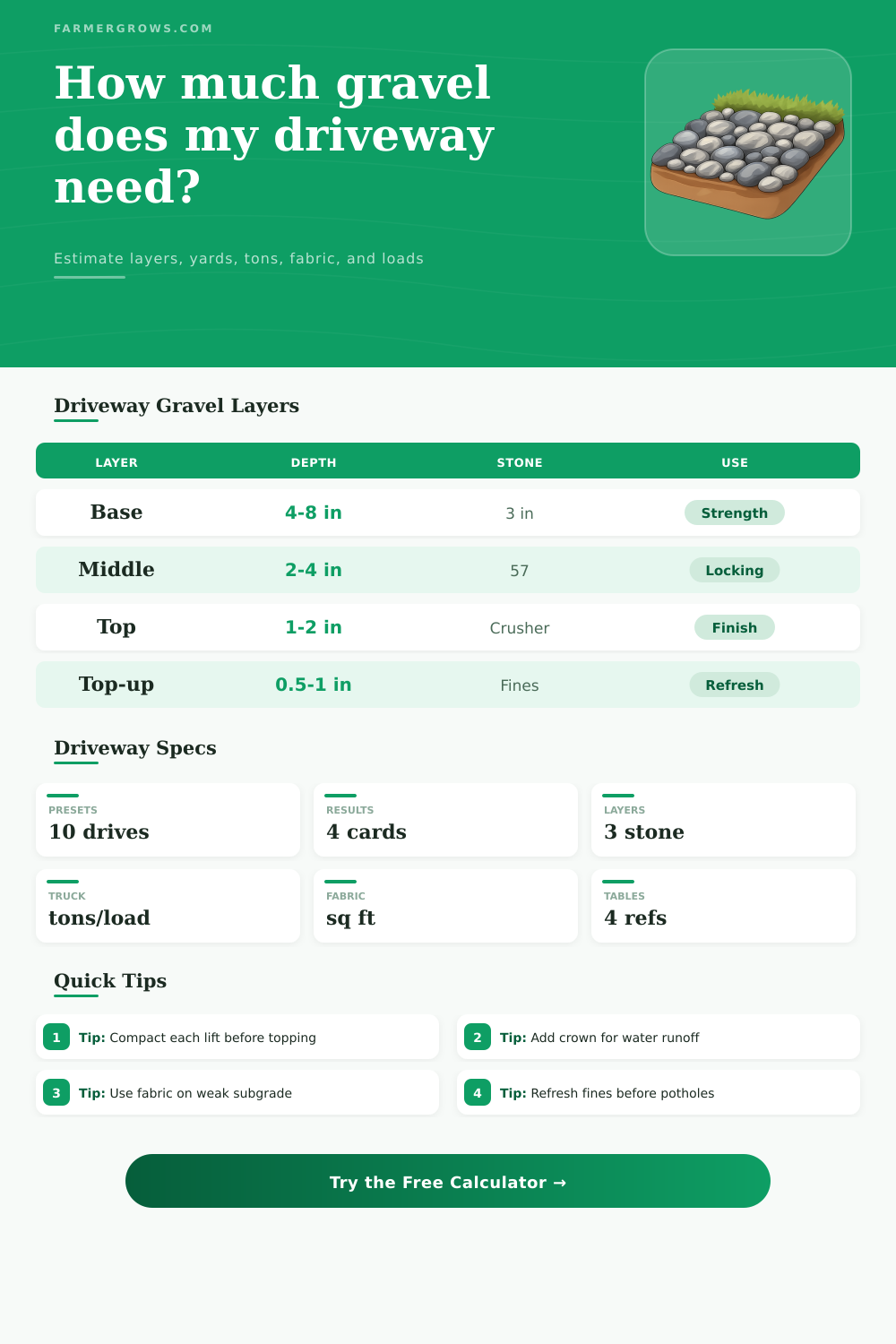
The middle layer of the gravel driveway fill the gaps created by the base layer. This middle layer is critical to ensuring that the gravel driveways surface does not shift when the driving vehicles turn or brake. The top portion of gravel driveways contain the stone that forms a smooth driving surface.
The top portion also includes a crown to allow water to run off of the gravel driveway. Each portion of gravel driveways require specific type of stones of specific sizes to last for an extended period of time. The compaction of the gravel driveway will change the amount of stone that is required for the driveway.
When the stone is delivered it will be in a loose state. When driving vehicles compact it the stone will compact into the gravel driveway. Therefore, you should of ordered more stone for the driveway to account for this settling of the stone.
Additionally, some stone may need to be ordered to grade the driveway to account for low spot. A stone calculator will help account for the loss of stone due to compaction and grading. Drainage is an essential part of gravel driveways; however, people often neglect this aspect of gravel driveways until there are standing puddles of water in the wheel track of the gravel driveway.
The crown that is created in gravel driveways will help water to drain off of the driveway; however, the crown only works if the shoulder and ditches of the gravel driveway are able to drain the water away from the gravel driveway. Clay soil present a problem for drainage because clay soils will remain soft and cause the fine particle of clay to rise into the gravel driveway. One way to solve this problem is to place geotextile fabric under the base layer of stone in gravel driveways.
The geotextile fabric will prevent the clay soil particle from entering into the gravel driveway while allowing water to pass through the stone. This will extend the life of the gravel driveway. Drainage maintenance involve performing the same steps as were performed during the original construction of the gravel driveway.
Fine particle of gravel will wash away from the gravel driveway. When these particle leave the gravel driveway the gravel will compact into potholes. To avoid forming potholes in the gravel driveway it is recommended to perform a top-up layer of gravel every one or two year.
Adding a top-up layer will restore the crown and the tight gravel surface of the gravel driveway. This will make it less likely that you will have to perform extensive repair in the gravel driveway in the future. Choosing the type of stone that will form the gravel driveway involve making a few trade-offs.
For instance, large amount of clean stone will allow water to drain from the gravel driveway; however, there will be a need for a choke layer of smaller stone to fill in the gap between the large stones for driving comfort. Crusher run stone will compact to form a firm surface for driving vehicle; however, it will hold more water due to the amount of fine particle in the crusher run stone. Recycled concrete can be used for the base layer; however, it may contain metal or oversized piece that will make grading the gravel driveway difficult.
A calculator can be used to test the different type of stones to determine the total tonnage of stones that will be required for the gravel driveway. The value of calculating how much stone will be required for gravel driveways is that people begin to view gravel driveways as system. Each layer of gravel driveways must support the other layer underneath the gravel driveway.
The process of compacting the gravel driveway will affect the total amount of stone that will be required. Additionally, people must take time to understand how the crown of the driveway will affect drainage, how often gravel should be topped up, and how the various component of gravel driveways are related to each other. By understanding these component, people can easily create a list of the stone that will be required for gravel driveways.