Conveyor Belt Calculator
Estimate throughput, belt loading, drive power, and pulley speed for grain, feed, fertilizer, and other bulk material runs. Test presets, then fine tune the drive.
Pick a real layout first. Each preset sets belt width, speed, length, lift, trough, fill factor, and drive efficiency for a common farm or yard conveyor.
This calculator is tuned for agricultural and yard conveyors, so it prioritizes flow, density, lift, and pulley speed instead of cost or purchase guidance.
Conveyor Output
Estimated capacity, belt loading, and drive demand from the settings above.
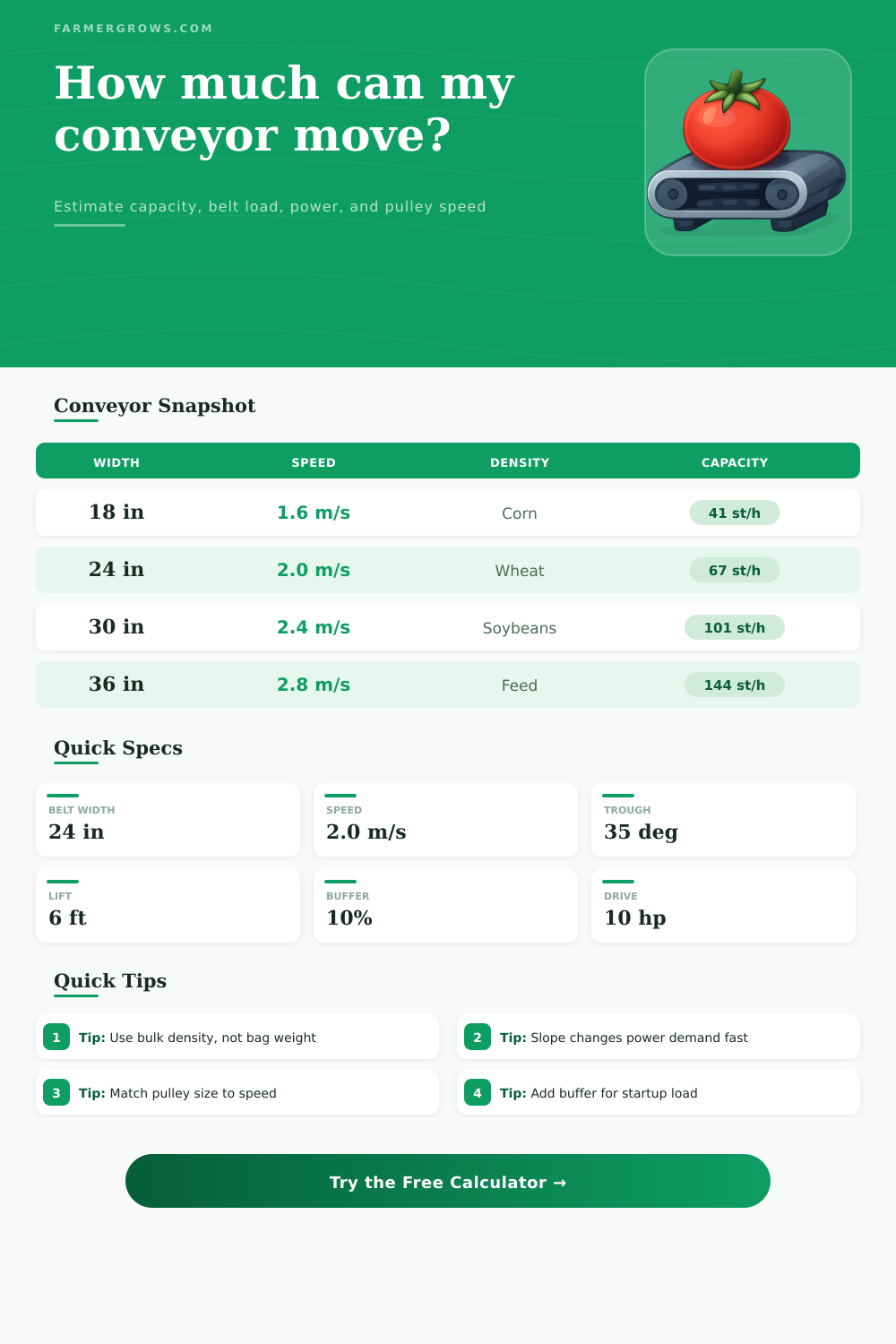
| Belt width | Practical speed | Typical use | Notes |
|---|---|---|---|
| 18 in | 1.6 m/s | Small feed line | Gentle loading |
| 24 in | 2.0 m/s | Grain transfer | Balanced duty |
| 30 in | 2.4 m/s | Fertilizer run | Higher output |
| 36 in | 2.8 m/s | Bulk handling | Heavy service |
| Width | Trough | Flow band | Common use |
|---|---|---|---|
| 18 in | 35° | 35-55 t/h | Seed line |
| 24 in | 35° | 55-85 t/h | Bin unload |
| 30 in | 35° | 90-135 t/h | Feed mill |
| 36 in | 35° | 130-190 t/h | Bulk yard |
| Pulley | Speed at 2 m/s | Best for | Note |
|---|---|---|---|
| 12 in | 318 rpm | Fast feed | Higher belt wear |
| 16 in | 239 rpm | Balanced run | Common choice |
| 20 in | 191 rpm | Gentle load | Lower belt stress |
| 24 in | 159 rpm | Slow bulk | Good for lift |
Conveyor belts are machines that can move bulk material from one location to another. The bulk materials can be things like corn, wheat, soybeans, or fertilizer. You have to decide on the size of the conveyor belt that youll use.
The size of the conveyor belt determine the amount of material that can be moved and the amount of power that the motor will need for moving the materials. If the conveyor belt is too small, it may starve the next machine in the conveyor belt system. However, if the conveyor belt is too large, it can waste power and lead to the motor of the conveyor belt wearing out too quick.
How to Choose the Right Conveyor Belt
The width of the conveyor belt is one of the primary considerations in selecting the appropriate conveyor belt. For tasks that require a slow and steady movement of materials, such as seed lines, an 18-inch conveyor belt may be appropriate. However, for bulk tasks in yard work, a 36-inch conveyor belt can move more materials.
However, using a wider conveyor belt place more demand on the idlers and the framing of the belt. The second primary consideration for the conveyor belt is the speed at which the conveyor belt can move. Increasing the speed will allow more materials to pass through the system.
However, increasing the speed will also increase the tension on the conveyor belt and may cause the belt cover to wear out more quick. The width and speed of the belt need to be balanced so that increasing the speed of the conveyor belt without increasing the width may result in the trough of the belt being half-empty of the materials it needs to move, thus wasting power. Another important specification for the conveyor belt is the angle of the trough of the conveyor belt.
The most common angle is 35 degree for moving grain. This angle allows the material to form a ridge in the middle of the belt without spilling any of the loaded materials. Using an incline that allows for steeper angles allows for more bulk material to be loaded on the belt.
However, steeper angles require the sidewalls of the trough to be stronger and the idler sets to be sharper. The fill factor of the belt is another consideration. Using a fill factor of 75 percent allow for headroom for surges in the materials.
However, you must make sure that you do not overfill the conveyor belt as this will cause the material to roll over during movement on the belt. Additionally, you must ensure that you do not underfill the conveyor belt as this will reduce the efficiency of the belt. Bulk density is another consideration for the type of materials that will be transported on the belt.
The bulk density of corn is 45 pounds per cubic foot. However, gravel has a bulk density of 109 pounds per cubic foot. Therefore, the bulk density of the materials will change the capacity of the conveyor belt.
The incline of the conveyor belt will also change the power requirements for the conveyor belt. If the conveyor belt is flat, gravity will remain neutral. However, if you lift the tail end of the conveyor belt, the conveyor belt must fight the mass of the materials that are on the belt.
Additionally, if the length of the conveyor belt is increased, the mass of the belt will increase, which will increase the rolling resistance of the belt. The duty class of the belt will also depend on the type of materials that are to be moved on the belt. For applications where there is little friction between the materials and the belt, a light duty class conveyor belt will work best.
However, for materials like sand that are abrasive, an abrasive duty conveyor belt will work best for the application. The diameter of the pulley that moves the belt is also another consideration for the conveyor belt. The diameter of the pulley will determine how fast the belt will turn and how much torque it will exert.
For instance, using a 16-inch drive pulley will allow the conveyor belt to turn at 240 revolutions per minute, which will reduce the stress on the belt. The drive power for the conveyor belt will have to account for the forces that move the materials. The friction of the moving belt and the load will pull on the belt in one direction, while the lift force will pull in the opposite direction.
If the horsepower of the motor is sized correctly, it should allow for 10 to 20 percent extra horsepower to start the conveyor belt. Using the measurements of the throughput capacity of the belt, such as the tons of materials per hour, the load in pounds per foot of the conveyor belt, and the speed of the conveyor belts pulley, you can determine the horsepower requirements for the motor. Additionally, these measurements will let you know if the motor will stall when trying to move wet wheat on an incline or if it will be inefficient when unloading corn from a conveyor belt onto a flat surface.
Some of the most common errors for conveyor belt selection include focusing on the speed of the conveyor belt when it comes to increasing the capacity of the belt. Others may focus solely on the width of the belt but may not think of the angle of the trough and the fill factor for the belt. Another common error involves bulk density if people use the packed weight of the material instead of the bulk flow rate.
Using the packed weight will produce incorrect estimates of the bulk density of the material. Additionally, a 10-foot lift over a 40-foot distance will require double the power of a flat conveyor belt. This is another consideration that many may not think of when purchasing a conveyor belt.
The startup of the conveyor belt also requires 15 to 20 percent extra horsepower. Other factors to consider are the effect of the environment on the conveyor belt. If the material that is to be conveyed is wet, troughs will have to be deeper or the speed of the belt reduced.
If the environment contains much dust, enclosed galleries could be used for the conveyance of the material. However, enclosed galleries create additional drag on the belt. The chutes on the belt must also be angulated to the correct degree to avoid burying the material back into the belt.
Additionally, the idlers should also be aligned to minimize the friction between the trough and the idlers. Proper alignment will save 10 percent on the friction of the belt. Lastly, sealed bearings will last longer in dirty environments.
Using the throughput bands of the conveyor belt will help to make decisions regarding the purchase of the belt. For example, 18-inch conveyor belts can serve seed cleaners at a rate of 35 to 55 tons per hour. Additionally, 36-inch conveyor belts can move bulk materials at a rate of 130 to 190 tons per hour.
These throughput bands can be used to determine the appropriate width of the belt. Additionally, the density of the crop that will be moved on the belt and the angle of the slope of the belt will help to determine the correct speed of the belt. If the conveyor belt is matched to the density of the material that will be on the belt and the angle of the slope of the belt, the belt will provide a steady flow of material from one location to another.