Auger Capacity Calculator
Estimate throughput, mass flow, required RPM, and tube load for grain, seed, feed, fertilizer, and wet product augers. Start with a preset, then fine tune the flighting and incline.
Choose a real farm setup to seed the fields. Each preset sets diameter, shaft, pitch, RPM, length, angle, fill, density, housing style, and safety margin.
Auger Capacity Output
Calculated from the auger geometry, duty style, material, and service settings above.
| Diameter | Pitch ratio | Typical fill | Best use |
|---|---|---|---|
| 6 in | 0.50D | 18-28% | Seed and light flow |
| 8 in | 0.75D | 22-32% | Bin unload |
| 10 in | 1.00D | 25-35% | General farm transfer |
| 12 in | 1.25D | 28-38% | Higher volume grain |
| 14 in | 1.25D | 30-40% | Longer lift runs |
| 16 in | 1.50D | 32-42% | Large capacity reclaim |
| Material | lb/ft3 | kg/m3 | Slip factor |
|---|---|---|---|
| Corn | 45 | 721 | 1.00 |
| Wheat | 48 | 769 | 0.98 |
| Soybeans | 47 | 753 | 0.97 |
| Seed mix | 35 | 561 | 0.94 |
| Feed meal | 38 | 609 | 0.96 |
| Fertilizer | 65 | 1041 | 0.90 |
| Wet grain | 50 | 801 | 0.84 |
| Oats | 28 | 449 | 1.02 |
| Angle | Capacity factor | Load note | Use note |
|---|---|---|---|
| 0 deg | 1.00 | Full baseline | Horizontal run |
| 5 deg | 0.95 | Small loss | Easy lift |
| 10 deg | 0.89 | Moderate loss | Watch fill |
| 15 deg | 0.82 | Backflow risk rises | Check drive margin |
| 20 deg | 0.74 | Strong derate | Reduce fill |
| 25 deg | 0.65 | Heavy penalty | Use conservative rpm |
| 30 deg | 0.57 | Very steep | Capacity drops sharply |
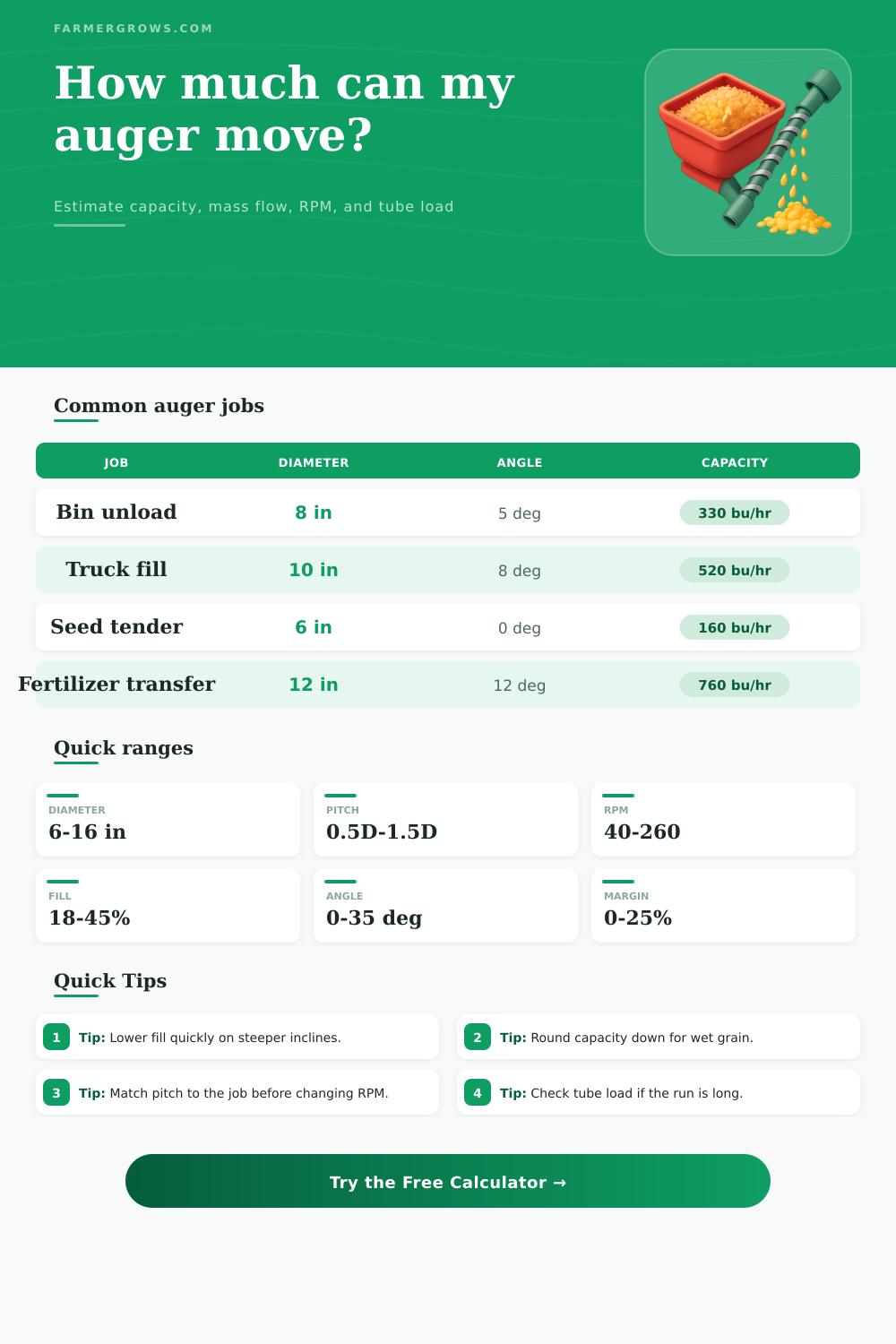
| Job | Diameter | Expected angle | Typical band |
|---|---|---|---|
| Seed tender fill | 6 in | 0-5 deg | 120-220 bu/hr |
| Bin unload | 8 in | 3-10 deg | 280-420 bu/hr |
| Truck loading | 10 in | 5-12 deg | 450-650 bu/hr |
| Fertilizer transfer | 12 in | 8-18 deg | 650-900 bu/hr |
An auger moves the material by trapping the material within the spiraling pocket between the flighting and the shaft, and then shoving the material forward as the auger rotate. The capacity of an auger isnt a fixed number. The capacity of an auger is based off the pitch of the auger, the amount of material in the flights of the auger, and the density of the material within the auger.
An auger’s capacity also mathematicaly decrease as the incline of that auger increases due to the tendency of the material to slide backwards within the auger, a motion referred to as slip. The diameter of the auger is one of the primary factors in determining it’s capacity. An auger with a smaller diameter is often used for seed tender and hopper wagons so that the operator has more control of the auger with its light loads.
What Affects How Much an Auger Can Move
However, larger diameter allow for an increased rate of bushels per hour to be dispensed from that auger. However, the larger the diameter of the shaft of the auger, the more dead space (known as an annulus) that is created within that auger. Thus, an increase in the diameter of that auger shaft can potentially lead to a decrease in the capacity of that auger.
The pitch ratio of the auger determine the amount of force that the auger will exert upon the material within the auger. For standard use with farm grains, a pitch ratio of one times the diameter of the auger is generally used. However, if the pitch ratio is shortened to half the diameter of the auger, that auger will be better suited for seeds or outlets that are likely to have surges of material being dispensed from those outlets.
However, a shorter pitch ratio will lead to lower rate of RPM for that auger. A pitch ratio of one-and-a-half times the diameter of the auger will increase the theoretical capacity of that auger. However, the slip of that auger will also increase.
Furthermore, the fill percentage of the flights is a factor in the capacity of that auger. The percentage of fill should be set carefully. If that percentage is increased past thirty percent, the backflow of material will reduce the capacity of that auger.
An incline in the auger will reduce the capacity for that auger. If that auger is installed to be horizontal with the ground, it will reach one hundred percent of its theoretical capacity. If that auger is inclined five degrees from horizontal, the augers capacity will drop five percent.
If that auger is inclined fifteen degrees from horizontal, its capacity will drop to eighteen percent of its theoretical capacity and it may experience backflow of material. Twenty-five degrees from horizontal will reduce the augers capacity to only forty-five percent of its theoretical capacity. Thus, an incline of the auger will reduce the amount of material the auger can handle; either using a lower percentage of fill for that auger or increasing its RPM will help compensate for that incline.
The density of the material that is being augered will impact the amount of material that the auger moves. Corn will have a density of forty-five pounds per cubic foot. However, wheat is heavier than corn and fertilizer is heavier than wheat.
Wet grain will be heavier than dry grain due to the weight of the water. The slip of the material will also change based on the type of material being augered. For instance, some materials will glide easy within the auger while other materials may be sticky and tend to drag against the flighting of the auger.
Finally, the housing of the auger will also mathematicaly impact the capacity of that auger. An enclosed tube will contain more material than an open trough auger. However, the enclosure of the auger may lead to the auger pinching the flow of that material.
The weight of the material within the auger is referred to as the tube load. The tube load can be calculated by multiplying the area of the flights of that auger by the length of that auger, the fill percentage of that auger, and the density of the material being augered. Short augers will not create a heavy tube load.
However, long augers will create a heavy tube load that may lead to overloading the bearings within that auger. Furthermore, the RPM of the auger can be calculated to determine the necessary RPM to reach the target bushel rate for that auger. This information can help determine the necessary motor and sheave for the auger.
Many people make the mistake of increasing the RPM of the auger to increase its capacity. However, increasing the RPM of the auger will increase the amount of heat output by the auger and may even lead to the auger bearing wearing out due to the increased heat output. Instead, the pitch of the auger should be matched to the material that is to be augered along with the fill percentage.
Furthermore, the target bushel rate calculations should include a service margin in the calculations. A service margin can account for various factor, such as the moisture content of the material, the wear on the auger, or even the specifications of the grain itself. If a service margin is not included in the calculations, those calculations may not account for these variables.
Thus, all these factors (diameter, pitch, density, and incline) must be accounted for in creating a realistic expectation for the capacity of that auger. You should of considered all these things to avoid problems.