Exhaust Fan CFM Calculator
Size grow tent and greenhouse exhaust airflow from room volume, exchange interval, lamp heat, BTU load, duct and filter restriction, altitude, intake opening, staging, and safety factor.
This CFM-focused sizing tool compares air exchange against heat removal, then adjusts the rated fan target for real-world resistance and thinner air at elevation.
Best when the fan can sit close to the outlet with few bends and a short, smooth path.
Useful in tents, but corrugation and sag add resistance, especially after tight turns.
Odor control usually becomes the largest single derate in compact indoor grow spaces.
Adds noise control, but the fan target should rise when the path includes silencers.
CFM Sizing Result
The rated fan target includes the controlling airflow load plus altitude, duct, filter, intake, staging, and safety allowances.
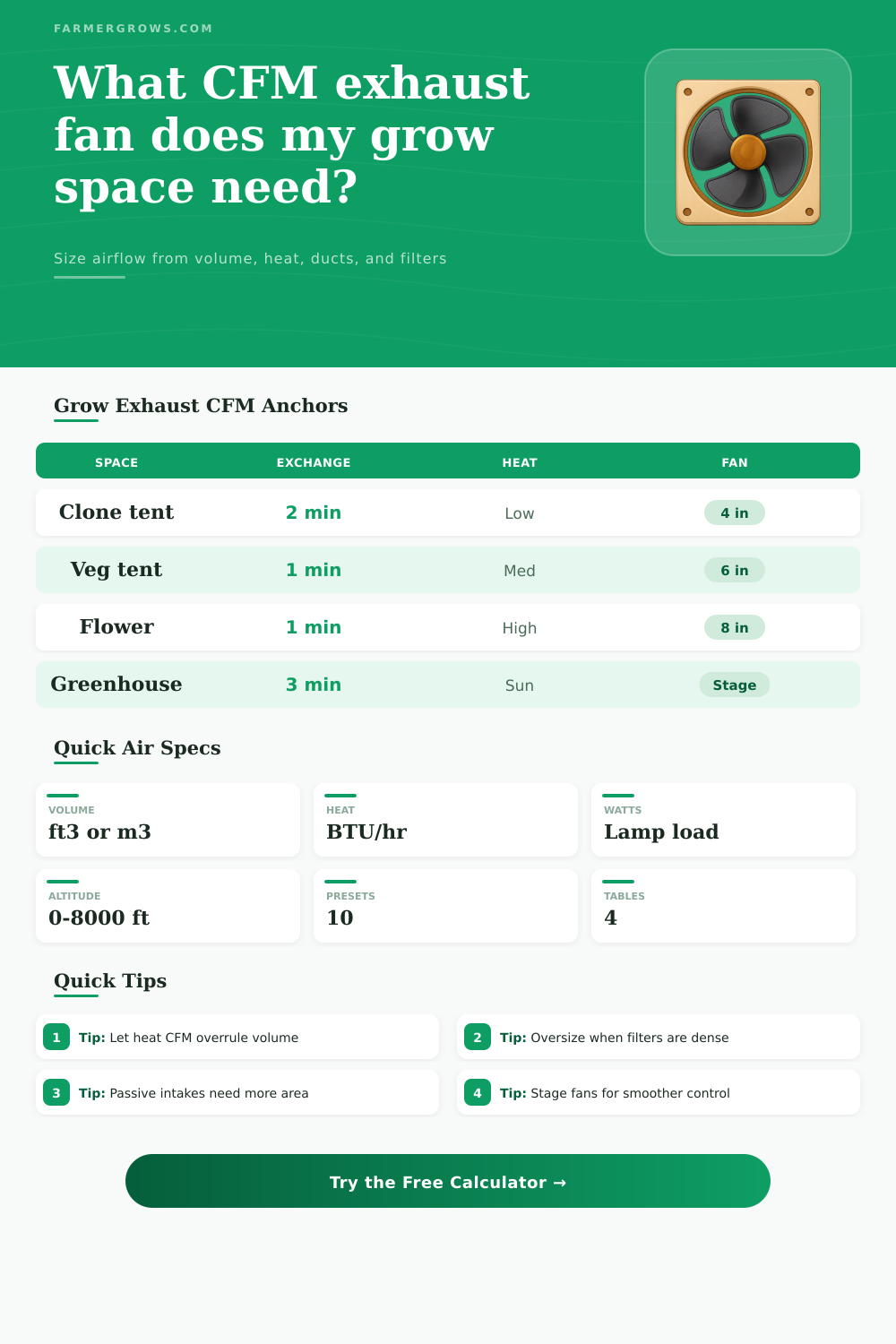
| Use case | Exchange interval | Room changes/hour | When to use |
|---|---|---|---|
| Seedling or clone tent | 2-3 min | 20-30 | Low heat and gentle pressure control. |
| Vegetative tent | 1-2 min | 30-60 | Steady humidity and moderate lamp heat. |
| Flowering tent | 1 min | 60 | Odor control, dense canopy, and higher heat. |
| Greenhouse bay | 2-5 min | 12-30 | Use staging and shade with high solar load. |
| Heat source | BTU/hr | CFM at 10°F rise | Notes |
|---|---|---|---|
| 200 W LED board | 682 | 63 | Small tent or propagation rack. |
| 450 W LED fixture | 1535 | 142 | Common compact flowering light. |
| 600 W fixture | 2047 | 190 | Heat often controls over volume CFM. |
| 1000 W fixture | 3412 | 316 | Needs strong exhaust or cooled air. |
| Restriction | Typical allowance | CFM effect | Design note |
|---|---|---|---|
| Clean carbon filter | 12-20% | Raise rated fan | Check again as the filter loads. |
| Dense carbon filter | 25-30% | Raise rated fan | Useful for odor-sensitive flowering rooms. |
| Flexible duct | 10-20% | Raise rated fan | Pull it straight and avoid crushed bends. |
| Each 90° bend | 4-6% | Raise rated fan | Sweep bends perform better than tight elbows. |
| Control setup | Stage 1 target | Stage 2 target | Best fit |
|---|---|---|---|
| Single fan | 100% | n/a | Simple tent with thermostat or speed knob. |
| Two-stage controller | 55% | 100% | Most tents with day and heat spikes. |
| Three-stage controller | 35% | 70% / 100% | Greenhouse bays and larger rooms. |
| Variable speed EC fan | 25-40% | Ramp to 100% | Smooth pressure and quieter operation. |
If heat CFM is higher than exchange CFM, size the exhaust around heat and allow the controller to slow the fan during cooler periods.
Passive intakes work best when the free opening is several times larger than the duct area, especially with carbon filtration.
Choosing the correct exhaust fan for a grow space require a balance of several factor. An exhaust fan have to handle both the air and the heat in the grow room. Plants requires a certain amount of fresh air to perform good.
The lights for the plants, however, emit a significant amount of heat. If the exhaust fan is too small to handle the air in the grow room, the plants will become stressed due to a lack of fresh air. If the exhaust fan is too large or incorrectly sized for the grow room, the exhaust fan will run constantly yet still fail to provide adequate control of the temperature in the grow room.
How to Choose the Right Exhaust Fan for Your Grow Room
The most common method of calculating exhaust fans is to calculate the volume of the grow room and the amount of air change that are required. The problem with this method, however, is the heat that the grow room lights emit change the requirements of the exhaust fan. The grow room lights emit an amount of heat that is related to the wattage of the lights.
In order to calculate the amount of air that must move through the grow room, you must find the balance between the amount of heat that the lights emit and the allowable temperature increase of the grow room. In other words, a small change in the allowable increase of the temperature of the grow room will necessitate a large change in the amount of air that move through that space. Thus, two grow rooms of the same size may have different exhaust fans depending on the amount of heat that the lights in each grow room emit.
Another factor that may impact the performance of the exhaust fans are the grow rooms altitude. Many grow room fans are not specifically designed for high altitude. The air that is present at high altitudes is thinner than the air at sea level.
Thus, an exhaust fan will move less air at high altitudes than it will at sea level. To account for this, you can make a density correction of the exhaust fan so that it will move the amount of air that is require in high altitudes. Another factor that impact the performance of the exhaust fan is the duct run and filters.
For instance, short and straight duct runs will create less resistance to the movement of air than long and flexible duct runs. Additionally, carbon filter will create resistance to the movement of air. Thus, you can select exhaust fans according to the amount of resistance that you will encounter in the grow room so that the exhaust fan can move the amount of air that is required.
In addition to the exhaust fan, the intake opening of the grow tent is also an important factor. The intake opening must allow the correct amount of air to enter the tent to replace the amount of air that the exhaust fan removes. If the intake opening is too small for the exhaust fan, it can create a negative pressure that may open tent door or collapse tent walls.
Thus, just as the exhaust fan must be sized to provide the correct amount of exhaust air, the intake opening must also be sized to allow for the same amount of intake air. The way that you control the exhaust fan will also have an impact upon how you use that exhaust fan. For instance, if you use a single-speed exhaust fan, it must be running at the highest speed setting.
However, a variable speed exhaust fan can run at various speed settings depending upon the amount of heat that the grow room lights emit. Additionally, the use of a variable speed exhaust fan can also impact the noise and power usage of the grow room. Thus, setting low, mid, and high speed targets will allow you to purchase the correct exhaust fan and fan controller.
Common mistake include focusing upon only one variable of exhaust fan sizing rather than considering all of the variables. For instance, a person that focuses only upon the air changes for a grow room may experience problems with the heat that the lights emit. In contrast, a person that focuses only upon the heat of the grow room may find that the carbon filter is reducing the amount of air that move through the grow room.
Thus, its best to consider each of these factor all at once. Additionally, you should of include a safety factor in the sizing of the exhaust fan. Filters will become loaded with the growth of the plants.
Additionally, the outside temperature will change throughout the summer. Thus, a safety factor will provide the exhaust fan with some headroom to account for these changes.