🦆 Duck Feed Calculator
Estimate complete feed, daily flock intake, crude protein supplied, water demand, and bags for ducklings, meat Pekins, adult layers, backyard mixed flocks, and forage-supported ducks.
Pick a common flock scenario to load realistic starting values. You can still edit every number before printing or sharing the feed plan.
Duck Feed Estimate
The totals combine flock size, breed/use, age stage, feed intake, protein phase, laying status, forage offset, water ratio, weeks, bag size, and waste buffer.
| Age stage | Typical feed per duck | Protein phase | Planning note |
|---|---|---|---|
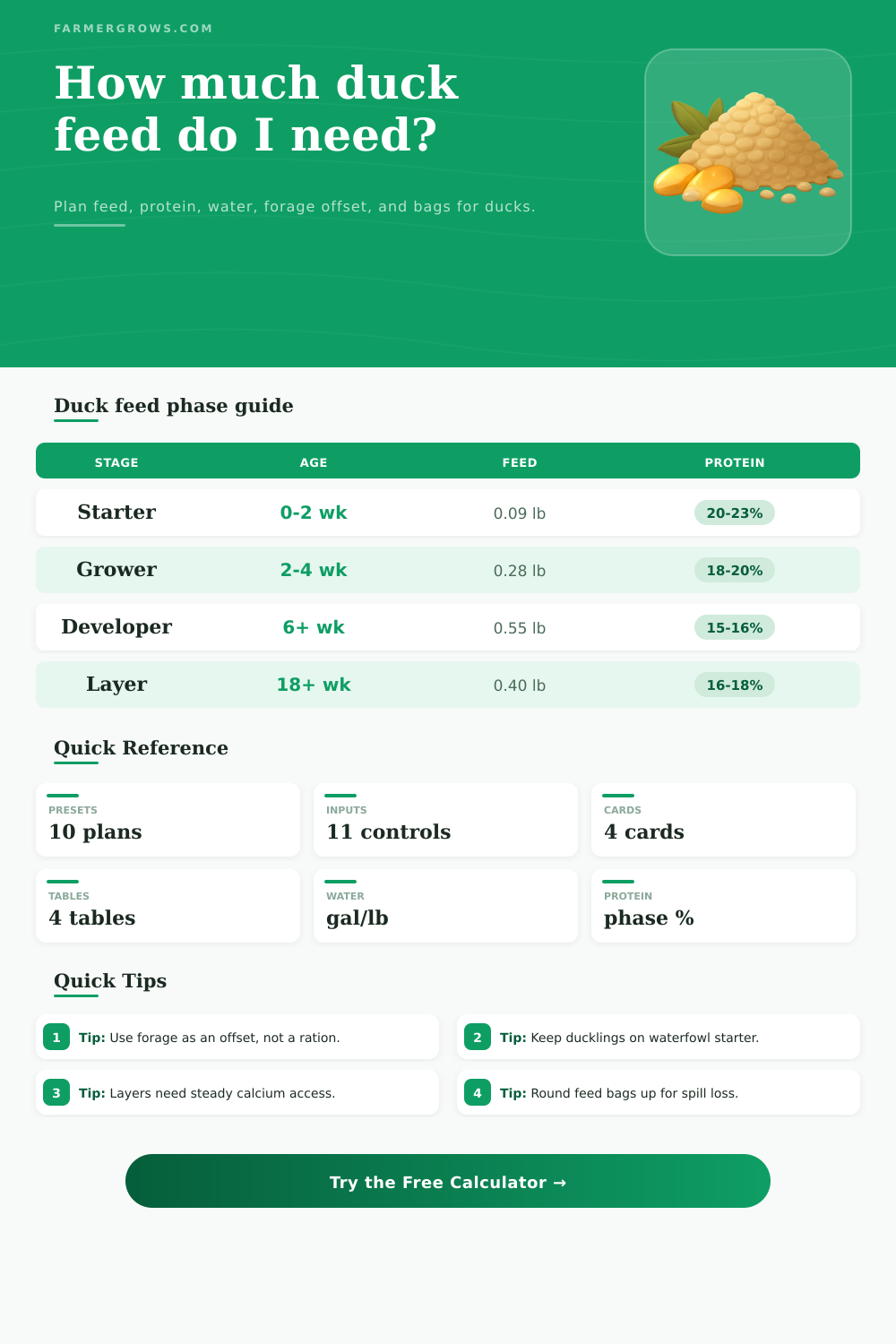
| 0-2 weeks starter | 0.09 lb/day (40 g/day) | 20-23% starter | Early ducklings need waterfowl starter or duck-safe niacin support. |
| 2-4 weeks grower | 0.28 lb/day (125 g/day) | 18-20% starter-grower | Fast body growth; spilled wet feed can raise waste quickly. |
| 4-6 weeks grower | 0.36 lb/day (165 g/day) | 18% grower | Pekin intake curves commonly climb above 2.5 lb weekly by this range. |
| 6+ weeks developer | 0.55 lb/day (250 g/day) | 15-16% developer | Developer feed keeps protein lower while body size fills out. |
| Adult maintenance | 0.35 lb/day (160 g/day) | 14-16% maintenance | Use body condition and forage access to refine the number. |
| Adult laying | 0.40 lb/day (180 g/day) | 16-18% layer | Egg output, weather, and breed size can move daily intake higher. |
| Factor | Adjustment | When to use | Calculator effect |
|---|---|---|---|
| Pekin meat ducks | 1.25x intake | Heavy market birds and finishers | Raises feed before forage offset. |
| Call ducks | 0.55x intake | Bantam-size ducks | Lowers complete feed estimate. |
| Peak laying | 1.25x intake | High egg production weeks | Raises feed and protein supplied. |
| Forage offset | 0-60% reduction | Pasture, pond edge, insects, greens | Reduces complete ration before waste. |
| Waste buffer | 0-35% addition | Open troughs, damp feed, dusty fines | Adds feed after forage offset. |
| Daily flock feed | 4-week feed | Water at 0.60 gal/lb | 50 lb bags |
|---|---|---|---|
| 5 lb/day | 140 lb | 84 gal | 3 bags |
| 10 lb/day | 280 lb | 168 gal | 6 bags |
| 20 lb/day | 560 lb | 336 gal | 12 bags |
| 40 lb/day | 1,120 lb | 672 gal | 23 bags |
| 75 lb/day | 2,100 lb | 1,260 gal | 42 bags |
| Scenario | Ducks | Feed phase | Baseline plan |
|---|---|---|---|
| Pekin starter brood | 25 | 23% pre-starter | Two weeks at 0.09 lb before breed adjustment. |
| Pekin grower pen | 40 | 20% starter-grower | Four weeks at 0.28 lb with high growth pressure. |
| Meat duck finish | 60 | 15% developer | Three weeks at 0.55 lb with 10% waste buffer. |
| Khaki laying flock | 18 | 16.5% layer | Four weeks with steady laying and light forage. |
| Runner forage flock | 12 | 16% layer | Six weeks with higher forage offset. |
| Winter mixed flock | 30 | 15% maintenance | Eight weeks with low forage and extra waste buffer. |
Reference basis: early protein guidance follows duck feeding extension summaries; practical gram-per-day phases follow commercial Pekin feeding guides; Pekin intake and water checks align with Cornell-style weekly consumption tables. Local feed labels and flock condition should override any generic estimate.
When you raises ducks, you must plan for duck feed. The amount of duck feed that your ducks require will change over time as the ducks grows. Ducklings require a certain amount of duck feed for there first two week of life.
After these two weeks, however, ducklings will consume more duck feed than other breeds of ducks. Duck feed consumption increases as the ducks grow larger due to the different stage of growth that the ducks experience. A calculator can assist with determine the amount of duck feed that is required for your ducks based off the size of your duck flock, the age of your ducks, and the breed of your ducks.
How Much Duck Feed Do Your Ducks Need
Different breeds of ducks will consume different amount of duck feed. For example, Pekin ducks, which have rapid growth rate, will consume more duck feed than other breeds of ducks. Muscovy ducks will consume a moderate amount of duck feed, while Call ducks will consume less duck feed than Muscovy or Pekin ducks due to their small size.
The calculator will account for these different breeds to ensure that you dont have to remember the specific amount of duck feed that each breed consume. Additionally, the breed of duck will impact the total amount of duck feed that you order for your ducks. The laying status of your ducks may also impact the amount of duck feed that is required by the ducks.
Ducks that lay eggs will require more duck feed than ducks that do not lay eggs. Additionally, laying ducks will require a higher protein level in their duck feed. You can change the laying status of your ducks in the calculator, which will then change the total amount of duck feed that is calculated for your ducks each day.
If you feed only the maintenance ration to your laying ducks, they may not recieve enough nutrition from their diet. The amount of forage that your ducks find on their own may impact the amount of complete duck feed that is required to be purchase for your ducks. Ducks will naturally find food in the pasture or pond where they live, reducing the amount of duck feed that is provided to them.
The amount of forage that is available to ducks, however, will vary with the available season and weather. The forage offset field in the calculator will allow you to account for the amount of forage that is available to your ducks. Many people will account for conservative amounts of forage because the availability of forage will decrease in wet weather or during winter month.
Ducks will drink a significant amount of water compared with the amount of duck feed that they consume. Ducks will drink more water than chickens based upon the amount of feed that the birds consume. The water ratio in the calculator will allow you to calculate the amount of water that is required for your ducks, based upon the amount of duck feed that you calculate as being necessary for your ducks.
There will always be some amount of waste and lost duck feed. Some feed may fall off the feeders, some feed may get too damp, and some feed may be stored in the feed bin for too long before being feed to the ducks. The waste buffer allows for allowance for this lost duck feed so that there is enough duck feed for the ducks.
After applying for the waste buffer to the total amount of duck feed that is calculated for your ducks, you will need to round up to the nearest bag of duck feed. The reference tables can help to determine the amount of duck feed that your ducks require. These tables include the typical intake and protein targets of ducks of different ages.
These reference tables can assist you to ensure that you have made accurate entries of the amount of duck feed that is required for your ducks. These tables are not exact requirements for your ducks, but they will provide guidelines that ensure that the amount of duck feed is within the normal range for ducks. If the ducks that you raise are different than the typical ducks defined in these tables, then you can override the settings for duck feed requirements.
Planning for several weeks at a time is better than planning for one day at a time. Planning for only one day will not allow you to account for the total amount of duck feed that your ducks will consume over time. Planning for several weeks will allow you to calculate the total amount of duck feed that will be consumed.
Additionally, planning for several weeks will allow you to determine the amount of storage for the duck feed. The planning period in the calculator can be changed based upon your desired planning cycle. It is more important to have a plan that may require more duck feed than one that may calculate the exact amount of duck feed that is required of your ducks.
If you do not have enough duck feed for your ducks, it is more difficult to find enough duck feed during certain season than to have too much duck feed. Using this calculator will allow you to prepare a plan that accounts for the needs of your ducks. With experience using the calculator, you will be able to input the settings for your ducks, and the calculator will confirm the calculated amount of duck feed.