Dressing Percentage Calculator
Estimate hot dressing percent, shrink-adjusted dressing, chilled carcass weight, and trimmed carcass weight from live weight, hot carcass weight, species, fill, hide or fat trim, and cooler loss.
1 Choose a livestock preset
Presets fill realistic starting weights and typical loss factors. Adjust the fields to match your scale ticket, carcass tag, or plant report.
2 Enter weights and adjustments
Dressing and carcass result
Enter weights to compare actual dressing with the selected species range.
3 Species dressing comparison grid
Use this grid to sanity-check a result. A value outside the band can still be correct when gut fill, hide, fat cover, mud, fleece, field dressing, or plant trim differs.
4 Reference tables
| Species or class | Low | Typical | High | What changes it |
|---|---|---|---|---|
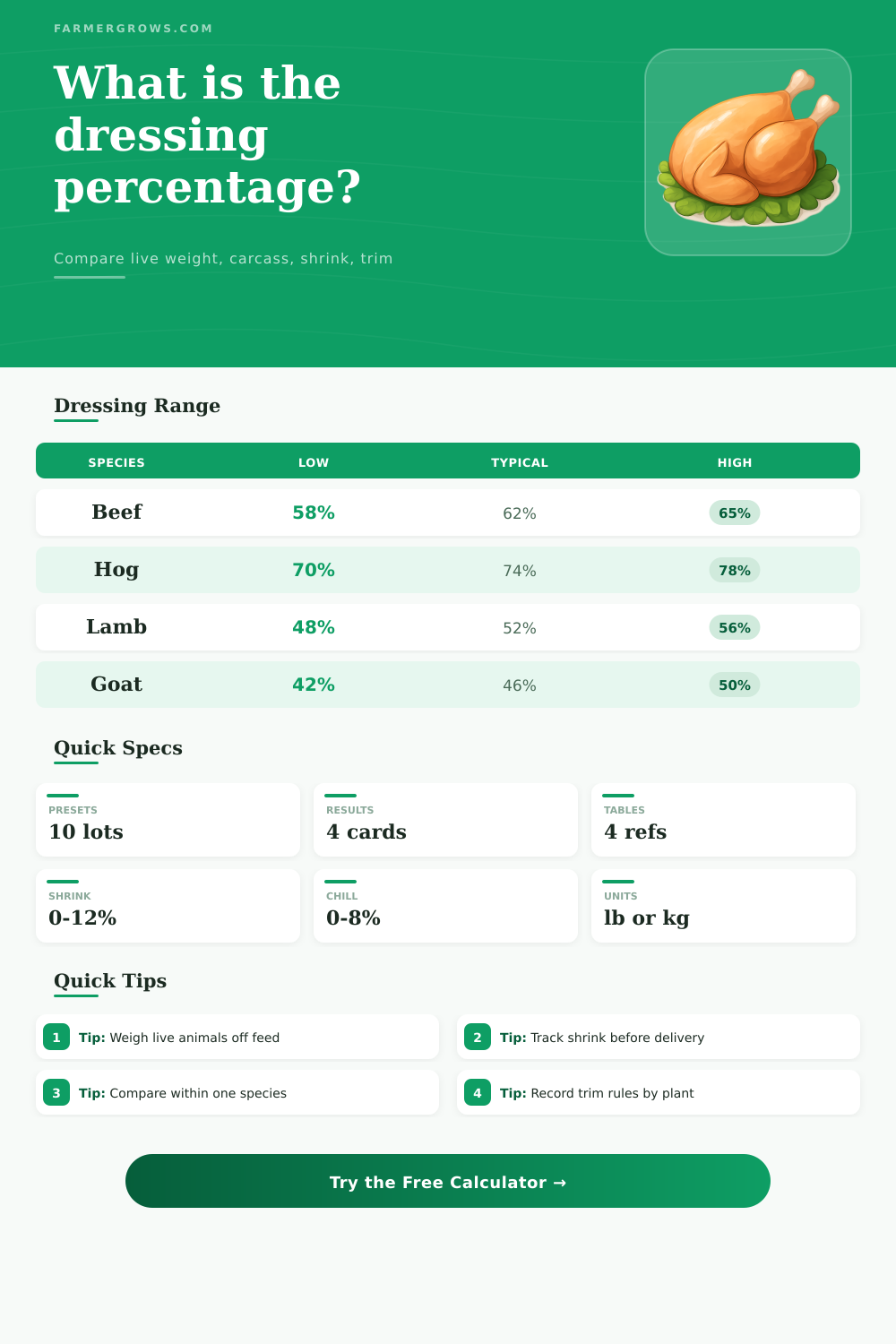
| Finished beef steer or heifer | 58% | 62% | 65% | Fat cover, muscling, gut fill, hide weight, mud |
| Grass-fed beef | 55% | 59% | 63% | Finish level, frame size, forage fill, age |
| Dairy or beef cull cow | 48% | 52% | 56% | Body condition, pregnancy status, rumen fill |
| Market hog | 70% | 74% | 78% | Skin-on basis, backfat, live shrink, trim style |
| Market lamb | 48% | 52% | 56% | Fleece, fatness, breed type, gut fill |
| Meat goat | 42% | 46% | 50% | Lean body, hide, age, fill, carcass specification |
| Deer or venison | 50% | 55% | 60% | Field dress timing, head and hide removal, shot trim |
| Turkey | 74% | 78% | 82% | Feather, evisceration, age, chilling method |
| Adjustment | Use this when | Typical range | Effect on dressing percent |
|---|---|---|---|
| Live shrink | Animal was hauled, held, or stood before the pay weight | 1% to 8% | Raises shrink-adjusted dressing because denominator is lower |
| Empty fill score | Overnight stand or very clean gut fill basis | 0% | Little added correction |
| Normal fill score | Ordinary farm or sale barn live weight | 2% to 3% | Raises normalized dressing for comparison |
| Heavy fill score | Fresh off lush pasture, feed, or wet weather | 4% to 6% | Can add several points after removing fill weight |
| Chilling loss | Hot carcass loses moisture in the cooler | 1% to 4% | Does not change hot dressing, lowers chilled weight |
| Live weight | Dressing % | Hot carcass | After 2% chill | After 3% trim |
|---|---|---|---|---|
| 1,200 lb beef | 62% | 744 lb | 729 lb | 707 lb |
| 1,400 lb beef | 63% | 882 lb | 864 lb | 838 lb |
| 285 lb hog | 74% | 211 lb | 207 lb | 201 lb |
| 135 lb lamb | 52% | 70 lb | 69 lb | 67 lb |
| 90 lb goat | 46% | 41 lb | 40 lb | 39 lb |
| 20 lb turkey | 78% | 15.6 lb | 15.3 lb | 14.9 lb |
| Observation | Likely cause | Check first | Record for next lot |
|---|---|---|---|
| Lower than expected | Heavy gut fill, mud, wool, hide, pregnancy, or light muscling | Was live weight taken full? | Fill score and stand time |
| Higher than expected | Long shrink, very empty gut, high finish, or skin-on basis | Was shrink already deducted? | Pay weight basis |
| Good hot yield, low chilled yield | Long cooler time, small carcass, airflow, or surface trim | Cooler loss percent | Chill hours and trim code |
| Lot varies widely | Mixed frame, breed, sex, finish, or age | Sort by class | Species and class notes |
| Plant report differs | Carcass specification may exclude different parts | Ask for weighing basis | Hot, chilled, or trimmed basis |
5 Practical tips
Record gross live weight, pay weight after shrink, hot carcass weight, chilled weight, and trimmed weight as separate numbers. Mixing those bases is the most common reason dressing percentage looks wrong.
Use the same stand time, fill score, plant trim style, and weighing point when comparing animals. A one-point yield difference can disappear after shrink and cooler loss are handled consistently.
This calculator is an estimating tool for farm planning and carcass comparison. Processor specifications, inspection rules, and market contracts determine official carcass weights.
When you sell or process livestock, the weight of the animal that you use to calculate your sale or processing cost isnt the weight of the live animal. The weight that determines the sale or processing cost of livestock is the percentage of the live weight that becomes a saleable carcass. This percentage is referred to as the dressing percentage, and the dressing percentage is a figure that represents the relationship between the live weight of the animal and the saleable carcass weight that is produced.
Each of these figures has a specific calculation that relates the two weights, and understanding each of these individual calculations is a key to understanding the dressing percentage figure that is provided to you as a producer. The most simple of the calculations of dressing percentage uses the weight of the hot carcass that is divided by the live weight of the animal. However, there are often other variables to these factors.
What Dressing Percentage Means and How to Calculate It
For example, the animal may have been transported over long distance during the night, or may have been held off of its feed before slaughter. Additionally, the carcass may have had the hide on the animal, the head of the animal, or may have had extra fat that the processor will trim off of the carcass prior to sale. Each of these factors will influence the percentage that is determined by the dressing percentage calculation, but none of these factors influence the animal that is being slaughtered.
One of the first adjustments that many livestock producers make to the weights is the shrink weight adjustment. Shrink weight occurs when the livestock travels or stands in a new pen. The animal loses water and gut fill while in transport or standing in a new pen.
The shrink percentage allows the live weight of the animal to be adjusted so that the sale weight of the animal is the same as the weight that the buyer used to determine the sales weight of the animal. If the shrink percentage is not accounted for, the dressing percentage will be determined based off the live weight of the animal only, which may result in determining a low dressing percentage based upon the sale of an animal that had a full tank of water or a long ride to the slaughter facility. If, however, a shrink percentage is entered into the calculations in addition to the weight that has already shrunk due to the transportation of the animal, the dressing percentage will be artificially increased to an inappropriate figure that does not accurately reflect the sale value of the carcass as compared to other lots of the same species of livestock.
The fill score adjustment is used in the opposite direction of shrink. The fill score adjusts for the weight of the gut content of the animal. An animal that was penned and grazed on pasture will typically have between 2 and 3% of the total weight of the animal represented by gut content that will dissapear before slaughter.
By adjusting the live weight of the animal for the weight of the gut content, the dressing percentage can be determined that reflects the muscling and the finish of the animal instead of the weight of its gut fill. Though the fill adjustment may seem minor to some producers, the difference in the amount of gut content within a group of animals can have the same weight as a single carcass within a pen of fifty head of livestock. Once the carcass is removed from the rail, two additional percentages influence the weight of the carcass.
The trim weight and the chilling weight of the carcass can influence the weight of the saleable carcass. Each plant may have different standards regarding the removal of the hide from the carcass, the removal of the head from the carcass, and the trimming of the fat from the carcass. Additionally, the chilling of the carcass will result in the loss of between 1 and 4% of the weight of the carcass as moisture evaporates from the carcass during the chilling process.
Each of these adjustments can be entered into the calculator to determine the final weight of the carcass that the facility will sell. The species from which the meat is sold also has an influence upon the dressing percentage. For example, hogs typically have dressing percentages within the low 70% range as the skin and backfat of the hog is sold with the carcass.
In contrast, lambs and goats will have lower dressing percentages because the fleece and the hide of these animals is sold along with the carcass. Additionally, a steer that is finished with beef will have a dressing percentage of around 60%, but a cull cow will have a dressing percentage within the low 50% range due to the lower muscling and gut fill of the cows that are sold at the culling age. Each of these percentages can be represented in the calculator that is provided, and the reference tables within the calculator will allow the producer to understand the typical dressing percentages of each group of animals.
Any results from the dressing percentage that are outside of the typical range are another indication that the slaughter facility needs to review each of the adjustments to the dressing percentage calculation. One of the most common errors that producers make is the assumption that the dressing percentage is a trait of the animal being slaughtered. The dressing percentage is, in fact, a relationship between two weights of the animal.
An animal that has a dressing percentage of 63% one week may have a dressing percentage of 59% the following week if the weight of the live animal was measured when the steer was full of grain, but the carcass was weighed after the removal of extra fat. The percentage has not changed due to any change in the steer, but the measurement of the live and carcass weights has changed. Maintaining a simple log of the weight of each of the live animals, the pay weight of the animals, the hot carcass weight, and the final chilled weight of the animals will help producers to avoid this error.
Another common error is to compare the dressing percentages of livestock from different slaughter facilities, especially if those two facilities have different specifications for the dressing of the carcass. For example, one facility may leave the head of the animal on the carcass, but another facility may remove the head of the animal prior to the first weighing of the carcass. Additionally, one facility may chill its carcasses in a cooler with higher humidity levels than other slaughter facilities, which will result in the loss of less moisture from the carcass.
The calculator does not have the specifications of the slaughter facility that is to be used, and as such, the slaughter facility itself should perform the dressing percentage calculations. By running the dressing percentage calculations for each facility, however, any remaining differences in the calculated percentages will indicate true differences in the animals being slaughtered. The dressing percentage calculation can also be applied to field-dressed deer or pasture-raised goats.
The time at which the deer is eviscerated or the goat is shorn, whether the deer was shot in the gut, and for how long the carcass hangs prior to skinning can influence the weight of the carcass that is sold. These factors are customizable within the calculator so that there is no industry standard for the dressing percentage of field-dressed deer or pasture-raised goats. However, if the factors are recorded as they are performed, the dressing percentage calculation can be made between animals of the same species from the same pasture or field.
Though the dressing percentage calculation is a simple calculation of the weight of the live animal and the saleable carcass, the dressing percentage is actualy less important than the questions that it prompts within the livestock producer. A low dressing percentage may prompt questions regarding the shrink weight of the animal, the fill score of the animal, or the trim weight. A high dressing percentage may prompt questions regarding whether the pay weight of the animal was taken after adequate stand-down time for the animal.
Though the calculator makes it easy to pose these questions by separating each variable in the dressing percentage calculation into its own entry field, the real benefit of utilizing such a calculator is that it enables the producer to maintain the weight of the live and saleable carcass as a straight sale between the livestock producer and the seller of the carcass.