Crop Yield Loss Calculator
Estimate net crop yield after measured stand loss, defoliation, lodging, harvest loss, moisture shrink, acreage, crop type, and optional price per yield unit.
Use field observations from several representative areas. The calculator keeps injury sources separate, then combines them with a remaining-yield method so overlapping losses do not simply add past the crop.
Crop Yield Loss Result
Enter field values to estimate crop loss.
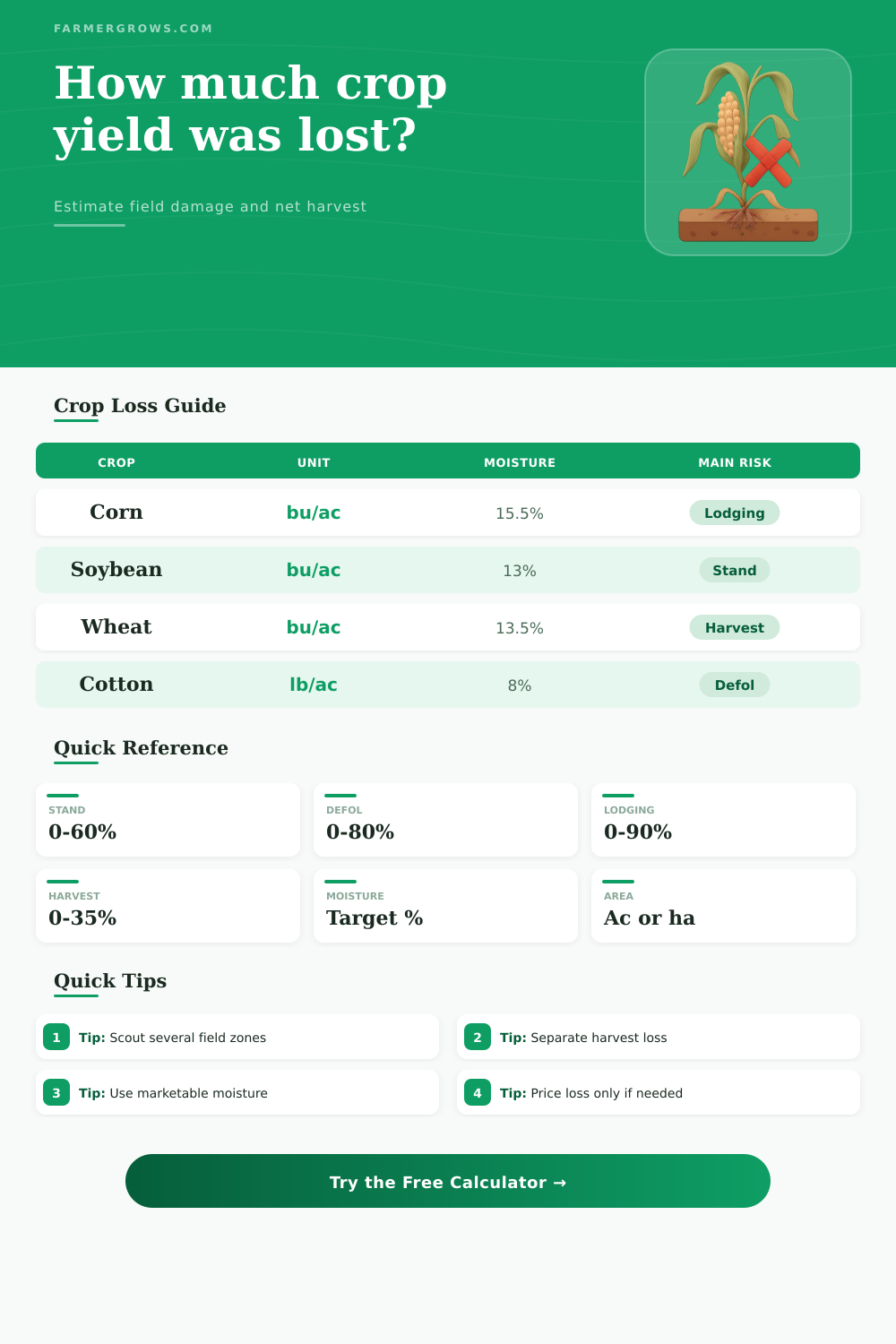
| Crop type | Default unit | Target moisture | Damage sensitivity notes |
|---|---|---|---|
| Corn grain | bushels per acre | 15.5% | Lodging near harvest raises header and ear loss; pollination injury can be severe. |
| Soybean | bushels per acre | 13.0% | Can branch after early stand loss, but pod-fill defoliation and shatter are costly. |
| Wheat | bushels per acre | 13.5% | Tillering helps early gaps; lodged mature wheat often loses test weight and pickup. |
| Cotton lint | pounds per acre | 8.0% | Open boll weathering, leaf loss, and harvest efficiency drive the final lint loss. |
| Rice | hundredweight per acre | 12.0% | Flattened rice can be slow to dry and hard to pick up cleanly. |
| Potato | hundredweight per acre | 78.0% | Culls, bruising, rot, and size profile usually matter more than grain moisture shrink. |
| Loss source | What to measure | Calculator treatment | Field note |
|---|---|---|---|
| Stand loss | Missing or dead plants as percent of normal stand | Adjusted by crop and growth stage sensitivity | Sample several row sections or quadrats before averaging. |
| Defoliation | Percent leaf area removed or no longer functional | Adjusted for canopy dependence and timing | Use the same crop stage for all field zones. |
| Lodging | Percent area flat, tangled, or below harvest pickup | Adjusted for crop lodging penalty and timing | Separate root lodging from stalk breakage if possible. |
| Harvest loss | Header, shatter, dropped ears, culls, or pickup loss | Applied as its own final percent | Do not double count lodging if it is already captured in machine loss. |
| Damage timing | Stand factor | Leaf factor | Lodging factor |
|---|---|---|---|
| Vegetative / early recovery | 0.75x | 0.55x | 0.70x |
| Flowering or pollination | 1.05x | 1.20x | 1.00x |
| Grain fill / bulking | 1.00x | 1.10x | 1.15x |
| Near harvest / mature | 0.45x | 0.35x | 1.35x |
| Moisture case | Formula | Effect | When to use |
|---|---|---|---|
| Measured above target | (100 - measured) / (100 - target) | Reduces wet yield to target basis | Wet grain or crop delivered above market moisture. |
| Measured at target | Factor equals 1.00 | No moisture shrink | Field estimate already matches the market basis. |
| Measured below target | Factor held at 1.00 | No yield bonus added | Conservative planning for very dry crop. |
| High-moisture forage or tubers | Use crop-specific target | Shows market-basis equivalent | Useful when comparing fields on the same moisture basis. |
For scouting: Average separate field zones only after noting the worst area, best area, and most representative area.
For claims or planning: Keep harvest loss separate from storm damage so the combine pass does not double count the same yield reduction.
When a storm damages a field, a farmer must recognize that there are many form of damage. Storm damage dont fall into one category. There are many types of damage to consider when calculating the loss from a storm.
For instance, there is stand loss, leaf removal, lodging and machine losses. Each of these types of damage interact with each other, yet each of them have an effect upon the same acres of land. A calculator is the most accurate way to determine yield loss from a storm because it accounts for each of these different forms of damage separately.
How to Measure Crop Loss After a Storm
The calculator allow for the different forms of damage to be entered separately into the calculation to arrive at the actual loss of that fields yield. Stand loss is one of the primary forms of damage to consider after a storm. Stand loss occurs when there are missing plants from a field that may result in fewer ear of corn, for instance.
The loss of those plants doesnt necessarily mean that the field will experience a loss of that many ears of corn, however. Some crops will branch or tiller to compensate for the loss of plants. Soybeans and wheat will perform these actions to compensate for stand loss, but corn will not.
Thus, the calculator accounts for stand loss according to the growth stage of the corn that is lost. Defoliation is another form of damage to consider after a storm. Defoliation means that the plants has lost some of their leaf.
Because the leaves are the farmacy of the plant, removing too many of the plants leaves will prevent it from performing enough photosynthesis to provide the plants seeds with the amount of sugars that it require. If the leaves are removed during the pollination and grain fill stage, the plant cannot produce enough sugar for its seeds. The plant may be able to recover from the loss of leaves early in its growth period, but it cannot recover from the loss of those leaves later in the plants growth cycle.
Thus, defoliation is another factor that the calculator can account for. Lodging is a form of damage to corn fields that many do not consider to be a problem. Lodging occurs when some of the stalks of the corn begin to lean towards others.
This type of damage to the field can result in fewer corn plants being able to perform photosynthesis for their plants, as well as in the trapping of moisture around the stalk that can result in crop disease. Additionally, the combine that is used to harvest the fields will have to work harder to cut the stalks that are lodged. Thus, lodging is considered to be a separate factor from the loss of the corn at the cutter bar of the combine; allowing for lodging as a separate factor prevents overcounting of the losses of that fields corn production.
Harvest loss is another factor that should be measured after the field is harvested; determining the harvest loss before the corn is harvested from the fields is discouraged. Loss of shatter, dropped ears and header losses can occur during the harvesting phase with the combine, but such losses can be separated from weather damage to the fields. Therefore, keeping the harvest loss factor separate from the yield calculation allows for an honest determination of the damage from the storm and the adjustments that can be made to the combines settings.
Moisture shrink is a factor in the calculation of yield loss that can be dificult for even the most experienced farmgrowers to manage. Moisture shrink occurs when the weight of the grain is measured when it is wet, but when the grain is sold on a dry basis. The calculator measures the moisture content of the grain and allows for the moisture shrink to be accounted for with the shrink formula.
By including this factor in the calculation, the farmer can present the true value of the crop to buyers. Should this factor be omitted, the value of the field will be overestimated. The tables included in the article contain the default targets for each type of crop.
Each table also features the sensitivity of that crop to the type of damage. For instance, cotton fields are more sensitive to the loss of leaves than to stand loss, but rice fields are more sensitive to lodging than to any other type of damage. These factors are built into the calculator to provide a result that reflects the biology of the crop.
Scouting is the method that is utilized to gather the numbers that are required to determine yield loss. The number for each acre should be accurate. One corner of the field may have suffered more damage than other portions of the same fields.
By scouting the fields and sampling several different zones within that field, the farmer can note the worst zone, the best zone and the most common zone within the fields. The yield loss can be calculated by taking the average of the most common zone and the best zone. Using only the worst zone will result in an inflated count of the losses of that fields corn production, and using only the best zone will leave money on the table for that farmer.
Price can be entered into the calculator as an optional field. The price will allow the adjustment of the calculation to determine the dollar value of the yield loss. Thus, if the price of corn is entered, that value will be multiplied by the yield of corn that is lost.
However, the calculation of that loss doesnt change with the entering of the price of the crop. The calculator will provide the farmer with the yield that is lost and the production that is lost as a result of the storm damage. However, the calculator will not provide the farmer with any recommendation as to whether or not to harvest the remaining corn from the field.
A 35 percent loss to 40 acres of corn may still be worth harvesting for those remaining corn plants, but the same percentage of loss to 400 acres of corn may not be worth the effort of harvesting the remainder of that fields corn production. Thus, the decision of whether to harvest the remaining corn from the field is up to the farmer himself based off his own calculations and risk tolerance. The most important habit to develop after experiencing storm damage to a field is to treat that damage event as two separate questions.
The first question that should be asked is what damage has occurred to the plants within the field. The second question that should be asked is what damage the combine and the dryer will do to the remainder of the fields crops. By treating storm damage as these two separate questions, farmers will not blame the storm for damage that the combine or dryer created to the fields corn.
Thus, each farmer can develop a plan for salvage of the remainder of the crops from those fields.